What Kind of Lock Can I Put on a Sliding Door?
A complete guide to every lock type available for sliding glass doors — what each one does, what it costs, and which combinations provide the best security for South Florida homes.
- Why Sliding Door Locks Deserve More Attention in South Florida
- Lock Type 1 — The Factory Latch Lock
- Lock Type 2 — Keyed Patio Lock
- Lock Type 3 — Foot Bolt
- Lock Type 4 — Charlie Bar (Security Bar)
- Lock Type 5 — Loop Lock
- Lock Type 6 — Pin Lock
- Lock Type 7 — Smart Locks and Electronic Options
- Coastal Considerations — Salt Air and Lock Materials
- Recommended Lock Combinations by Property Type
- Local Security Context — Naples and Pompano Beach
- Frequently Asked Questions
The sliding door is the most common point of entry for residential break-ins in Florida — and the factory latch lock that comes standard on most patio doors is, on its own, not enough to stop a determined intruder. The good news is that upgrading sliding door security doesn't require replacing the door. There are several lock types that can be added to any existing sliding door, and most of them cost between $20 and $150 and can be installed in an afternoon. Understanding which options exist and which combinations work best for your specific property is the starting point.
This guide covers every lock type available for sliding glass doors — from the standard factory latch to electronic smart locks — with specific guidance for South Florida's coastal properties where salt air adds a material selection variable that most generic lock guides don't address. Whether you're securing a beachfront home near Naples' Vanderbilt Beach, a condo overlooking the Pompano Beach Pier, or an inland home in Collier or Broward County, the right lock combination starts with understanding what's available. For professional sliding door lock installation and repair across South Florida, same-day service is available.

A properly secured sliding door uses both a primary latch lock and at least one secondary device — providing two independent barriers against forced entry.
Why Sliding Door Locks Deserve More Attention in South Florida
Florida's Department of Law Enforcement consistently reports that sliding glass doors are among the most frequently exploited entry points in residential burglaries statewide. The reasons are specific to how these doors work: the standard factory latch can often be defeated with a screwdriver, the door can sometimes be lifted off its track from the outside if the anti-lift pin is missing or damaged, and the glass itself — in non-impact doors — can be broken quickly and quietly.
In Naples communities near the waterfront — Fifth Avenue South, Port Royal, Pelican Bay, and the beachside neighborhoods along Gulf Shore Boulevard — the prevalence of high-value vacation homes and part-year occupancy makes sliding door security a genuine priority. In Pompano Beach, with its mix of condominiums along the Federal Highway corridor, single-family homes near the Hillsboro Inlet, and beachfront properties near the Pompano Beach Pier, the same vulnerability exists across different property types. A single additional lock significantly raises the difficulty and time required for forced entry — which is often enough to deter an opportunistic intruder entirely.
Lock Type 1 — The Factory Latch Lock
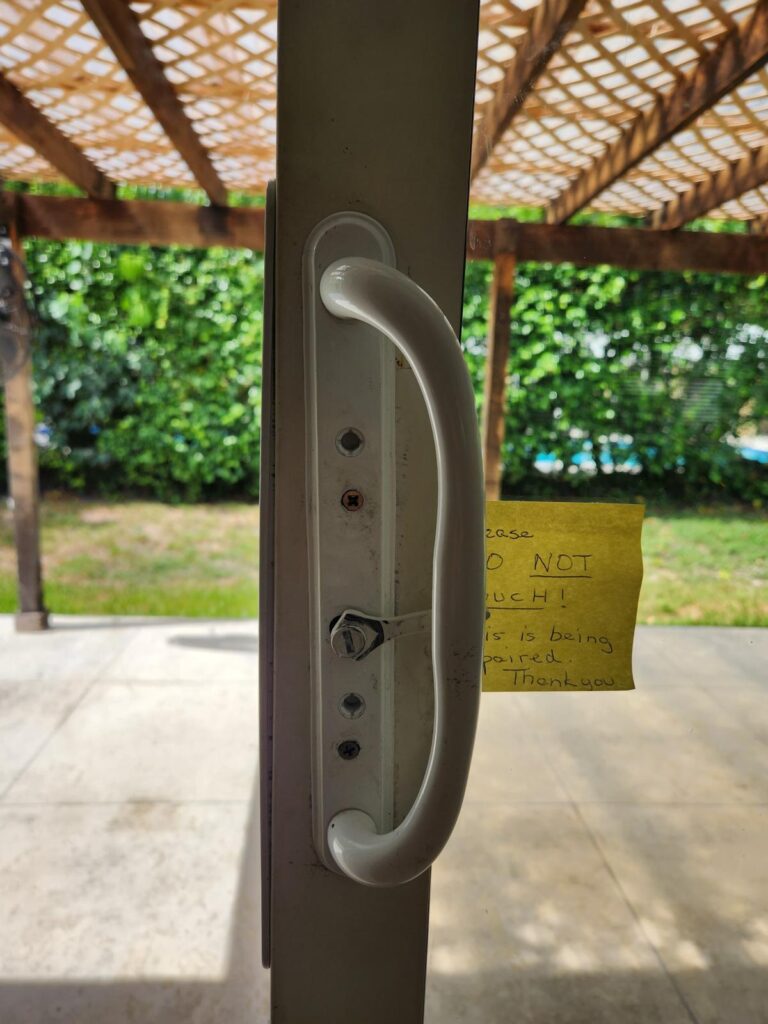
Every sliding glass door comes with a built-in latch mechanism — a handle on the interior side that engages a hook or bolt into the door frame when the handle is turned or lifted. This is the baseline security device on virtually every residential patio door in South Florida.
The limitation of the factory latch is that it's designed primarily as a closure device rather than a security device. Most standard latches can be defeated from the outside with basic tools, and the latch housing is typically made from zinc die-cast or aluminum that degrades in salt air over time, making the mechanism increasingly unreliable as the door ages.
Lock Type 2 — Keyed Patio Lock
A keyed patio lock replaces or supplements the standard latch with a cylinder lock mechanism that requires a key to open from the outside. Some versions replace the handle assembly entirely; others are separate auxiliary locks mounted on the door frame above or below the handle.
Keyed patio locks provide significantly stronger resistance than the standard latch because they engage a hardened steel bolt rather than a simple hook, and they require a key to defeat rather than a tool. For South Florida coastal properties, choose versions with stainless steel cylinders and corrosion-resistant housings — standard zinc and mild steel versions corrode visibly within 12 to 18 months in salt air environments near Naples' Gulf Coast or Pompano Beach's Atlantic waterfront.
Keyed patio lock — a significant security upgrade over the standard factory latch.

The latch and bolt assembly — the heart of any sliding door lock system.
Lock Type 3 — Foot Bolt
A foot bolt — also called a floor bolt or threshold lock — is a bolt mechanism mounted at the bottom of the door frame that drops vertically into a receiver in the threshold when engaged. It locks the door against both horizontal sliding and vertical lifting simultaneously.
Foot bolts are operated with a toe — you kick the lever down to engage it and lift it with your foot to release. This makes them fast to deploy from inside and invisible from the outside, providing security without being an obvious target. They're particularly useful for doors that back onto a pool deck or patio in Naples waterfront communities like Crayton Cove or Old Naples, where the door is used frequently during the day but needs fast, reliable locking when the home is unoccupied.
Lock Type 4 — Charlie Bar (Security Bar)
A Charlie bar is a horizontal bar that sits in a bracket on the door frame and braces across the width of the door opening, preventing the door from sliding even if all other locks are defeated. The name comes from Charlie Chaplin, who was reportedly known for keeping doors secure with a wooden bar — though the modern product is typically aluminum or steel.
The Charlie bar is one of the most effective sliding door security devices available because it provides purely mechanical resistance that can't be picked, shimmed, or bypassed with basic tools. It's deployed and removed from inside in seconds and requires no installation beyond screwing a bracket to the door frame. For homes in Naples' Pelican Bay or Port Royal that may be unoccupied for extended periods, a Charlie bar provides strong deterrence without any ongoing maintenance concern.
The classic DIY alternative to a Charlie bar is a cut-down wooden dowel or broom handle laid in the track channel. It works on the same principle and costs almost nothing. The disadvantage is that it requires bending down to deploy and retrieve, and it can shift position if the door is shaken. A properly installed Charlie bar bracket is faster and more reliable.
Lock Type 5 — Loop Lock
A loop lock — sometimes called a Charley bar add-on or an anti-lift lock — is a device that prevents the door panel from being lifted out of the track from the outside. It typically consists of a metal hook or bracket mounted on the header track that engages the top of the door panel, preventing upward movement.
This is particularly important for older sliding doors in South Florida where the anti-lift pin in the header may be worn, missing, or never present. A door that can be lifted from the track from the outside is vulnerable to entry even with all sliding locks engaged. The loop lock closes this specific vulnerability quickly and inexpensively.
Lock Type 6 — Pin Lock
A pin lock involves drilling a downward-angled hole through the inner door frame and partially through the outer frame at the point where they overlap when the door is closed. A steel pin or bolt is inserted into this hole, preventing the door from sliding open. When you want to open the door, you pull the pin, slide the door, and reinsert the pin on the closed side.
The pin lock is inexpensive (a hardened steel bolt costs a few dollars) and provides surprisingly strong resistance — the pin must be sheared to defeat it from the outside. Its limitation is that it requires the homeowner to remember to insert it, and it provides no resistance if the door is accessed from inside. For secondary security on Pompano Beach vacation rentals or seasonal properties, it's a worthwhile addition.
Lock Type 7 — Smart Locks and Electronic Options
The smart home security market has produced several electronic locking options designed for sliding doors. These include keypad-operated deadbolts that replace the standard handle assembly, sensor-based alert systems that detect vibration or opening, and integrated smart home devices that connect to home automation systems.
For South Florida homes — particularly in newer Naples communities like Lely Resort and Mediterra, or in renovated Pompano Beach condominiums along the Atlantic — smart lock integration makes practical sense when the property is remotely monitored or managed. Remote locking capability is particularly valuable for vacation rental properties where keyless access for guests is a convenience and security log capability is useful.
The salt air caveat applies here as well. Electronic components in devices mounted on or near exterior sliding doors face corrosion challenges in coastal environments. Look specifically for marine-rated or coastal-rated certifications on any electronic device installed within 500 feet of saltwater.
Need a Lock Installed or Replaced?
Same-day sliding door lock service across Naples, Pompano Beach, Fort Lauderdale, Boca Raton, and all of South Florida. Free estimates, flat-rate pricing, warranty on every job.
Coastal Considerations — Salt Air and Lock Materials
For homeowners in South Florida — and particularly for those within a mile of saltwater — material selection in lock hardware matters as much as the lock type itself. The salt air environment along Naples' Gulf Coast, Pompano Beach's Atlantic shoreline, and throughout the Intracoastal communities of Broward County is one of the most corrosive environments for exposed metal components in the residential market.
Standard lock hardware uses zinc die-cast housings and steel bolts that begin showing surface corrosion within one to two years of coastal exposure. Within three to five years, corrosion can compromise the mechanical function of the lock — making it stiff, unreliable, or completely seized. This is not just an appearance issue: a lock that doesn't operate smoothly due to corrosion provides false security because it may not engage fully, and it's far more likely to fail at the moment it's needed most.
For any property within sight of salt water, specify locks with stainless steel bolts and cylinders, brass or marine-grade aluminum housings, and corrosion-resistant coatings on any exposed fasteners. These options exist at every price point and significantly extend reliable service life in coastal conditions. When in doubt, ask specifically for marine-grade or coastal-rated hardware.
Under the Florida Building Code, any door lock on an impact-rated sliding door must not compromise the door's impact certification. Installing aftermarket locks that require drilling through impact-rated frames without proper sealing can void the door's wind certification. Always confirm compatibility with your door's certification before installing any new hardware.
Recommended Lock Combinations by Property Type
Primary Residence — Daily Use Door
Keyed patio lock (primary) + foot bolt (secondary). The keyed lock provides strong daily security while the foot bolt engages quickly for overnight security. Both are fast to operate with daily use in mind.
Vacation Home or Seasonal Property
Keyed patio lock (primary) + Charlie bar (secondary) + loop lock (anti-lift). Three independent mechanisms ensure security during extended unoccupied periods. A neighbor or property manager can verify the Charlie bar is deployed on departure.
Rental Property
Smart keypad lock (primary) + pin lock (secondary). The keypad eliminates physical key management across multiple guests; the pin lock provides a simple backup that guests can deploy at night without technical knowledge.
Oceanfront or High-Salt-Exposure Property
Any combination above, but all hardware must be stainless steel or marine-grade components. Standard hardware lifespans are cut by 50 to 70 percent in direct coastal exposure — the upgrade cost at time of purchase is insignificant compared to replacement cost within 2 to 3 years.
Local Security Context — Naples and Pompano Beach
In Naples, the combination of high property values, significant seasonal vacancy, and Gulf Coast salt air creates a specific sliding door security profile. Communities from Old Naples and Crayton Cove near the waterfront to newer inland developments in North Naples all benefit from secondary locking devices — the primary latch alone is insufficient for properties that may be unoccupied for weeks or months at a time during the summer off-season. For waterfront properties within view of Tin City or along the Naples Pier area, marine-grade lock hardware is the only reasonable choice.
In Pompano Beach, the Atlantic coastal exposure combined with the area's mix of condominiums, vacation rentals, and year-round residences makes sliding door lock upgrades one of the most requested services we handle. Properties near the Pompano Beach Pier, along the Hillsboro Inlet corridor in Lighthouse Point, and in the inland communities along Sample Road all see sliding door lock requests — though the material requirements vary significantly with distance from the water. If you're ready to upgrade your sliding door security, our sliding door lock service covers installation, replacement, and repair same-day across the full region. Get a free estimate and we'll recommend the right combination for your specific door and property type.
Upgrade Your Sliding Door Security Today
Serving Naples, Pompano Beach, Fort Lauderdale, Boca Raton, and all of South Florida. Same-day lock installation and repair, free estimates, warranty on every job.
Frequently Asked Questions
Sliding doors can be fitted with keyed patio locks, foot bolts, Charlie bars, loop locks, pin locks, and smart electronic devices. Most South Florida homeowners benefit from combining the primary latch with at least one secondary security device for meaningful burglary resistance.
Yes — and it's strongly recommended. Options include a foot bolt in the frame, a Charlie bar across the door opening, a pin lock through the overlapping frames, or a loop lock to prevent door lifting. Most secondary locks cost $15 to $80 and can be installed without professional help.
A Charlie bar is a horizontal security bar that braces across the door frame to prevent the door from sliding, even if all other locks are defeated. It's one of the most effective and affordable secondary security devices available — fast to deploy from inside and providing purely mechanical resistance that can't be picked or shimmed.
Choose locks with stainless steel or marine-grade components. Standard steel corrodes rapidly in salt air. The best combination for an oceanfront door is a keyed patio lock with stainless internals plus a secondary foot bolt or Charlie bar — two independent mechanisms that both resist corrosion in coastal conditions.
Yes — all sliding glass doors include a factory latch lock as standard equipment. However, the factory latch alone provides only basic security. Adding a secondary lock significantly raises the difficulty of forced entry and is strongly recommended for any sliding door used as a primary access point or facing a semi-private outdoor space.
Yes. Sliding door locks are designed for horizontal movement rather than swinging doors. They engage against the frame or threshold rather than a jamb, and the latch is built into the handle assembly rather than the door edge. Secondary devices like Charlie bars, foot bolts, and loop locks are specific to the sliding door format.