Can You Put a New Lock on a Sliding Door?
Yes — and it's one of the most cost-effective security improvements available for any South Florida home. Here's exactly what's involved, what fits what, and when you need a pro.
- Yes You Can — Here's What That Covers
- Option 1 — Replace the Primary Latch and Handle
- Option 2 — Add a Keyed Deadbolt
- Option 3 — Add a Secondary Lock
- Option 4 — Add a Loop Lock Anti-Lift Device
- Finding the Right Replacement Lock
- Impact Door Considerations
- How the Primary Lock Replacement Works
- DIY vs Professional — When Each Makes Sense
- New Locks in Pompano Beach
- Frequently Asked Questions
The answer is yes — and in most cases it's far simpler than homeowners expect. A sliding door lock is not integral to the door panel, the glass, or the frame. It's a hardware assembly that sits in pre-existing cutouts in the door frame, secured by a handful of screws. Replacing it requires a screwdriver, the correct replacement part, and about 20 minutes. Adding secondary locks like a Charlie bar or foot bolt requires a drill and a bracket. Neither job requires replacing the door.
Understanding what "putting a new lock on a sliding door" actually covers is the useful starting point — because it's not one thing, it's four distinct options ranging from a $20 secondary device to a complete primary lock upgrade. A1 Sliding Doors installs and replaces sliding door locks across Pompano Beach and South Florida every day. Here's the full picture.

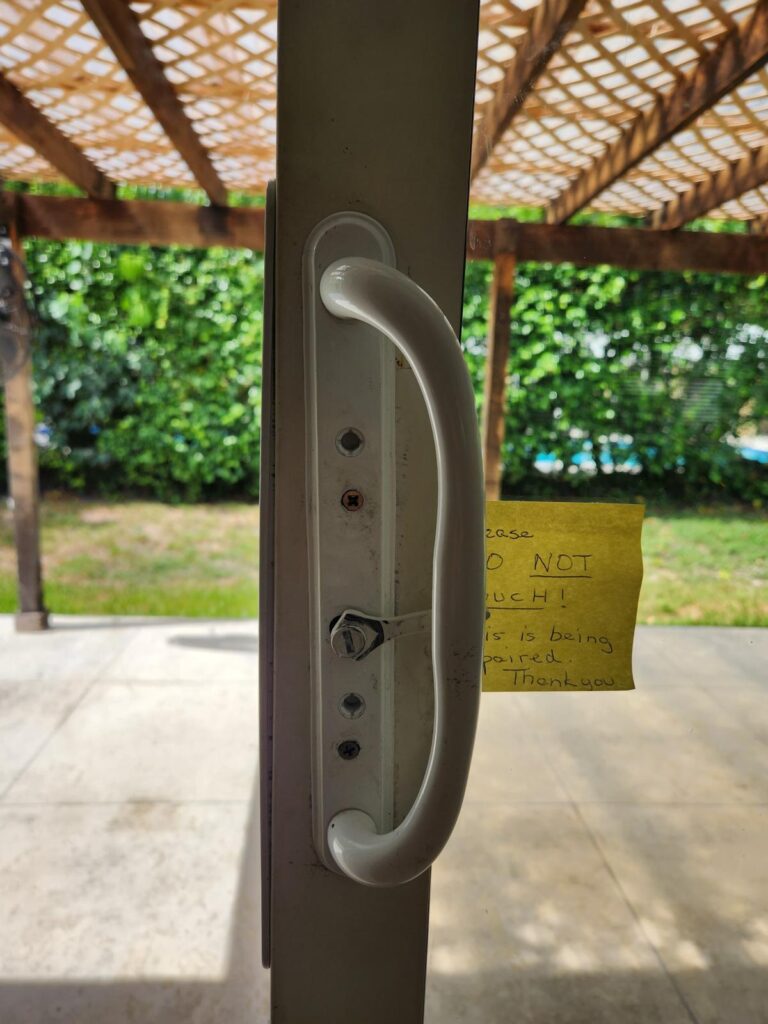
A new lock installed on an existing door — the panel, glass, and frame stay in place throughout the process.
Yes You Can — Here's What That Covers
When homeowners ask whether they can put a new lock on a sliding door, they usually mean one of four things — and all four are possible without replacing the door.
- Replacing the primary latch and handle assembly with a better version of the same type or with an upgraded keyed deadbolt.
- Adding a keyed deadbolt above or below the existing handle as a supplementary primary lock.
- Adding a secondary lock — Charlie bar, foot bolt, or pin lock — to create a second independent barrier.
- Adding an anti-lift device — a loop lock in the header track — to close the lift-off vulnerability.
Each of these is a standalone job. They can be done individually or in combination. None of them requires removing the door panel, modifying the glass, or touching the frame beyond the mounting points the lock uses. The door stays functional throughout — there's no extended period where the home is without a lockable door during a lock replacement job.
Option 1 — Replace the Primary Latch and Handle
The handle and latch assembly is the most frequently replaced lock component on sliding doors in South Florida — primarily because salt air corrosion degrades the standard zinc and mild steel mechanism within 5 to 8 years in coastal locations. When the handle becomes stiff, the latch stops holding, or the mechanism fails entirely, the whole assembly comes out as a unit and a matching replacement goes in.
The replacement process is direct: remove the two to four screws securing the interior handle plate, pull the assembly out of the door frame cutout, slide the new assembly in, and secure with the same screws. The entire job takes 15 to 20 minutes with the correct replacement part in hand. The key variable is sourcing the correct part — the replacement needs to match the existing cutout dimensions and screw hole spacing, which varies between door manufacturers.
When replacing a corroded latch in a Pompano Beach coastal location — particularly properties near the Intracoastal or along the A1A corridor — specify marine-grade stainless steel over standard zinc hardware. The incremental cost is $20 to $40 and the service life improvement is 8 to 12 additional years in a salt air environment.
Option 2 — Add a Keyed Deadbolt
A keyed deadbolt can be added to the existing door frame as an upgrade to or replacement for the standard latch. Some models replace the handle assembly entirely in the same cutout. Others mount separately above or below the handle in a new hole drilled through the frame.
The deadbolt's cylinder requires a key to retract from the outside — a significantly stronger resistance than the spring-latch design that can be shimmed or tool-manipulated. For any sliding door that serves as a primary entry point, the keyed deadbolt is the appropriate primary lock specification. The interior side uses a thumb-turn for keyless exit, as required by the Florida Building Code for emergency egress compliance.
Installations that require drilling new frame holes should be done carefully — particularly on impact-rated doors where incorrect sealing of frame penetrations can affect the door's wind certification. This is the main scenario where professional installation is preferable over DIY for this lock type.

Old corroded latch removed — marine-grade replacement goes into the same cutout in under 20 minutes.
New lock installed — same cutout, upgraded hardware, immediate security improvement.
Option 3 — Add a Secondary Lock
Adding a secondary lock to an existing sliding door is the single highest-return security upgrade available. It makes latch defeat irrelevant — even if an intruder bypasses the primary lock, the door still cannot be opened because a second independent mechanism holds it closed.
A Charlie bar bracket mounts to the door frame with two to four screws — a 15-minute installation that requires only a drill and the correct anchor type for the frame material. The bar itself pivots out of the way when the door is in use and drops into position for security. A foot bolt requires drilling a receiver hole in the threshold in addition to mounting the bolt mechanism — typically a 30-minute installation. A pin lock requires drilling a single angled hole through both door frames — under 10 minutes with a drill and the correct bit.
Any of these can be added to any existing sliding door regardless of the age, brand, or condition of the primary latch. They're entirely independent installations that use their own mounting points — the primary lock's condition has no bearing on whether a secondary device can be added.
Option 4 — Add a Loop Lock Anti-Lift Device
A loop lock mounts in the header track above the door panel and prevents the panel from being lifted off the track. It addresses a specific vulnerability that no horizontal sliding lock can cover — the ability to tilt and lift the door panel out of the track entirely from the outside, bypassing every other lock simultaneously.
The installation involves securing a bracket or adjustable stop into the header track channel. It's a simple job requiring only a screwdriver in most cases. For any door where the anti-lift test (lift the open panel — it should stop after half an inch) shows insufficient protection, a loop lock is an immediate fix that closes this vulnerability without touching any other component of the door.
If you're replacing the primary lock because it's corroded, inspect the strike plate at the same time. The strike plate takes the same salt air exposure as the latch — a corroded strike plate with an oversized or worn opening undermines even a brand-new latch hook. Replace both together for a complete security reset at minimal additional cost.
Finding the Right Replacement Lock
The most common obstacle in a DIY primary lock replacement is sourcing the correct hardware. Here's how to identify what you need before purchasing.
- Remove the existing handle assembly and note the screw hole center-to-center spacing — the most critical measurement for replacement fitment.
- Measure the door frame thickness at the cutout — the replacement assembly must match this depth.
- Note the handle height from the bottom of the door panel to the center of the handle — this determines whether a replacement with the same latch-to-handle geometry will line up with the strike plate correctly.
- Check the door manufacturer's stamp on the frame or panel edge — if identifiable (PGT, CGI, Andersen, Milgard), the manufacturer can cross-reference the correct replacement part number directly.
- Bring the old assembly to a sliding door parts supplier for direct comparison if measurements alone aren't conclusive. This is the most reliable method for older or proprietary door systems.
Impact Door Considerations
Impact-rated sliding doors — required in South Florida's High Velocity Hurricane Zone and increasingly common throughout Broward County following the post-2004 building code updates — have specific considerations for lock replacement that standard doors don't share.
The primary concern is the door's wind certification. Impact doors are certified as complete systems — the frame, glass, hardware, and glazing all contribute to the certification. Modifications to the hardware, including drilling new holes for locks, must be done correctly to preserve the certification. Specifically, any new frame penetration on an impact door must be sealed with the appropriate compound to maintain the system's air and water infiltration rating.
Replacing the primary latch assembly in the existing cutout — using the same holes — carries no certification risk. Adding secondary locks that mount to the frame surface (Charlie bar bracket screws, for example) also presents minimal risk when proper fasteners are used. Drilling new through-frame holes for a deadbolt installation is the scenario that warrants professional involvement on an impact door.
Under the Florida Building Code, impact door hardware modifications that compromise the certification can affect the home's insurability. Some insurers in South Florida specifically require impact-rated openings to maintain their certification for wind mitigation credits to apply. Confirm with your insurer before modifying any impact door hardware beyond like-for-like replacement.
How the Primary Lock Replacement Works
Measure the existing assembly's screw spacing, frame depth, and handle height. Identify the door manufacturer if possible. Confirm the replacement fits before starting the job.
Most handle assemblies use two to four Phillips screws on the interior plate. Remove them and set aside. The exterior handle typically releases once the interior screws are out.
The full latch and handle assembly slides out of the frame cutout as a unit. If it's corroded in place, a gentle tap with a rubber mallet from the exterior side frees it. Never force it with a screwdriver or pry bar — frame damage complicates the replacement.
Remove any corrosion residue, old sealant, or debris from the frame cutout. A clean, dry seating surface ensures the new assembly sits flush and the screws secure properly.
Slide the new assembly into the cutout, align the screw holes, and secure with the provided screws. Hand-tighten first across all holes, then snug down — don't overtighten on aluminum frames.
Close the door and test the latch engagement. The hook should enter the strike plate cleanly and hold under light pressure. If the latch is above or below the strike plate, adjust the door's roller height screws until alignment is correct.
DIY vs Professional — When Each Makes Sense
- Replacing latch and handle in existing cutout
- Installing a Charlie bar bracket
- Installing a pin lock
- Installing a loop lock in the header
- Adding a foot bolt (threshold drilling required but straightforward)
- Any job where the correct replacement part is confirmed in advance
- Keyed deadbolt requiring new frame holes on an impact door
- Any lock on a door where the manufacturer is unknown and measurements are unclear
- Lock replacement combined with roller or track service (panel removal required)
- Smart lock integration requiring wiring or frame modification
- Any job where a previous DIY attempt left damaged frame threads or a misaligned cutout
New Locks in Pompano Beach
Lock replacement and security upgrades are among the most frequent service calls across Pompano Beach and the broader Broward County market. The pattern is consistent: a homeowner notices the latch is stiff, the handle feels rough, or the door can be pushed open despite appearing locked — all signs that the factory hardware has reached the end of its service life in South Florida's coastal environment.
For Pompano Beach properties specifically, the urgency of lock replacement correlates strongly with location. Homes east of Federal Highway — particularly oceanfront and Intracoastal properties near the Hillsboro Inlet, along the Pompano Beach Pier corridor, and through Lighthouse Point — are in the highest-corrosion zone and should expect primary lock hardware to need replacement by year 6 to 8 on standard spec. Homes further inland along Sample Road and the Coconut Creek border see significantly longer intervals before hardware failure, but the principle remains the same: a corroded lock that appears functional provides far less security than its design specification.
For any lock replacement or security addition in Pompano Beach or anywhere across South Florida, our sliding door lock service covers same-day diagnosis and installation. We carry the most common replacement assemblies on every vehicle — most primary lock replacements are completed in a single visit without a return trip for parts. Schedule a free estimate and we'll confirm the correct part and pricing before any work begins.
Ready to Put a New Lock on Your Sliding Door?
Same-day lock installation and replacement across Pompano Beach, Fort Lauderdale, Deerfield Beach, Boca Raton, and all of South Florida. Free estimates, warranty on every job.
Frequently Asked Questions
Yes. The existing handle and latch can be replaced with an upgraded keyed patio lock, and secondary devices like Charlie bars, foot bolts, and loop locks can be added to any existing door without replacing the door itself. Most lock upgrades are completed in under two hours.
Yes — the lock is a separate, replaceable component. Replacing the lock assembly requires no modification to the door panel, glass, or frame beyond the fastener holes that already exist. The door stays in place throughout the process.
Replacing a primary latch and handle assembly requires only a Phillips screwdriver. Adding a Charlie bar bracket or foot bolt requires a drill and appropriate bit. No specialized locksmithing tools are needed for any standard sliding door lock installation.
Note the screw hole center-to-center spacing, the frame thickness at the cutout, and the door manufacturer's stamp. Most replacements fit standard dimensions, but impact-rated and older proprietary doors may need brand-specific hardware. Bringing the old assembly to a sliding door parts supplier is the most reliable fitment confirmation.
Yes. A door without a functioning lock can have a new handle and latch assembly installed in the existing frame cutout, and secondary locks can be added to the frame without any existing hardware. A complete new lock system can be installed in a single same-day visit.
No. Sliding door lock replacement is a door hardware job, not a locksmithing job. A sliding door specialist or a capable DIYer with the correct parts can complete a primary lock replacement. A locksmith may be called for re-keying a cylinder if needed, but is not required for installation.