What Are the Common Problems With Sliding Door Tracks?
Every track problem has a cause, a symptom, and a fix. Here's how to identify what's happening with your sliding door track and what to do about it in South Florida's demanding coastal climate.
- Problem 1 — Debris and Sand Buildup
- Problem 2 — Corrosion and Oxidation
- Problem 3 — Bending and Denting
- Problem 4 — Grooves Worn Into the Track Floor
- Problem 5 — Track Misalignment
- Problem 6 — Water Pooling and Drainage Failure
- Problem 7 — Door Repeatedly Coming Off the Track
- Track Problem or Roller Problem? How to Tell
- Why Broward County Tracks Need More Attention
- Frequently Asked Questions
The sliding door track sits at floor level, open to the outside, and bears the full mechanical load of the door panel on every single open-and-close cycle. In most of the country, that's a manageable set of demands. In South Florida — where fine coastal sand blows in from every direction, salt air corrodes exposed aluminum, summer rainstorms flood the threshold, and hurricane season stress-tests every component — it's a significantly tougher environment. Track problems are among the most common service calls A1 Sliding Doors handles across Broward County, and understanding what you're looking at makes the difference between a quick clean and a track replacement.
This guide covers every common sliding door track problem — what causes it, what it looks like, and what the right fix is. Start with whichever symptom matches what you're seeing on your door, then check the diagnostic section at the end to confirm whether the track or the rollers are the primary issue.
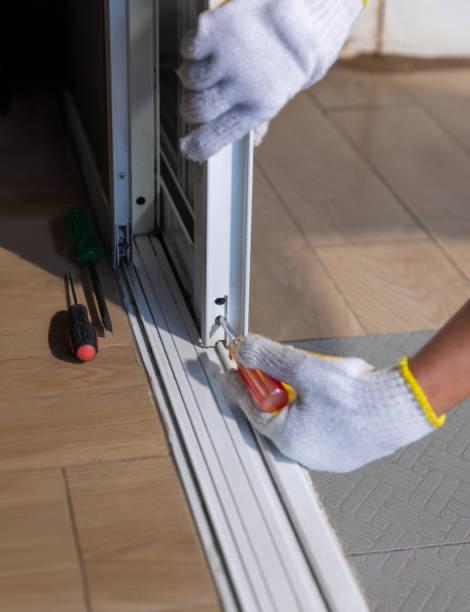
A track showing multiple common problems — debris accumulation, surface corrosion, and a localized dent all visible in one inspection.
Problem 1 — Debris and Sand Buildup
The door feels progressively heavier to slide. There may be a faint scraping sound. The door moves more smoothly right after cleaning but stiffens up again within weeks.
Debris accumulation is the most common and most easily resolved track problem. The bottom track channel sits at floor level with no cover or barrier, making it a natural collection point for everything that blows in from outside — fine beach sand, dried leaf material, salt residue, insect debris, and whatever gets tracked in from footwear. In South Florida, the accumulation rate is significantly faster than in drier or less coastal environments.
The problem compounds itself: packed debris creates friction against the roller wheel, which causes homeowners to push harder to open the door, which packs the debris even more tightly into the channel. Over months, loose sand can compress into a solid gritty layer that bonds to both the track floor and the roller wheel surface. At that stage, regular cleaning is still the first step — but if the debris has been present long enough to wear grooves into the aluminum, the track itself may need replacing (see Problem 4).
In Broward County communities within a mile of the beach — Deerfield Beach, Pompano Beach, Fort Lauderdale, Hallandale Beach — clean the track every 3 months without exception. After any storm, clean within 48 hours. Storm-driven sand packs under pressure and bonds to the track surface if left to dry, making subsequent cleaning significantly harder.
Problem 2 — Corrosion and Oxidation
The track surface appears dull white or chalky (surface oxidation) or shows small pits and craters across the rail floor (deeper corrosion). The door may catch or bump at corroded sections during operation.
Aluminum naturally forms a thin oxide layer that provides some corrosion resistance. In salt air environments, sodium chloride deposits disrupt this protective layer and allow chloride ions to penetrate the aluminum surface, creating pitting corrosion that works from the surface downward. Unlike surface oxidation — which is largely cosmetic — pitting corrosion creates an uneven rail surface that affects roller operation and structurally weakens the track material over time.
For homeowners along the Broward County coastline, the proximity to the ocean determines how fast this process occurs. Properties directly on the beach or Intracoastal may see significant pitting within 5 years of track installation with standard aluminum extrusion. Properties a mile or more inland, in communities like Coral Springs or Plantation, have significantly longer track lifespans under the same baseline maintenance.
Light surface oxidation — the chalky white appearance — can be addressed with fine steel wool and an aluminum-specific protectant or clear sealant applied annually. Deep pitting that has created craters or rough spots on the rail floor cannot be reversed and indicates a track that needs replacing. Our sliding door track service includes on-site assessment to confirm which situation you're dealing with.
Problem 3 — Bending and Denting
The door jolts or stops at a specific point during operation. There's a visible bump, depression, or crushed section in the track channel. The door may feel fine everywhere except that one spot.
Bent and dented tracks are almost always the result of physical impact — furniture being dragged across the threshold, a heavy object dropped in the doorway, or the door panel itself coming off the track and landing on the rail. In South Florida homes that use the sliding door as the primary access to a pool or patio, high traffic and occasional furniture movement make track denting more common than in lower-use settings.
The symptom is distinctive: the door slides smoothly everywhere except one specific point where it jolts, stops, or requires extra force to push through. That spot marks the location of the deformation. Run your finger along the track rail to feel for high points — even a 2mm bump creates noticeable resistance under the full weight of the door panel.
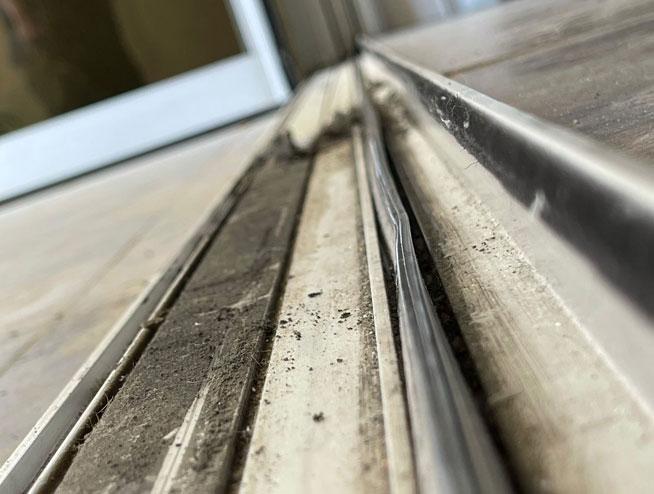
A localized track dent — the door stops or jolts at exactly this point during operation.
Track section replaced after impact damage — smooth rail restored throughout.
Never attempt to straighten a bent track with a metal hammer. The impact creates stress fractures in the aluminum that aren't visible on the surface but cause the track to crack weeks or months later under the door's operating load. Use only a rubber mallet with a flat wood block as a buffer for minor dents. Significant bends require track replacement.
Problem 4 — Grooves Worn Into the Track Floor
The door feels rough throughout its travel rather than smooth. New rollers were recently installed but the door still doesn't glide cleanly. Running a finger along the track rail reveals distinct ridges and channels worn into the aluminum.
Track grooving is the end result of years of abrasive roller contact — particularly when the track has been running dirty, with sand and grit acting as an abrasive between the roller wheel and the aluminum rail. The roller wheel cuts a groove into the softer aluminum surface over thousands of cycles, creating a recessed channel that the wheel then rides in. This sounds like it might be okay, but the groove profile doesn't match the wheel profile — the edges of the groove create two sharp contact points instead of the flat rolling surface the roller was designed for, which dramatically increases friction and wear on both components.
Grooving is the most important reason why replacing rollers doesn't always fix a stiff door. If the track has been grooved by years of roller contact, new rollers installed on the grooved surface will begin wearing unevenly immediately. The correct repair sequence when both grooving and roller wear are present is to replace the track first, then install new rollers on the fresh surface.
Problem 5 — Track Misalignment
The door binds at the frame on one side but not the other. The gap between the door panel and the frame is uneven. The door feels like it's being pushed against the frame as it slides.
Track misalignment happens when the track moves out of its correct position relative to the door frame. In South Florida, the most common cause is minor foundation movement — Florida's sandy soil and high water table allow slabs to shift slightly over time, particularly after periods of heavy rainfall. A threshold that has settled even a few millimeters can pull the track out of parallel with the door frame, causing the door panel to run toward one side of the opening as it slides.
Loose track fasteners are another common cause, particularly in older installations where the screws have worked loose over years of vibration and thermal expansion. Inspecting and re-torquing the track fasteners is a simple first step that sometimes resolves the binding completely without any additional work.
Recognize Any of These Track Problems?
Our technicians serve all of Broward County — Fort Lauderdale, Pompano Beach, Hollywood, Coral Springs, Deerfield Beach, and surrounding areas. Same-day track assessment and repair, free estimates.
Problem 6 — Water Pooling and Drainage Failure
Water pools in the track channel after rainfall and doesn't drain. There may be a musty smell near the door. The track shows accelerated corrosion along its full length rather than just in one area.
Sliding door tracks include small weep holes — drainage openings at the base of the channel — that allow water that enters the track to drain out through the threshold rather than pooling inside the channel. In South Florida, where heavy summer rainstorms regularly push water against sliding door thresholds, these weep holes are critical to track longevity.
When weep holes become blocked with debris, compacted sand, or paint from previous renovation work, water has nowhere to go and pools in the channel. Standing water accelerates corrosion dramatically — instead of the track being exposed to salt air, it's sitting in salt-contaminated water for hours at a time after each rain event. Within a few rainy seasons, a track with blocked weep holes can show corrosion damage that would normally take 15 years to develop.
Clearing weep holes is a simple maintenance task — a small wire or compressed air directed into the openings at the base of the track channel is usually enough to restore drainage. Check them during the track cleaning routine every few months, and always check them after a storm when debris is most likely to have been pushed in.
Problem 7 — Door Repeatedly Coming Off the Track
The door panel has come off the track more than once. It tends to happen when the door reaches the fully open position, or occasionally mid-slide. Reinstalling it is getting harder each time.
A door that repeatedly derails almost always has a combination of problems — worn rollers that have lowered the door too far, and track damage that's preventing the roller from staying seated in the channel. Each derailment event also risks additional track damage as the heavy panel drops onto the rail, potentially bending or cracking the track wall at the point of impact.
Repeated derailment is also a safety issue. A sliding glass door panel weighing 100 to 200 pounds coming off its track unexpectedly poses a genuine injury risk, particularly in homes with children. This is not a problem to defer or manage with repeated reinstallation — it needs a proper diagnosis and repair of both the track and roller systems. If the door has come off the track more than once, schedule a repair immediately rather than reinstalling it and hoping it holds.
Track Problem or Roller Problem? How to Tell
Many of the symptoms above overlap with roller wear symptoms. Here's the fastest way to determine which component is the primary cause.
- Problem at one specific spot: Track issue. A roller problem creates consistent resistance throughout the full slide; a track problem creates a specific point where the door jolts, stops, or requires extra force.
- Problem throughout the full travel: More likely rollers — worn bearings or flat-spotted wheels produce consistent friction across the entire track length.
- New rollers installed but door still rough: Track surface is damaged. New rollers can't compensate for grooves, deep pitting, or bent sections in the track rail.
- Door sits unevenly in the frame: Roller wear — rollers control door height, not the track.
- Door fine when new rollers were installed but rough again within months: The track is grooved and destroying the new roller wheel surfaces from day one of installation.
When in doubt, a technician can confirm within minutes by inspecting both components. Our guides on roller replacement and track replacement cover both repair paths in detail if you want to dig deeper into either one.
Why Broward County Tracks Need More Attention
Every problem in this guide is accelerated in Broward County by the combination of coastal salt air, fine beach sand, heavy summer rainfall, and year-round heat and UV exposure. NOAA climate data consistently places Southeast Florida's coastal corridor among the highest-humidity, highest-salt-deposition regions in the continental United States. Aluminum track extrusions that would last 20 to 25 years in a dry inland climate may need attention in 8 to 12 years in oceanfront or Intracoastal communities in Fort Lauderdale, Pompano Beach, Hollywood, or Deerfield Beach.
The practical response is more frequent maintenance rather than more frequent replacement. Cleaning the track every 3 to 4 months, checking and clearing weep holes seasonally, applying aluminum protectant to the exposed rail surface annually, and lubricating with silicone spray after each cleaning extends track life substantially even in the most demanding coastal environments. The homeowners who call for track replacement the least often are the ones who treat track maintenance as a seasonal routine rather than something they do only when the door stops working.
Track Issue Confirmed? We'll Fix It Same Day.
Serving Fort Lauderdale, Hollywood, Pompano Beach, Coral Springs, Deerfield Beach, and all of Broward County. Free estimates, flat-rate pricing, warranty on every repair.
Frequently Asked Questions
The most common causes are debris and sand accumulation grinding the track surface, salt air corrosion pitting the aluminum, furniture or objects dropped onto the track, forcing a stiff door which deforms the rail walls, and water pooling in the channel from blocked weep holes accelerating corrosion from below.
The bottom track sits at floor level in an open channel — it's a natural collection point for sand, leaves, salt deposits, and anything tracked in from outside. In South Florida's coastal environment, accumulation is faster than most other climates. Cleaning every 3 to 4 months is the only effective way to stay ahead of it.
Light surface oxidation can be treated with fine steel wool and an aluminum protectant. Deep corrosion pitting that has created an uneven rail surface cannot be restored by cleaning — the track needs to be replaced. A technician can assess the depth of corrosion and confirm which situation applies.
Repeated derailment is usually caused by worn rollers that have lowered the door too far, a bent or damaged track section that deflects the roller out of the channel, or a missing anti-lift bracket. Often it's a combination of roller wear and track damage working together. Both need to be addressed — reinstalling the door without fixing the underlying cause guarantees it will happen again.
A bent track creates a high point that the roller must ride over on every cycle, producing a jolt or stop at that spot. Over time the repeated impact wears both the roller wheel and track material faster, and can eventually cause the door to derail at that location.
If the door binds at one specific spot, the track is likely the cause. If resistance is consistent throughout the full slide, the rollers are more likely at fault. If new rollers were recently installed but the door is still rough, the track surface is almost certainly damaged. A technician can confirm by inspecting both components in a single visit.