Can Sliding Door Tracks Be Replaced?
Yes — and in most cases you don't need to replace the door, the glass, or the frame to do it. Here's everything South Florida homeowners need to know about sliding door track replacement.
- Yes, Tracks Can Be Replaced
- Understanding Your Sliding Door Track System
- How to Know When a Track Needs Replacing
- Track Repair vs. Track Replacement
- What Track Replacement Actually Involves
- What Does Track Replacement Cost?
- Why South Florida Tracks Wear Out Faster
- DIY vs. Professional Track Replacement
- Track Replacement in Pompano Beach and Broward County
- Frequently Asked Questions
A bent, grooved, or corroded sliding door track is one of the most common reasons a door stops working smoothly — even after the rollers have been replaced and the channel has been cleaned. When the track itself is the problem, homeowners often assume the whole door needs to go. That assumption is almost always wrong and almost always expensive. Sliding door tracks are a replaceable component, and in the majority of cases the track can be swapped out while the door panel, glass, and frame stay exactly where they are.
For homeowners in Pompano Beach and across South Florida, track damage is particularly common. The coastal climate accelerates corrosion on aluminum track extrusions, fine beach sand packs into the channel and grinds the track surface under roller pressure, and the mechanical stress of doors being forced on worn rollers bends and dents the track walls over time. Understanding when a track can be repaired, when it needs replacing, and what that process looks like saves significant cost and unnecessary work. A1 Sliding Doors handles track replacement across the full South Florida region — here's the complete picture.
A worn sliding door track showing grooves and corrosion — replaceable without touching the door panel or frame.
Yes, Tracks Can Be Replaced
The bottom track — the aluminum extrusion set into the threshold that the door panel rides on — is a separate component from the door frame. It can be removed and replaced without disturbing the frame, the door panel, or the glass. This is true for both the bottom track (the one that takes the most abuse) and the upper header track (the channel that guides the top of the door panel).
The process involves removing the door panel to access the track, extracting the old track extrusion from the threshold, installing a matching replacement cut to the correct length, and reinstalling the door with proper height adjustment. Done correctly by a professional, it's typically a one to two hour job that completely restores the door's operating surface without the cost or disruption of a full door replacement.
The key word is "matching." Like rollers, tracks are not universal. The replacement track must match the profile of the original — the width of the channel, the height of the rails, and the shape of the groove that the roller wheel seats in. Getting this wrong produces the same problems as installing the wrong roller: binding, uneven operation, and premature wear on the new components.
Understanding Your Sliding Door Track System
Most residential sliding glass doors have two track components — a bottom track and a header track — plus an outer track for the screen door if one is present.
Bottom Track
The bottom track is set into or onto the threshold at floor level and carries the full weight of the door panel through the roller wheels. It takes the most mechanical stress, collects the most debris, and is the component most likely to need replacement. It's an aluminum extrusion with a raised center rail that the roller wheels ride on, flanked by channels that keep the door aligned laterally.
Header Track
The header track is mounted at the top of the door opening and provides a guide channel that the top edge of the door panel slides through. It carries no weight load — its job is lateral stability and keeping the panel from tilting outward at the top. Header tracks rarely need replacement unless the door has been derailed repeatedly or the aluminum has been physically bent by impact.
Screen Door Track
Most sliding door systems have a separate outer track for the screen door, sitting parallel to the main door track. Screen door tracks are lighter-duty extrusions that can also be replaced independently. Screen door track damage is more common because screen doors are lighter and more prone to being knocked off track or bent at the corners.
Before assuming the track needs replacing, confirm it's the track and not the rollers causing the problem. A door that grinds or binds on a visually clean track may simply have worn rollers. Our guide on sliding door roller replacement covers how to distinguish roller wear from track damage when both symptoms look similar.
How to Know When a Track Needs Replacing
Not every track problem requires full replacement. The first step is understanding which type of damage you're dealing with.
Signs the Track Can Be Cleaned and Repaired
- The track surface is dirty or coated with debris but the aluminum is structurally intact
- There's minor surface corrosion — light oxidation or pitting that hasn't penetrated deeply into the metal
- There's a small localized dent or bend that hasn't creased the aluminum
- The door operates smoothly everywhere except one spot — usually indicating a specific dent or debris concentration rather than general track wear
Signs the Track Needs Replacing
- Deep longitudinal grooves worn into the track floor by roller wheels operating on a dirty or damaged surface — these create a rail-within-a-rail that the replacement roller wheels won't match
- Significant bending or crushing of the track walls that can't be straightened without cracking the aluminum
- Corrosion that has eaten through the track material, creating pits or holes in the rail surface
- Cracked or broken sections where the aluminum has fractured, usually from heavy impact or from a door panel that came off the track suddenly
- The door continues to bind or derail after new rollers have been installed and the track has been thoroughly cleaned — the track surface damage is preventing the new rollers from seating correctly
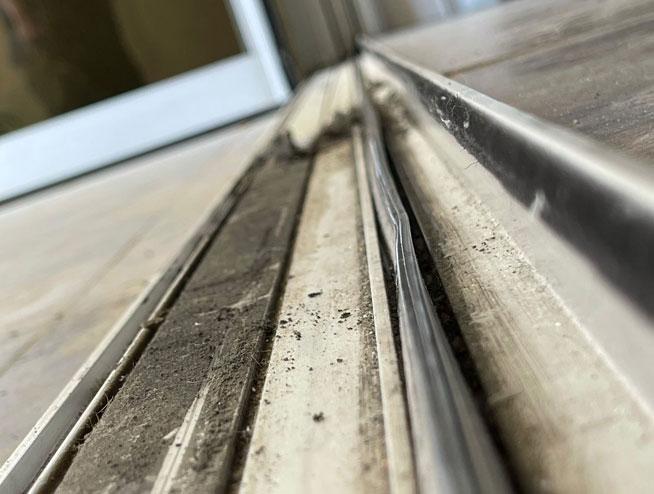
Deep grooves worn into track floor — past the point of repair, needs replacement.

New track installed — clean, flat rail surface for smooth roller contact.
Track Repair vs. Track Replacement
The decision between repairing and replacing comes down to the type and extent of the damage. Here's a clear framework for thinking through it.
| Damage Type | Repair or Replace? | Notes |
|---|---|---|
| Debris and surface contamination | Clean — no repair needed | Thorough brush cleaning + silicone lubricant |
| Light surface oxidation | Clean and treat | Fine steel wool + aluminum protectant |
| Minor localized dent | Repair (straighten) | Rubber mallet + flat block — professional recommended |
| Significant bend or crush | Replace | Aluminum past yield point — can't straighten reliably |
| Deep longitudinal grooves | Replace | New rollers won't seat correctly in grooved surface |
| Corrosion pitting through track | Replace | Structural integrity compromised |
| Cracked or broken section | Replace | Safety issue — door can derail suddenly |
Never use a metal hammer to straighten a bent track. The impact creates stress fractures in the aluminum that aren't visible on the surface but cause the track to crack under the door's operating load weeks or months later. Use only a rubber mallet with a flat wood block as a buffer — and only for minor dents. Significant bends should be handled by a professional or the track should be replaced.
What Track Replacement Actually Involves
Understanding the process sets accurate expectations — both for DIY homeowners and for those scheduling professional service.
The screen door comes out first — lift and tilt it free of its track and set it aside. This clears the work area and gives full access to the main door panel and track.
Retract the rollers using the adjustment screws, then tilt the bottom of the door panel toward you and lift it free of the track. This requires two people — panels weigh 80 to 200 pounds. Set the panel safely on padded surface.
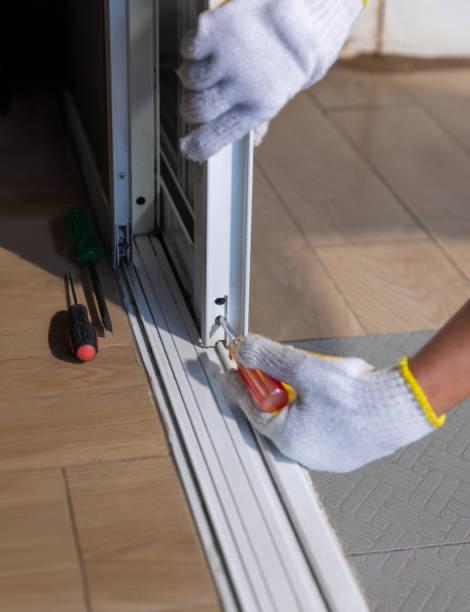
The bottom track is typically secured to the threshold with screws at intervals along its length, or set in a bed of sealant, or both. Screws are removed first, then the track is worked free of the threshold. Any old sealant or adhesive is cleaned off the threshold surface before the new track goes in.
The replacement track extrusion is cut to the exact length of the opening using a fine-tooth hacksaw or aluminum-rated circular saw blade. Cut ends are filed smooth to remove burrs that could catch the roller or weatherstripping.
The new track is set into position on the threshold and secured with screws at the manufacturer-specified intervals. A bead of appropriate sealant may be applied at the threshold junction to prevent water intrusion — important in South Florida's rainy season and hurricane climate.
The door panel goes back onto the new track and the roller height is adjusted to the correct operating position. The door is tested for smooth operation, proper lock alignment, and even gap at the frame before the job is complete.
What Does Track Replacement Cost?
Track replacement costs vary by track type, accessibility, and whether additional work — such as threshold repair or roller replacement — is needed at the same time.
| Job Type | Typical Cost Range | Notes |
|---|---|---|
| Bottom track replacement only | $150 – $350 | Parts and labor for standard residential door |
| Track + roller replacement | $200 – $450 | Combined job — most efficient when both need doing |
| Screen door track replacement | $75 – $150 | Lighter-duty work, shorter time |
| Header track replacement | $100 – $250 | Access difficulty varies by door design |
| Full door replacement | $800 – $3,500+ | Only when frame or glass also damaged |
Track replacement is consistently one of the best-value repairs available on a sliding glass door — it costs a fraction of full door replacement and produces results that are immediately obvious. A door that was grinding and binding on a damaged track becomes effortless to operate after a track swap, assuming the rollers are also in good condition.
Track Damaged? We'll Assess and Fix It Same Day.
Serving Pompano Beach, Fort Lauderdale, Boca Raton, Deerfield Beach, Coral Springs, and all of South Florida. Free estimates, flat-rate pricing, warranty on every job.
Why South Florida Tracks Wear Out Faster
Track damage in South Florida is more common and arrives sooner than in most other parts of the country. The reasons are the same ones that accelerate roller wear — salt air corrosion, coastal sand abrasion, UV degradation, and the mechanical stress of hurricane-season conditions — but they affect the track in specific ways worth understanding.
Aluminum track extrusions are durable in most environments but highly susceptible to salt air corrosion in coastal settings. In neighborhoods along Federal Highway in Pompano Beach, near the Intracoastal in Fort Lauderdale, or in oceanfront buildings throughout Broward County, aluminum tracks can develop significant surface pitting within 5 to 10 years of installation without protective treatment. Once the pitting is deep enough to affect the rail surface, the track provides an uneven rolling surface that wears roller wheels prematurely and eventually needs replacement regardless of how well the rollers are maintained.
Sand abrasion is the other major factor. Fine beach sand packed into the track channel under the operating pressure of the door panel creates a grinding interface between the roller wheel and track surface. Over years, this removes measurable material from both surfaces. When it's the track that wears through first — which happens when the track is softer aluminum or has been in service longer — the result is longitudinal grooves that no roller can operate cleanly on.
NOAA coastal weather data shows that Southeast Florida's salt deposition rates rank among the highest in the continental U.S. for residential environments. Proactive track maintenance — cleaning every 3 to 4 months and applying protective aluminum treatment annually — extends track life significantly. But for tracks that have already reached the replacement threshold, cleaning alone won't help. The sliding door track service covers assessment and replacement for all track types across the South Florida region.
DIY vs. Professional Track Replacement
Track replacement is more involved than roller replacement and is generally better suited to professional service for most homeowners. Here's an honest assessment of where the DIY approach works and where it doesn't.
DIY Is Reasonable If:
- You have experience with the door panel removal process and a capable helper
- The track profile is a standard extrusion available at a local supplier
- The threshold is clean and undamaged — no rotted wood, cracked concrete, or corroded metal to deal with
- The door does not have impact glass
- You have the tools to cut aluminum cleanly and safely
Call a Professional If:
- The door has impact glass — heavy panels demand proper handling
- The threshold shows damage alongside the track — rotted wood subfloor, cracked concrete, or corroded frame members need to be addressed before the new track goes in
- You can't source a matching track profile — using a close-but-wrong extrusion causes the same problems as the wrong roller
- The rollers also need replacing — a combined track-and-roller job is most efficiently done by a technician who can handle both in one visit
- You want the work warrantied — a professional backs the installation; a DIY repair doesn't come with coverage if something goes wrong
Track Replacement in Pompano Beach and Broward County
For homeowners in Pompano Beach and throughout Broward County, sliding door track replacement is one of the most common service calls during and after hurricane season. Storm-driven debris, pressure-packed sand, and the mechanical stress of storm preparation — repeatedly opening and closing heavy impact doors to clear outdoor furniture — all take a toll on track systems that are already contending with the baseline coastal environment.
The Pompano Beach area's housing stock includes a wide mix of door ages and types: older aluminum-frame doors in communities along Atlantic Boulevard and the Federal Highway corridor, newer impact-rated systems in Lighthouse Point and hillsboro Beach, and mid-range doors in the inland western communities toward Coral Springs and Deerfield Beach. All of them use track systems that can be replaced independently of the door panel and frame — the key is correct diagnosis and matched parts. If you're ready to get a straight assessment of whether your track needs cleaning, straightening, or full replacement, contact us for a free estimate and we'll have the answer on the same visit.
Get Your Track Assessed and Fixed Today
Serving Pompano Beach, Fort Lauderdale, Deerfield Beach, Boca Raton, Coral Springs, and all of South Florida. Same-day service, free estimates, warranty on every job.
Frequently Asked Questions
Yes. Sliding door tracks can be replaced without replacing the door panel, glass, or frame. The old track is removed from the threshold, a matching replacement is cut to size and secured in place, and the door is reinstalled and adjusted. It is a targeted repair that restores smooth operation at a fraction of full door replacement cost.
Signs include deep grooves worn into the track floor, visible bending or crushing of the track walls, corrosion pitting through the track surface, cracked or broken sections, and a door that continues to bind or derail after new rollers have been installed and the track cleaned. Any of these conditions means the track needs replacing, not just cleaning.
Minor bends can sometimes be carefully straightened with a rubber mallet and a flat block. However, deep bends, cracks, severely corroded sections, or areas where the aluminum has been compressed past its yield point cannot be reliably straightened and require track replacement. A technician can assess on the spot which situation applies.
A professional technician typically completes a bottom track replacement in 1 to 2 hours, including door panel removal, old track extraction, new track installation, door reinstallation, and height adjustment. Combined track and roller replacement may take 2 to 3 hours.
Yes. The door panel must be removed from the track before the old track can be extracted and the new track installed. This is a two-person job due to panel weight — standard sliding glass door panels weigh 80 to 200 pounds depending on glass type.
Track replacement is more involved than roller replacement and generally benefits from professional service. It requires sourcing a matching track profile, safely removing the door panel, extracting and securing the track to the threshold, and properly adjusting the door afterward. For doors with impact glass or damaged threshold areas, professional service is strongly recommended.