What Are the Common Problems With Sliding Door Locks?
A diagnostic guide for every sliding door lock symptom — cause, what's actually failing, and whether the fix is an adjustment, a repair, or a replacement.
- Why Lock Problems Are More Common in South Florida
- Problem 1 — Latch Won't Stay Closed
- Problem 2 — Handle Turns But Doesn't Lock
- Problem 3 — Lock Is Stiff or Seized
- Problem 4 — Door Won't Close All the Way
- Problem 5 — Lock Engages but Door Still Opens
- Problem 6 — Strike Plate Misalignment
- Problem 7 — Visible Corrosion on Lock Hardware
- Adjust vs. Replace — How to Decide
- How Long Do Sliding Door Locks Last in Florida?
- Lock Problems in Pompano Beach and Broward County
- Frequently Asked Questions
Sliding door locks fail in specific, identifiable ways — and in most cases the symptom points directly to the cause once you know what each failure mode looks like. A handle that turns but doesn't lock is a different problem from a latch that won't stay closed, which is different again from a lock that works but the door still opens. Each has a different root cause and a different fix, and knowing which situation you're dealing with is the difference between a $10 adjustment and an unnecessary $150 lock replacement.
This guide covers every common lock problem in diagnostic format — symptom, cause, and recommended action — with specific attention to the South Florida context where salt air corrosion accelerates most of these failure modes compared to what a generic guide would describe. For professional sliding door lock diagnosis and repair across the region, same-day service is available.

A lock diagnostic starts with the handle mechanism, then the latch assembly, then the door height — in that order.
Why Lock Problems Are More Common in South Florida
Sliding door locks in South Florida fail earlier and more frequently than in most of the country for a straightforward reason: the salt air environment accelerates corrosion of the zinc, aluminum, and mild steel components used in most standard lock hardware. NOAA atmospheric data for Southeast Florida's coastal corridor consistently shows chloride deposition rates that are dramatically higher than interior regions — and each chloride ion deposited on a metal surface initiates oxidation that, left unchecked, compromises mechanical function.
The result is that a lock which might last 12 to 15 years in a dry inland climate may show functional problems at 5 to 7 years in a Pompano Beach property near the Atlantic or Intracoastal. Homeowners who moved to South Florida from other states sometimes assume their door hardware should last as long as what they had up north — and are surprised when the lock starts failing within the first few years of ownership. It's not a quality issue with the lock itself. It's the environment doing what it does to standard materials.
A1 Sliding Doors diagnoses lock problems across Broward County daily — here's what each failure mode looks like and what it takes to fix it.
Problem 1 — Latch Won't Stay Closed
The door closes but the latch hook doesn't stay in the engaged position — it springs back, disengages under light pressure, or never engages at all even when the handle is turned. The door can be pushed open from outside without forcing the lock.
Problem 2 — Handle Turns But Doesn't Lock
The handle turns fully in both directions with normal or reduced resistance, but the latch hook doesn't move at all. The door appears locked from the outside but can be slid open with normal force.
A handle that turns but doesn't lock is a security emergency, not just a convenience problem. The door appears secured from the outside but provides zero resistance to entry. If this happens, deploy a Charlie bar or lay a track rod in the floor channel immediately and schedule lock replacement same-day rather than waiting.
Problem 3 — Lock Is Stiff or Seized
The handle requires significant force to turn, turns roughly or with grinding resistance, or won't turn at all from one or both directions. In advanced cases the handle snaps under force applied by someone trying to open the door normally.

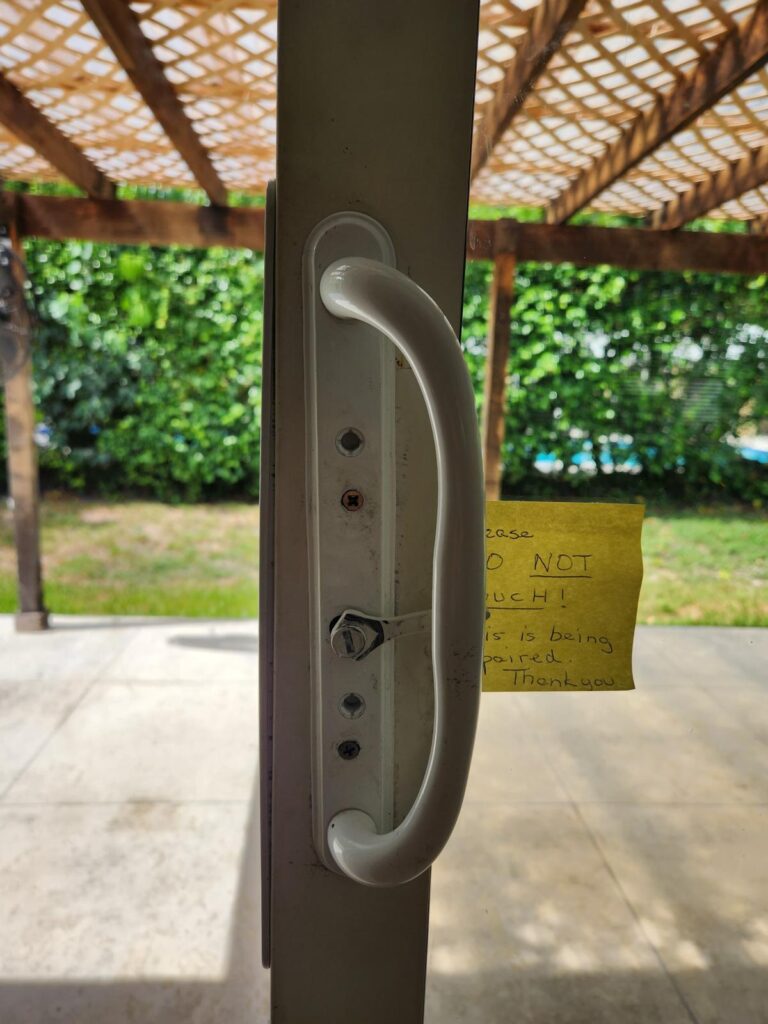
A corroded lock housing — salt crystals packed into the mechanism cause progressive stiffness that ends in complete seizure.

New assembly installed — marine-grade hardware lasts significantly longer than standard spec in South Florida's coastal environment.
Problem 4 — Door Won't Close All the Way
The door slides smoothly but stops 1 to 3 inches before reaching the fully closed position. The latch hook can't reach the strike plate because the door panel itself isn't completing its travel. This is often misdiagnosed as a lock problem when it's actually a track or roller problem.
Problem 5 — Lock Engages but Door Still Opens
The handle turns and the latch hook moves visibly into position, but the door can still be slid open with moderate force. The lock feels functional but isn't actually holding. This is the most dangerous failure mode because it creates a false sense of security.
Problem 6 — Strike Plate Misalignment
When the door closes, the latch hook contacts the door frame above or below the strike plate opening rather than entering it cleanly. The handle may turn but the hook scrapes the frame surface rather than engaging. Sometimes the lock "catches" only when the door is lifted slightly before closing.
Problem 7 — Visible Corrosion on Lock Hardware
Surface pitting, white oxidation deposits, rust staining, or discoloration on any part of the lock hardware. The lock may still function, but visible corrosion is a leading indicator of imminent mechanical failure in South Florida's environment — what's visible on the surface is always more advanced inside the mechanism.
Diagnosed the Problem — Ready to Fix It?
Same-day sliding door lock repair and replacement across Pompano Beach, Fort Lauderdale, Deerfield Beach, Boca Raton, and all of Broward County.
Adjust vs. Replace — How to Decide
Most homeowners either jump straight to replacement when adjustment would solve the problem, or keep adjusting a lock that genuinely needs replacement. Here's the decision framework.
Adjust First When:
- The latch misses the strike plate — this is almost always a door height issue, not a lock issue. Adjust the roller height screws before touching the lock.
- The lock is stiff but responds to lubrication — if dry graphite spray and working the mechanism restores smooth operation, the lock has more service life remaining.
- The door won't close fully — clean the track before assuming the lock needs attention.
- The lock engaged correctly until recently and nothing changed except the season — thermal expansion in Florida's summer heat can temporarily tighten tolerances. Test again in the morning when temperatures are lower.
Replace When:
- The handle turns but the latch doesn't move — internal mechanical failure that adjustment cannot address.
- The lock appears engaged but the door opens under moderate force — the hook engagement depth is insufficient and won't improve.
- Stiffness doesn't respond to lubrication — corrosion has progressed past the point where surface treatment helps.
- Visible corrosion pitting on the housing, especially combined with any functional symptom.
- The lock is more than 8 years old in a coastal Pompano Beach or Broward County waterfront location — proactive replacement before failure is more cost-effective than emergency repair.
Never apply WD-40 to a sliding door lock mechanism. Its petroleum solvent component strips the internal lubricant from the mechanism and the petroleum residue it leaves captures sand and salt particles, accelerating the corrosion it's temporarily masking. Use dry graphite spray or silicone spray for lock mechanism lubrication only.
How Long Do Sliding Door Locks Last in Florida?
Expected lifespan varies significantly by location and hardware grade.
- Standard hardware, oceanfront or Intracoastal: 5 to 7 years before functional problems typically appear.
- Standard hardware, near-coastal (1 to 5 miles): 7 to 10 years with annual inspection.
- Standard hardware, inland (5+ miles): 10 to 15 years in normal use.
- Marine-grade stainless hardware, coastal: 12 to 18 years with periodic maintenance.
- Marine-grade stainless hardware, inland: 20+ years in most cases.
The upgrade from standard to marine-grade hardware at time of replacement costs $20 to $60 more per lock — an investment that pays back in doubled or tripled replacement intervals in South Florida's coastal environment.
Lock Problems in Pompano Beach and Broward County
Broward County's sliding door lock problems follow a clear geographic pattern that maps directly to salt air exposure. Properties along the A1A corridor in Pompano Beach — oceanfront and barrier island homes near the Pompano Beach Pier and Hillsboro Beach — see the full range of corrosion-driven failures, often within 5 to 6 years of a lock installation using standard hardware. The Intracoastal communities through Lighthouse Point and into Deerfield Beach aren't far behind.
Moving inland along Sample Road and the Atlantic Boulevard corridor, lock lifespans extend noticeably. Homes in western Pompano Beach and the inland Broward communities of Coconut Creek and Margate see their sliding door locks last 10 years or more before functional problems develop — the same hardware, dramatically different lifespan, driven almost entirely by the reduction in salt air exposure with distance from the coast.
For any lock problem in Pompano Beach or anywhere in Broward County, our sliding door lock service covers same-day diagnosis and repair. We carry the most common replacement assemblies on the vehicle — most lock repairs are completed in a single visit without a return trip for parts. Get a free estimate and we'll confirm the diagnosis and pricing before any work begins.
Lock Problem Diagnosed — Let's Fix It Today
Same-day lock repair across Pompano Beach, Fort Lauderdale, Deerfield Beach, Coral Springs, and all of South Florida. Free estimates, warranty on every job.
Frequently Asked Questions
The most common causes are a worn latch spring, a corroded hook that can't seat fully, or door misalignment where the hook doesn't meet the strike plate at the correct height. In South Florida, salt air corrosion of the spring mechanism is the most frequent cause in doors more than 5 years old near the coast.
Stiffness is almost always caused by internal corrosion or sand and salt crystals packed into the mechanism. Try dry graphite spray worked in with repeated handle cycles. If stiffness doesn't significantly improve, the lock needs replacement — a stiff lock is close to complete failure in most cases.
The internal connection between the handle cam and the latch hook has failed — typically a broken cam, a sheared pin, or a failed spring. This requires full handle and latch assembly replacement. It's also a security emergency — the door provides no resistance to entry even though it appears locked.
Yes — it's one of the most common causes of apparent lock failure. When rollers wear and the door drops, the latch hook sits below the strike plate and can't engage. Adjusting or replacing the rollers restores correct door height and the lock works properly again without touching the lock hardware.
Adjust first if the latch misses the strike plate — that's a roller height issue. Replace if the handle turns without engaging the latch, if the lock appears engaged but the door still opens under force, or if stiffness doesn't respond to lubrication. Visible corrosion pitting is a strong indicator that proactive replacement is overdue.
Standard hardware lasts 5 to 7 years in coastal locations and 10 to 15 years inland. Marine-grade stainless hardware extends these ranges to 12 to 18 years coastal and 20+ years inland. The upgrade cost at replacement time is modest and pays back significantly in South Florida's salt air environment.