Should You Use WD-40 on Sliding Glass Door Tracks?
No — and the track-specific damage it causes goes deeper than most people realize. Here's exactly what WD-40 does to your track channel, your weep holes, and your aluminum rail surface in South Florida's climate.
- The Answer Is No — Here's the Track-Specific Reason
- What WD-40 Does to Aluminum Track Surfaces
- The Debris-Bonding Cycle — Why It Gets Worse
- The Weep Hole Problem — A South Florida Specific Risk
- The WD-40 Damage Timeline in a Coastal Track
- How to Remove WD-40 Residue From a Track
- What to Use Instead
- Silicone Spray vs WD-40 — Side by Side
- WD-40 and Track Damage in Broward County
- Frequently Asked Questions
WD-40 is the single most commonly misused product in sliding door maintenance across South Florida, and its damage to track channels is more specific and more serious than most homeowners realize. The short-term improvement it provides — a door that moves more freely for a few days — is convincing enough that the cycle repeats, each time leaving a layer of petroleum residue that captures more debris, blocks more drainage, and strips more of the aluminum's protective surface treatment. By the time a homeowner calls for a professional assessment, the track channel often looks like a sand trap, the weep holes are packed solid, and the aluminum rail surface has been stripped of the oxide layer that was protecting it from corrosion.
This guide focuses specifically on what WD-40 does to the track — to the aluminum surface, to the weep holes, and to the debris accumulation cycle. If you've been using WD-40 on your track and want to know how to reset correctly, the removal section covers exactly what to do. And if your Broward County door is still rough after WD-40 has been in the track for years, the final section addresses when professional intervention is the right next step.
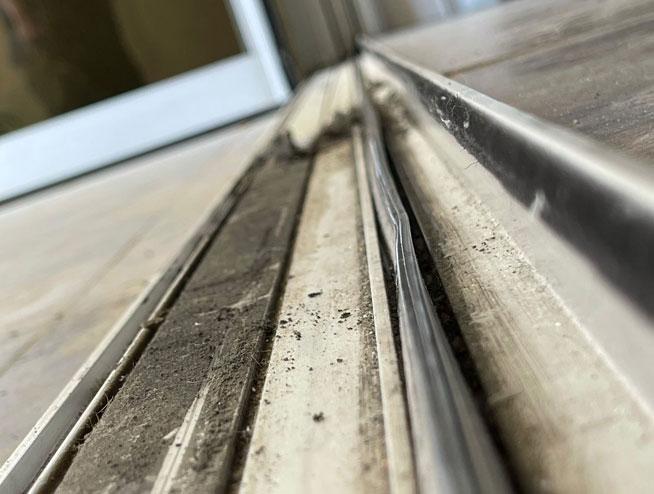
A track channel after years of WD-40 application — petroleum residue has bonded sand and salt deposits into a hardened abrasive layer.
The Answer Is No — Here's the Track-Specific Reason
WD-40 was formulated in 1953 as a water displacement product for aerospace applications — specifically to protect metal surfaces from moisture and free corroded fasteners. It was never designed as a lubricant for sliding mechanisms, and its behavior in a sliding door track channel demonstrates exactly why. The track environment is the worst possible context for a petroleum-based water displacer: an open channel at floor level, constantly exposed to fine abrasive particles, receiving water from rain, and made of aluminum that relies on a natural oxide layer for corrosion protection.
Every single property of WD-40 that makes it useful for its intended purpose — displacing moisture, penetrating tight spaces, carrying a petroleum solvent base — makes it harmful in a sliding door track. It displaces the natural moisture barrier from the aluminum surface. It penetrates weep holes and coats their interior. Its solvent base strips the aluminum oxide layer. And the petroleum residue it leaves behind in the track channel becomes the most effective debris-collection system imaginable in South Florida's sand-laden coastal air.
The correct product for sliding door tracks is silicone-based spray lubricant. It's available at any hardware store for a few dollars, takes the same 30 seconds to apply, and produces results that last 3 to 4 months rather than 3 to 4 days. The rest of this guide covers exactly why WD-40 fails and exactly what silicone spray does differently. If you've already used WD-40 on your track, the removal section tells you how to reset.
What WD-40 Does to Aluminum Track Surfaces
Aluminum naturally forms a thin, hard oxide layer on its exposed surface — aluminum oxide — that acts as a passive barrier against further oxidation and corrosion. This is why bare aluminum doors and track extrusions hold up reasonably well even in coastal environments: the oxide layer sacrifices itself to protect the aluminum beneath it. In South Florida's salt air, this layer is constantly under attack from chloride ions, but it regenerates continuously as long as the surface conditions allow.
WD-40's solvent components strip this oxide layer. Applied to the track rail, WD-40 dissolves and removes the protective aluminum oxide coating, leaving bare aluminum exposed to whatever the environment throws at it. In an inland dry environment, this matters less — the oxide layer regenerates and the exposure is brief. In South Florida's salt air, stripping the oxide layer means exposing bare aluminum to continuous chloride attack without the passive protection that was previously in place. The result is accelerated corrosion initiation — pitting that starts earlier and progresses faster than it would on an untreated surface.
Combined with the debris-bonding effect of the petroleum residue (covered below), stripped aluminum in contact with salt-laden debris creates a corrosion environment that is demonstrably more damaging than simply leaving the track dirty and dry.
In anodized aluminum track extrusions — which have a hard, corrosion-resistant surface treatment — WD-40's solvent components can damage the anodized coating, reducing its effectiveness and allowing corrosion to initiate at compromised points. If you have anodized tracks (common in higher-end door systems installed post-2010 in South Florida), this risk is even more significant than with standard aluminum.
The Debris-Bonding Cycle — Why It Gets Worse
The debris-bonding cycle is the mechanism most responsible for why WD-40 makes South Florida doors harder to operate over repeated applications. Understanding it explains why homeowners who use WD-40 regularly often end up with doors that are dramatically worse than those maintained with proper products.
The First Application
WD-40 is applied. The petroleum solvent penetrates and temporarily reduces friction between the debris already in the track and the roller wheel. The door moves more freely. The homeowner believes the problem is solved.
Days 1 to 3 — The Residue Sets
The lighter volatile components of WD-40 evaporate. What remains is a petroleum-based residue coating the track channel floor, walls, and any debris that was present. This residue is tacky rather than slick. South Florida's coastal air — loaded with fine salt particles and beach sand — begins immediately depositing onto this tacky surface.
Days 3 to 14 — The Paste Forms
The petroleum residue combines with accumulated sand and salt to form an abrasive paste coating the track surface. The roller wheel now contacts this paste on every open-and-close cycle. The gritty texture of the paste means each pass removes microscopic amounts of material from both the roller wheel surface and the aluminum track rail. The door starts getting stiffer again.
The Repeat Application — Compounding the Problem
The homeowner applies more WD-40. This temporarily loosens the paste and reduces friction again. But it also adds another layer of petroleum residue on top of the existing layer, and the debris-capture process restarts with a thicker, stickier base. Each application cycle leaves more residue, bonds more debris, and produces a shorter period of improvement before the stiffness returns — worse than before.
The End State
After months or years of repeated WD-40 applications, the track channel contains a compressed layer of petroleum residue, beach sand, salt crystals, and organic debris that has essentially hardened in place. The roller wheel grinding through this layer has worn grooves into the aluminum track rail surface. The track now needs replacement — a situation that proper lubrication from the start would have prevented entirely.
The Weep Hole Problem — A South Florida Specific Risk
This is the most underappreciated damage WD-40 causes in South Florida's climate, and it's specific to the track rather than the rollers. Sliding door tracks have small weep holes at their base — drainage openings that allow water entering the track channel to drain out through the threshold rather than pooling. In South Florida's rainy season, these weep holes are critical infrastructure. A track with functional weep holes drains after every rainstorm. A track with blocked weep holes holds standing water for hours or days after each rain event.
WD-40 flows. When applied to the track channel, it follows the lowest path — which leads directly into and through the weep holes. The petroleum residue coats the inside of the weep hole opening. In an environment with fine coastal sand and salt particles constantly present in the air, this interior petroleum coating immediately begins capturing debris. Over several WD-40 application cycles, the accumulated debris inside the weep hole builds up into a plug that progressively restricts and ultimately blocks drainage.
The consequence for South Florida tracks is severe. A track with blocked weep holes sits in water after every summer storm. That water carries salt from the air and from the debris already in the track, creating a salt-water environment directly against the aluminum rail surface. The corrosion rate of aluminum in contact with salt water is dramatically higher than its rate in salt air alone — months of water contact can produce years' worth of air-exposure corrosion damage. NOAA data consistently shows that Southeast Florida averages more than 60 inches of rainfall per year, virtually all of it concentrated in the June through October period. That's months of potential standing water in any track with blocked weep holes.
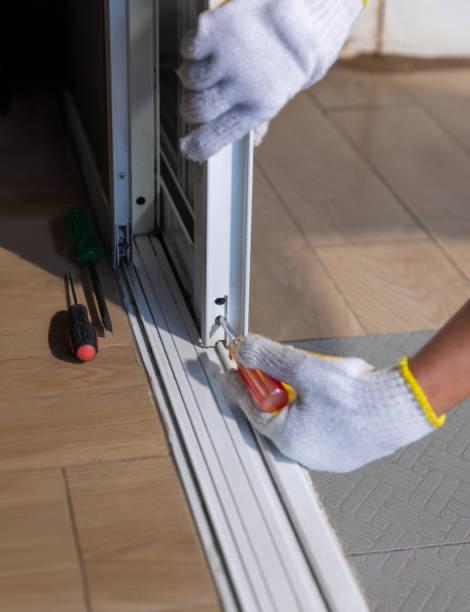
Blocked weep holes — WD-40 residue combined with debris has sealed these openings completely.

After cleaning and weep hole clearing — water now drains freely after every rain event.
The WD-40 Damage Timeline in a Coastal Track
Petroleum solvent temporarily reduces friction. The door moves freely. The homeowner is satisfied. The oxide layer on the aluminum rail has just been stripped by the solvent components.
Volatile components evaporate. Tacky petroleum residue coats the track channel floor, walls, and weep hole interiors. Sand and salt particles in South Florida's coastal air begin bonding to the residue immediately.
The debris-bonded paste in the track increases rolling friction past the pre-WD-40 baseline. Another application is made, adding a fresh layer of residue over the existing contamination.
Multiple WD-40 cycles have built up residue and debris inside the weep hole openings. The first significant rain events of the season leave standing water in the track channel for hours. Accelerated corrosion begins on the stripped aluminum rail surface.
Corrosion pitting is visible on the rail surface. The debris layer in the track channel has compressed into a hardened layer. Roller wheels show accelerated wear from grinding against the contaminated track. Door operation is significantly worse than before WD-40 was ever applied.
Grooves worn into the track floor, deep corrosion pitting, and fully blocked weep holes have brought the track to end of life years earlier than proper maintenance would have allowed. The damage done by WD-40 has compressed a 15-year track into a 5-year track.
WD-40 Track Damage Beyond Cleaning? We'll Fix It.
Same-day track assessment and repair across Fort Lauderdale, Hollywood, Pompano Beach, Coral Springs, and all of Broward County. Free estimates, flat-rate pricing.
How to Remove WD-40 Residue From a Track
If WD-40 has been applied to your track — once or repeatedly — the priority is removing the petroleum residue before it bonds any more debris and before it continues stripping the aluminum surface. Here's the correct removal process.
Apply a degreasing solution to the track — either isopropyl alcohol (70% or higher) or diluted dish soap (a few drops in a cup of water). Use a stiff brush to scrub the full length of the channel floor and walls, working the degreaser into the petroleum residue. The goal is to break down and lift the tacky film from the aluminum surface.
Use an old toothbrush for the track corners and the area around each weep hole opening. These spots collect the highest concentration of debris-bonded residue and require more focused attention than the open channel floor.
After degreasing, address the weep holes specifically. Insert a thin wire or small pick into each opening to break up any accumulated debris plug. Follow with compressed air directed into each weep hole to blow out loosened material. Test drainage by pouring a small amount of water into the track — it should exit through the weep holes within a few seconds.
Vacuum out all loosened material from the channel. Wipe down with a clean damp cloth to pick up any remaining residue. Allow the track to dry completely — 5 to 10 minutes in South Florida's heat is typically sufficient.
Once the track is clean and dry, apply a thin coat of silicone-based spray lubricant along the full length of the rail surface. Slide the door back and forth to distribute it evenly. The difference in door operation compared to the WD-40 cycle will be immediately noticeable.
If the track has had multiple WD-40 applications over an extended period, one degreasing pass may not be sufficient to remove all the accumulated residue. In that case, repeat the degreasing and scrubbing steps twice before drying and lubricating. The track should feel clean and non-sticky to the touch before silicone spray is applied.
What to Use Instead
The correct product is silicone-based spray lubricant. It's widely available at hardware stores under various brand names — look for any product labeled "silicone spray," "dry silicone lubricant," or "silicone lubricant." It costs roughly the same as WD-40 and is applied in the same way.
The key difference is what happens after application. Silicone spray dries to a thin, slick film that doesn't attract or bond to debris. Sand and salt particles that contact the silicone-treated surface slide off rather than sticking. The lubricant maintains its slick surface over many open-and-close cycles before reapplication is needed — typically 3 to 4 months in South Florida conditions. And it never enters the weep holes in a form that causes blockage, because it doesn't leave a tacky petroleum residue behind as it dries.
PTFE (Teflon) spray is an excellent alternative to silicone for particularly sandy coastal environments. It leaves an even more debris-repellent dry coating and can extend the interval between applications slightly compared to standard silicone. Both products represent a genuine upgrade over WD-40 in every measurable way for sliding door track applications. For more on product selection across all track maintenance scenarios, our post on what to use on sliding door tracks covers the full comparison.
Silicone Spray vs WD-40 — Side by Side
Here's a direct comparison across every relevant property for sliding door track use in South Florida's coastal environment.
- Lubrication duration: Silicone spray — 3 to 4 months on a clean track. WD-40 — 1 to 3 days before debris bonding overrides the lubricant.
- Debris attraction: Silicone — repels debris, stays clean. WD-40 — immediately begins attracting and bonding sand and salt particles to the petroleum residue.
- Effect on aluminum oxide layer: Silicone — no effect, protective layer intact. WD-40 — solvent components strip the protective oxide layer.
- Weep hole impact: Silicone — dries clean, no residue in weep holes. WD-40 — petroleum residue coats weep hole interiors and captures debris, progressively blocking drainage.
- Effect on rubber weatherstripping: Silicone — compatible and safe. WD-40 — petroleum solvent degrades rubber flexibility over time.
- Long-term track surface condition: Silicone — track surface remains clean and protected. WD-40 — track surface becomes contaminated with hardened debris-petroleum paste, accelerating corrosion and abrasion.
- Cost: Comparable — both available for a few dollars at any hardware store.
WD-40 and Track Damage in Broward County
Broward County's mix of oceanfront, Intracoastal, and inland residential communities means WD-40 track damage manifests differently depending on location — but it's consistently one of the most common contributing factors to premature track failure across the county.
For properties along the Atlantic coast in Deerfield Beach, Pompano Beach, Fort Lauderdale, and Hallandale Beach, WD-40's weep hole blockage problem is the most serious consequence — blocked weep holes combined with South Florida's 60+ inches of annual rainfall create the standing-water corrosion environment that compresses track lifespan most dramatically. For inland communities in Coral Springs, Plantation, and Sunrise, the debris-bonding paste effect is the primary damage mechanism, since salt air exposure is lower but the abrasive paste still accelerates roller and track wear significantly.
If your Broward County door has been maintained with WD-40 for years and is now rough or difficult to operate despite repeated applications, the track and possibly the rollers have accumulated enough damage that cleaning alone won't restore smooth operation. Get a free estimate — we'll assess the track and roller condition in a single visit and give you a straight answer on what the door actually needs.
WD-40 in the Track? Start Fresh Today.
Serving Fort Lauderdale, Hollywood, Pompano Beach, Coral Springs, Deerfield Beach, and all of Broward County and South Florida. Same-day service, free estimates, warranty on every job.
Frequently Asked Questions
No. WD-40 is not a lubricant — it is a petroleum-based solvent and water displacer. On sliding door tracks it strips the aluminum's protective oxide layer, attracts and bonds debris into an abrasive paste, blocks weep holes, and makes the track progressively harder to operate. The correct product is silicone-based spray lubricant applied to a clean, dry track.
Yes, in two specific ways. Its solvent components strip the protective aluminum oxide layer, leaving bare aluminum exposed to accelerated corrosion in South Florida's salt air. And the petroleum residue it leaves behind bonds salt and sand particles directly to the track surface, creating a concentrated corrosive environment that pits the aluminum faster than salt air exposure alone.
WD-40 provides 1 to 3 days of lubrication before the volatile components evaporate, leaving a tacky petroleum residue. That residue immediately begins collecting sand, salt, and debris. Within a week, the accumulated debris forms a gritty paste that creates more rolling friction than the original dirty track — making the door noticeably harder to operate than before the WD-40 was applied.
Apply isopropyl alcohol or diluted dish soap to the track and scrub thoroughly with a stiff brush. Clear the weep holes with a thin wire and compressed air after degreasing. Vacuum and wipe clean, allow to dry completely, then apply silicone spray to the clean surface.
WD-40 flows into weep holes and coats their interior with petroleum residue. That residue captures debris, progressively building a plug that blocks drainage. Blocked weep holes cause water to pool in the track after rain, dramatically accelerating corrosion — particularly damaging in South Florida's rainy season.
Silicone spray applied to a clean track lasts 3 to 4 months in South Florida conditions. WD-40 provides effective lubrication for 1 to 3 days before its residue starts increasing friction. Over a 4-month period, one silicone application outperforms WD-40 applied a dozen times — with no cumulative track damage.