How to Fix a Broken Sliding Door Track?
A step-by-step guide covering every type of track damage — from quick DIY fixes to knowing exactly when the track needs to be replaced entirely.
- Diagnose Before You Fix
- Fix 1 — Deep Track Cleaning
- Fix 2 — Straightening a Bent or Dented Track
- Fix 3 — Re-Securing a Loose Track
- Fix 4 — Clearing Blocked Weep Holes
- Fix 5 — Full Track Replacement
- Repair or Replace — The Decision Framework
- Tools You Actually Need
- Track Repairs in Palm Beach County
- Frequently Asked Questions
A broken sliding door track shows up in several different ways — a door that jolts at one specific spot, a track that's visibly bent or dented, a channel packed solid with debris, or a track that has worked loose from the threshold and wobbles when the door moves. Each of these is a different problem with a different fix. The most important first step is figuring out which type of damage you're actually dealing with, because the wrong fix — cleaning a track that needs replacing, or replacing a track that just needed its fasteners tightened — wastes both time and money.
This guide walks through every repair approach in order of complexity, starting with the simplest and working up to full track replacement. Whether you're in Boca Raton, Delray Beach, West Palm Beach, or anywhere across Palm Beach County, the same diagnostic logic applies — and A1 Sliding Doors is available same-day if any of these repairs goes beyond what you're comfortable tackling yourself.
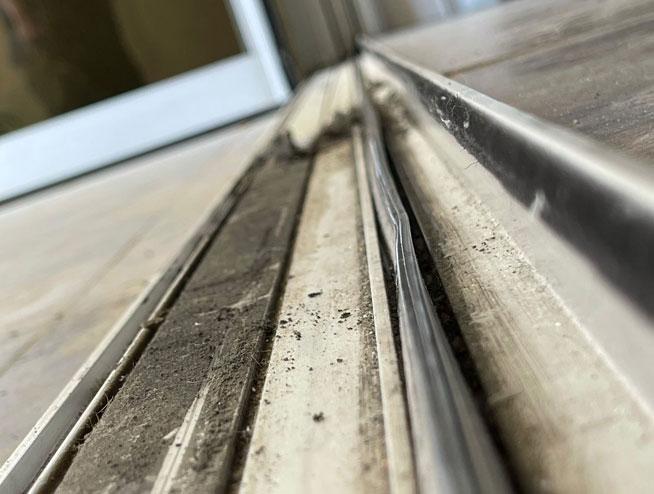
Different types of track damage require different fixes — identification comes before any repair attempt.
Diagnose Before You Fix
Run through these quick checks before starting any repair. They'll tell you which fix to go to and potentially save you from doing the wrong one.
- Door jolts or stops at one specific point: Run your finger along the full length of the track rail. A bump, groove, or raised section at that point confirms localized track damage — go to Fix 2.
- Door is stiff throughout its full travel: This is usually debris, not a bent track. Start with Fix 1.
- Track wobbles or moves when touched: The fasteners have worked loose. Go to Fix 3.
- Water pools in the track after rain: Blocked weep holes. Go to Fix 4.
- Track has visible cracks, deep grooves, or sections missing: Beyond repair — go directly to Fix 5.
- Door was recently repaired or new rollers installed but still rough: The track surface is likely grooved and needs replacing — Fix 5.
Before any repair, slide the door to the fully open position and inspect the track underneath where it normally sits. This section of the track sees the most debris accumulation and often the most wear — it's frequently overlooked because the door covers it during normal use.
Fix 1 — Deep Track Cleaning
This is the right starting point for any door that's getting progressively harder to open, especially if the track looks dirty or hasn't been cleaned recently. In South Florida's coastal climate, debris accumulation is the single most common cause of sliding door stiffness — and it's the easiest and cheapest fix.
Use a vacuum with a narrow crevice attachment to remove loose sand, debris, and material from the full length of the track. Work both the main door channel and the screen door channel if present. Don't skip the corners — debris compacts most heavily at the ends of the track.
Use a stiff-bristle brush to work along the full length of the channel floor and walls. A narrow brush that fits inside the track channel is ideal. An old toothbrush handles the corners. Apply firm pressure — compacted coastal sand doesn't come off with a light scrub.
After brushing, wipe the channel with a damp cloth to pick up loosened material. For salt residue — white chalky deposits along the track walls — use a cloth dampened with a mild dish soap solution. Rinse with a clean damp cloth and dry thoroughly before lubricating.
Once the track is completely dry, apply a thin coat of silicone-based spray lubricant along the full length of the rail surface. Slide the door back and forth several times to distribute it evenly. Never use WD-40 — it attracts debris and makes the problem return faster.
If the door improves significantly after cleaning and lubricating, debris was the primary problem. Maintain the track every 3 to 4 months to prevent recurrence. If the door is still rough after a thorough cleaning, move on to the next diagnostic — there's underlying track or roller damage that cleaning alone won't address.
Fix 2 — Straightening a Bent or Dented Track
A localized dent creates a high point on the track rail that the roller wheel bumps over on every cycle. The fix is carefully working the aluminum back toward its original profile. This is only appropriate for minor dents — not for sections that have been creased, cracked, or crushed.
Slide the door to the open position and run your finger slowly along the top of the track rail to feel for raised sections. Mark the location with a small piece of tape so you don't lose it when you start working.
Cut a piece of hardwood — a scrap of 2x4 works well — that fits inside or against the track channel. The wood distributes the mallet force over a wider area, preventing new dents from forming while you work on the existing one.
Apply controlled taps to the wood block over the dented section. Work gradually from the edges of the deformation toward the center. Check progress after every few taps by running your finger along the rail. Stop and test the door when the high point feels flush.
Slide the door back and forth through the repaired section. If the jolt is gone and the door moves smoothly, the repair is complete. If there's still a catch, continue working the area in small increments. If the aluminum has cracked or won't flatten, the track needs replacing.
Never use a metal hammer directly on the track. The impact creates stress fractures in the aluminum that aren't visible on the surface but cause the track to crack under the door's operating load weeks or months later. Always use a rubber mallet with a hardwood buffer block.
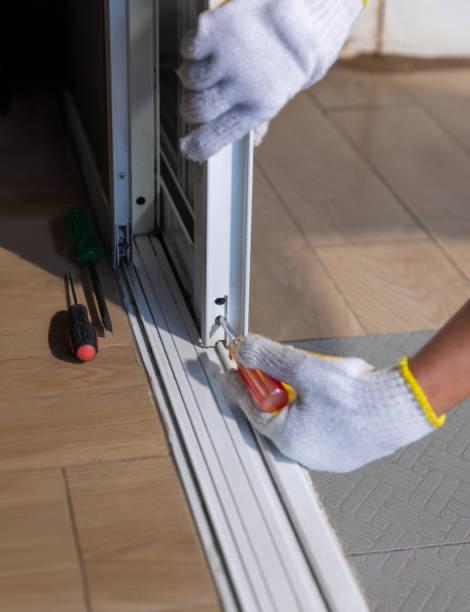
Assessing track dent location before repair — localized damage is often fixable without full replacement.

When straightening doesn't hold — a new track section is the reliable long-term fix.
Fix 3 — Re-Securing a Loose Track
A track that wobbles or has lifted partially from the threshold creates a variable operating surface that changes with the door's weight position. This is more common in older South Florida homes where repeated thermal expansion and contraction, and minor foundation movement, have worked the original fasteners loose over time.
Safe access to the track fasteners requires the door panel to be out of the way. Retract the rollers and lift the panel free with a helper. Set it on a padded surface.
Check each screw along the track length. Stripped screws need to be replaced with slightly larger diameter screws or removed and the holes filled with epoxy before re-drilling. Screws that are simply loose can be re-torqued in place.
If the threshold is wood and shows signs of rot or water damage, the fastener substrate is compromised and needs repair before the track can be properly re-secured. Concrete thresholds may need appropriate anchors rather than screws if the original fastener holes have widened.
After re-securing the fasteners, apply a bead of appropriate exterior sealant at the junction between the track base and the threshold surface. This prevents water from working under the track and accelerating corrosion and substrate damage. Use a sealant rated for aluminum and the threshold material.
Fix 4 — Clearing Blocked Weep Holes
Weep holes are small drainage openings at the base of the track channel that allow water to escape rather than pool. They block easily with sand and debris — particularly after storms — and blocked weep holes are one of the fastest ways to accelerate track corrosion in South Florida's rainy climate.
Locate the weep holes by looking at the bottom corners of the track channel on the exterior side of the door. They appear as small rectangular or round openings at the base of the track wall. Clear them by inserting a small wire or thin screwdriver to break up the blockage, then blow out the loosened material with compressed air or a can of compressed air. Test drainage by pouring a small amount of water into the track channel — it should exit through the weep holes within a few seconds.
Check weep holes every time you clean the track — it adds about 30 seconds to the routine. In Palm Beach County communities along the Intracoastal or near the ocean in Delray Beach or Boca Raton, check them after every significant rain event during the June-through-November storm season. A blocked weep hole discovered after a storm prevented significant corrosion damage is worth the inspection time many times over.
Track Damage Beyond DIY? We'll Handle It.
Same-day sliding door track repair and replacement across Palm Beach County, Broward County, and all of South Florida. Free estimates, flat-rate pricing, warranty on every job.
Fix 5 — Full Track Replacement
When the track damage is beyond what cleaning, straightening, or re-securing can address, full track replacement is the correct repair. This produces a fresh, flat rail surface that restores proper door operation and gives the door's other components — particularly the rollers — a clean surface to work against.
The process involves removing the door panel, extracting the old track from the threshold, installing a matching replacement extrusion cut to the correct length, and reinstalling the door with proper height adjustment. For the complete step-by-step breakdown of what track replacement involves, our post on sliding door track replacement covers the full process in detail.
For most homeowners in Palm Beach County — where the combination of coastal conditions and a wide range of door ages and types makes track specification matching important — professional track replacement is the most reliable path to a correctly completed job. A technician carries matching track extrusions for the most common South Florida door systems and can complete the replacement in a single visit with a warranty on the result.
Repair or Replace — The Decision Framework
Use this framework to confirm which path is right for your specific situation before committing to either approach.
- Damage is debris and surface contamination only
- Surface oxidation is light and hasn't pitted the rail
- A single localized dent that hasn't creased the aluminum
- Fasteners are loose but the track itself is undamaged
- Weep holes are blocked but track is structurally sound
- Deep longitudinal grooves worn into the track floor
- Corrosion pitting has penetrated the rail surface
- Bending or crushing that has creased or cracked the aluminum
- One or more sections are cracked or missing
- Door still rough after new rollers and track cleaning
- Track has been repaired multiple times without lasting results
Tools You Actually Need
Here's the honest tool list for each level of track repair — nothing more than what the job actually requires.
For Cleaning and Minor Repairs
- Stiff-bristle brush and old toothbrush for corners
- Vacuum with narrow crevice attachment
- Damp cloth and mild soap solution
- Silicone spray lubricant
- Rubber mallet and flat hardwood block (for dent straightening)
- Phillips screwdriver (for loose fasteners)
- Thin wire or compressed air (for weep holes)
For Full Track Replacement
- Everything above, plus:
- Fine-tooth hacksaw or aluminum-rated circular saw blade to cut replacement extrusion
- Metal file to deburr cut ends
- Appropriate fasteners for your threshold material (wood screws, concrete anchors)
- Exterior-grade sealant for track-threshold junction
- A capable helper for door panel removal and reinstallation
Track Repairs in Palm Beach County
Palm Beach County's housing stock spans everything from 1970s aluminum-frame patio doors in older Boca Raton neighborhoods to modern impact-rated systems in newer gated communities in Wellington, Jupiter, and Boynton Beach. Track repair needs vary significantly by door age and proximity to the coast.
Older aluminum-frame doors in communities near the ocean — particularly in Delray Beach, Boynton Beach, and along the A1A corridor in Palm Beach — typically present with corrosion-related track damage that requires replacement rather than repair. Newer impact-rated systems in inland communities more commonly show debris accumulation and occasional fastener loosening that respond well to cleaning and maintenance. In both cases, the diagnostic approach is the same — identify the specific damage type, apply the correct fix, and confirm the door operates correctly before closing out the repair. If you're not certain which situation you're dealing with, get a free estimate and we'll assess both the track and the full door system in a single visit.
Track Fixed — Or We'll Tell You Exactly Why Not
Serving Boca Raton, Delray Beach, Boynton Beach, West Palm Beach, and all of Palm Beach County. Same-day service, free estimates, warranty on every repair.
Frequently Asked Questions
Minor repairs — debris cleaning, light dent straightening, re-securing loose fasteners, and clearing blocked weep holes — are manageable DIY tasks with basic hand tools. Full track replacement requires removing the door panel, sourcing a matching track extrusion, and correctly securing it to the threshold. For doors with impact glass or corroded thresholds, professional service is strongly recommended.
Place a flat hardwood block against the deformed section and apply controlled taps with a rubber mallet, working gradually from the edges toward the center. Never use a metal hammer directly on the track. If the aluminum has creased or cracked, straightening won't hold and the track needs replacing.
A track can be repaired when damage is limited to surface debris, light oxidation, a small localized dent, or loose fasteners. It needs full replacement when it has deep longitudinal grooves, significant bending that has creased the aluminum, corrosion pitting through the rail surface, or cracked sections.
For cleaning and minor repairs: stiff brush, vacuum, rubber mallet, flat hardwood block, Phillips screwdriver, and silicone spray. For full track replacement: all of the above plus a fine-tooth hacksaw or aluminum-rated saw blade, a metal file for deburring, appropriate threshold fasteners, and exterior sealant.
Remove the door panel for safe access. Re-drill stripped screw holes with slightly larger fasteners or fill with epoxy before re-drilling. Re-torque all fasteners along the track length. Apply exterior sealant at the track-threshold junction to prevent water intrusion. Reinstall the door and test operation.
If the rollers are in good condition and the track was the primary problem, yes — fixing the track restores smooth operation. If the track was damaged by worn rollers dragging on it for years, the rollers also need replacing. Installing new rollers on a damaged track destroys them quickly; fixing only the track without addressing worn rollers produces the same result in reverse.