How Do You Fix a Sliding Door That Will Not Slide Smoothly?
From a quick track clean to a full roller replacement — here's the exact step-by-step process South Florida technicians use to restore a stiff, grinding, or jammed sliding door.
A sliding glass door that drags, grinds, sticks halfway, or takes two hands and a shoulder lean to open is one of the most common — and most fixable — problems South Florida homeowners face. In Pompano Beach, Fort Lauderdale, Boca Raton, Deerfield Beach, and Coral Springs, the combination of salt air, fine coastal sand, and year-round humidity creates the perfect environment for sliding door hardware to degrade faster than anywhere else in the country. The good news is that in the majority of cases, the fix is straightforward — and many of the initial steps can be done by a homeowner with basic tools in under an hour.
This guide walks you through the exact diagnostic and repair process our technicians use in the field every day across Broward and Palm Beach Counties. Work through these steps in order. If you reach a point where the fix is beyond DIY, we'll tell you clearly — and our team is available for same-day service 24/7 throughout South Florida. Don't let a stiff door become a jammed one — the longer it's ignored, the more expensive the repair gets.
Why Sliding Doors Stop Sliding Smoothly in South Florida
Before you grab a screwdriver, it helps to understand what's actually causing the resistance. There are four primary culprits — and each one has a different fix:
🔩 Worn Rollers
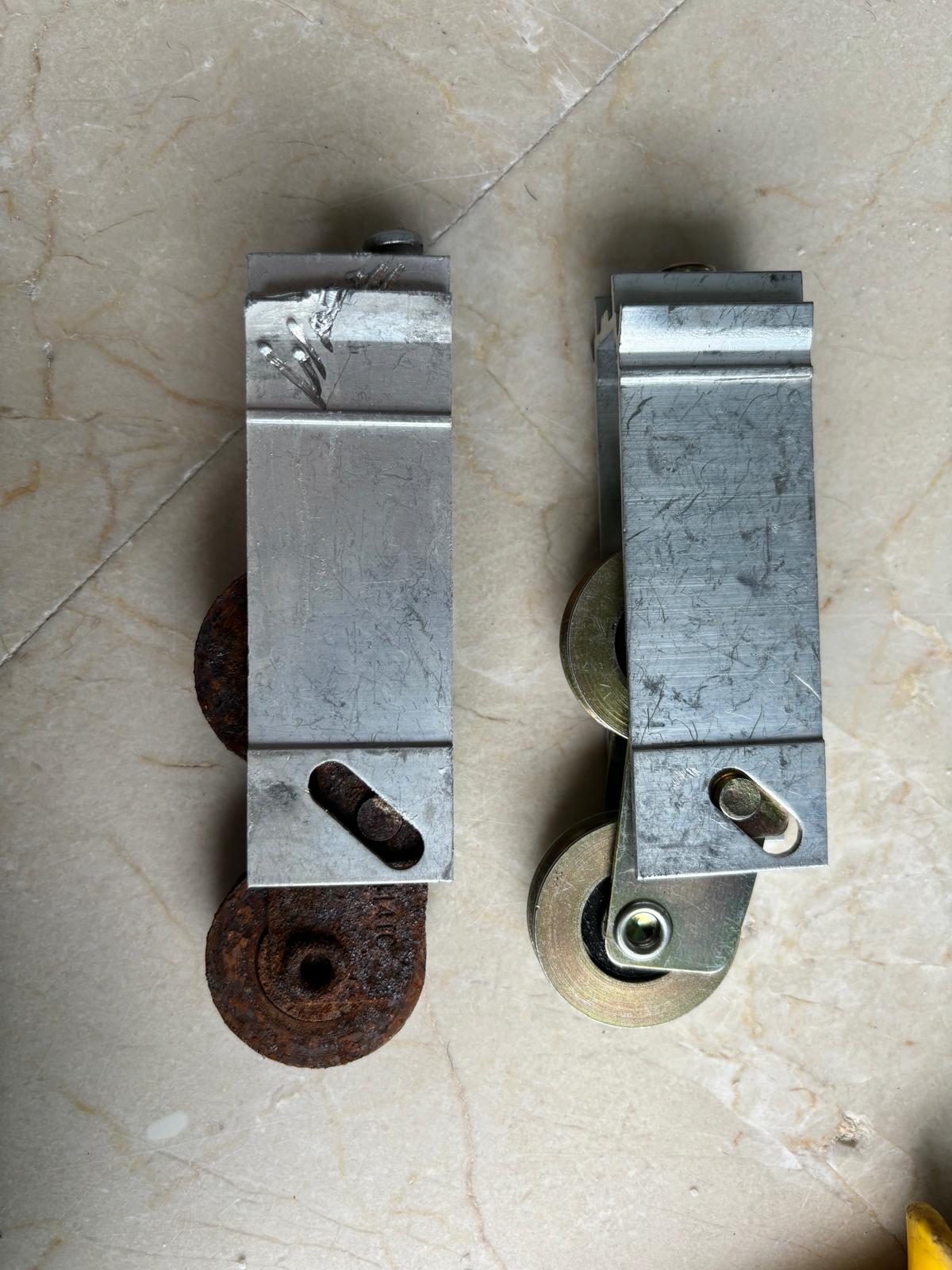
The ball bearings inside the roller housing corrode in South Florida's salt air, causing the wheels to drag instead of roll. This is the #1 cause of a stiff sliding door in coastal communities near Pompano Beach Pier and Fort Lauderdale's A1A.
🪨 Debris-Packed Track
Fine sand, grit, and salt crystals accumulate in the track channel and create friction against the rollers with every use. Common in homes along Deerfield Beach and Coral Springs where construction dust and coastal sand are constant factors.
📐 Misaligned Door Panel
The door panel can drop or shift out of alignment, causing it to rub against the frame or track instead of riding cleanly above it. Often mistaken for a roller problem — but the fix is a height adjustment, not a replacement.
🔧 Bent or Damaged Track
Foot traffic, furniture impact, or hurricane debris can bend the track channel, creating an obstacle the rollers physically cannot pass over smoothly. Visible as a bump or dip when you run your finger along the track floor.
Step 1 — Diagnose the Root Cause First
Don't start cleaning or lubricating until you know what you're actually dealing with. A proper diagnosis takes less than five minutes and ensures you're fixing the right thing:
Look at the Track
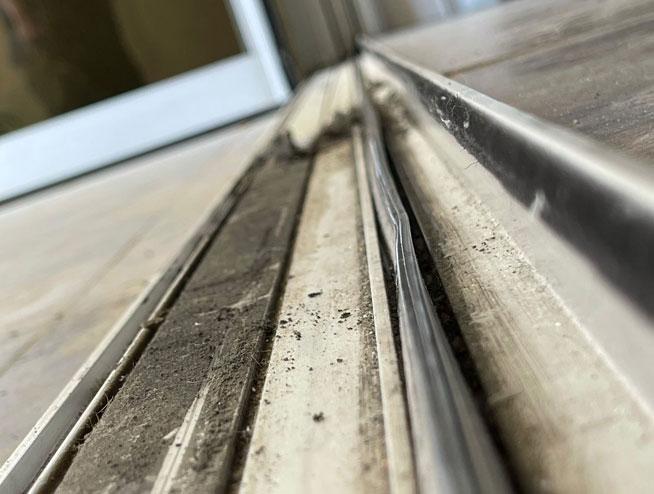
Get down and run a finger along the full length of the bottom track channel. Feel and look for packed sand or debris, visible bends or deformations, and surface corrosion. A packed track is the easiest fix. A bent or cracked track needs repair or replacement before anything else will work.
Lift the Door Slightly While Sliding
With the door closed, push up slightly on the panel while sliding it open. If the resistance disappears immediately, the door has dropped off its roller height and needs a roller adjustment — not a replacement. If lifting doesn't help, the rollers themselves or the track are the issue.
Listen and Feel for the Type of Resistance
A grinding or crunching sound usually means debris in the track or corroded roller bearings. A smooth but heavy drag typically means the rollers have seized. A sharp catch at a specific point in the travel means there's a bend or obstruction in the track at that exact location. Each sound points to a different solution.
Check the Bottom Gap
Look at the gap between the bottom of the door panel and the track. It should be even across the full width of the door — roughly 3–5mm clearance. If one side is noticeably lower than the other, the door has dropped on that side and the roller on that corner needs height adjustment.
Step 2 — Clean the Track Properly
If your diagnosis reveals debris in the track, start here before doing anything else. A thorough track clean fixes a surprising number of "broken" doors across Broward County without any additional work:
- Vacuum the track channel using a narrow crevice attachment. Remove all loose sand, grit, and debris along the full length of the track — both the inner and outer channels if your door has them.
- Scrub with a stiff brush (an old toothbrush or a dedicated track cleaning brush) using a solution of warm water and mild dish soap. Work the bristles into the channel corners where compacted salt and sand accumulate.
- Wipe out the residue with a damp cloth or paper towel. Be thorough — any remaining grit will continue to act as an abrasive against the rollers.
- Dry the track completely before lubricating. Never apply lubricant over a wet or dirty track — it traps debris instead of preventing it.
For homes near Pompano Beach's ocean corridor or Fort Lauderdale's barrier island communities, salt crystal buildup in the track is a major contributor to door stiffness. A solution of equal parts white vinegar and warm water dissolves salt deposits that soap and water alone won't budge. Apply, let sit for 2–3 minutes, then scrub and wipe clean.
Step 3 — Lubricate Correctly (and What Never to Use)
Lubrication is one of the most misunderstood steps in sliding door maintenance — and the most common source of DIY damage. The wrong lubricant doesn't just fail to help; it actively accelerates wear by trapping abrasive particles inside the roller housing and track channel. Here's exactly what to use and what to avoid:
- Silicone spray lubricant — dry formula, doesn't attract dirt, safe for aluminum and nylon rollers. Best overall choice for South Florida conditions.
- Teflon (PTFE) spray — extremely low friction, dries clean, resists moisture and salt air. Excellent for tracks and roller housings.
- White lithium grease — for heavy-duty steel roller bearings on larger commercial-grade doors. Use sparingly and only on the bearings themselves.
- WD-40 — a water displacer, not a lubricant. Petroleum-based, attracts sand and salt, degrades nylon rollers, and leaves a sticky residue that worsens over time.
- Cooking oil or household grease — goes rancid, attracts debris, and can stain flooring and door frames.
- Standard motor oil — too heavy, attracts grit, incompatible with most roller materials.
- Petroleum jelly (Vaseline) — petroleum-based, same problems as WD-40 in a worse consistency.
How to apply: Spray silicone lubricant lightly along the full length of the track channel and directly into the roller housing access points at the bottom of the door panel. Slide the door back and forth several times to distribute. Wipe up any excess with a cloth — you want a thin film, not a pool of lubricant collecting debris.
Step 4 — Adjust the Roller Height
If cleaning and lubricating the track didn't fully resolve the issue, the next step is checking and adjusting the roller height. Most sliding doors have a small adjustment screw accessible at the bottom of the door panel on each side — usually behind a plastic plug or cover cap. Turning this screw raises or lowers the roller, which lifts or drops the door panel relative to the track.
- Locate the roller adjustment screws — typically Phillips head, found at the bottom corners of the door panel, set into small holes in the aluminum frame bottom rail.
- Turn clockwise to raise the door panel on that side (lifts the panel higher above the track). Turn counter-clockwise to lower it.
- Adjust both sides evenly — raise or lower each screw by the same number of turns to keep the panel level. An uneven door will bind against the frame even if the rollers are fine.
- After each adjustment, slide the door through its full travel to feel for improvement. You're looking for even, light resistance along the entire path.
- Check the gap between the door panel and the frame at the top and sides when closed — it should be even all the way around, roughly 3–5mm.
Don't over-adjust. Raising the door too high causes it to bind against the top track or frame header. Raising it too low causes the panel to drag on the bottom track. Make small, incremental adjustments — a quarter turn at a time — and test after each one. If the adjustment screws are stripped, corroded, or won't turn, that's a sign the roller assembly needs professional replacement, not just adjustment.
Step 5 — How to Unjam a Completely Stuck Door
If your door won't move at all — not stiff, but completely jammed — don't force it. Forcing a jammed sliding door risks bending the frame, cracking the glass, or snapping the roller assembly entirely, turning a $150 repair into a $600 one. Here's the safe approach used by our technicians across Deerfield Beach and Coral Springs:
- Inspect the track for a physical obstruction first — a fallen screw, a piece of debris, or a section of bent track that the roller is catching on. Sometimes the fix is simply removing an object from the track channel.
- Try lifting while sliding — place both palms flat on the door panel at mid-height, apply upward pressure, and try to slide. This can free a roller that has dropped into a bent section of track.
- Check the lock — a partially engaged lock or a misaligned latch can physically prevent the door from moving. Confirm the lock handle is fully in the open position before attempting to slide.
- Apply silicone spray to the track and let it penetrate for 2–3 minutes before trying again. This can free a roller that's seized against the track surface.
- If none of the above works, stop and call a professional. A door that is completely immovable after these steps has a mechanical issue — seized rollers, a severely bent track, or a derailed panel — that requires the door to be lifted off the track for proper repair.
Door Still Not Moving? We'll Fix It Same Day.
If your door is jammed, off-track, or just won't respond to DIY fixes, our Pompano Beach team is ready. Same-day service across all of Broward & Palm Beach County — call now for a free estimate.
Step 6 — When to Replace the Rollers
If you've cleaned the track, applied the right lubricant, and adjusted the roller height — and the door still drags, grinds, or feels heavy — the rollers themselves have failed and need replacement. This is not a DIY job. Replacing sliding door rollers requires lifting the door panel out of the track, which is a two-person job on any door over 40kg, and risks cracking the glass panel or damaging the frame if done without the right technique and equipment.
In South Florida's coastal environment, rollers in homes near Pompano Beach Pier, Las Olas Blvd in Fort Lauderdale, and the barrier island communities of Palm Beach County typically fail within 5–8 years due to salt air corrosion of the ball bearing housing. Replacement with stainless-steel or marine-grade rollers extends the service interval significantly in these high-exposure locations. Our sliding door roller replacement service covers the full job — panel removal, new roller fitting, height adjustment, track clean, and reinstallation — in a single visit, typically under two hours.
When rollers are replaced, always have the track inspected and cleaned at the same time. Installing new rollers into a dirty or damaged track shortens the lifespan of the new hardware significantly — a mistake that costs homeowners across Boca Raton and Coral Springs unnecessary repeat service calls within a year or two of a roller replacement.
How to Fix a Sliding Door That Is Uneven When Closed
A door that sits unevenly in the frame when closed — one side higher than the other, or a visible gap at the top corner — is almost always a roller height issue, not a frame problem. This is one of the most common calls we receive from homeowners in established Coral Springs neighborhoods and Boca Raton gated communities, and it's almost always resolved with a simple roller height adjustment following the process in Step 4 above.
The exception is a door that has physically dropped off one of its rollers — where the panel is sitting directly on the track instead of riding above it on its wheels. In that case, the door needs to be lifted back onto its rollers, which again requires lifting the panel. If you can see the bottom of the door panel resting directly on the aluminum track surface rather than sitting above it with a visible gap, call a professional rather than attempting to force the panel back onto its rollers manually — the glass is at risk.
When to Stop DIY and Call a Professional
Most sliding door smoothness issues can be resolved with the steps above. But there are specific situations where attempting to continue with DIY work risks making things significantly worse and more expensive:
- The door is completely immovable after the unjamming steps — the panel may be derailed
- The roller adjustment screws are stripped or seized — forcing them risks snapping the roller housing
- The track has a visible bend, crack, or raised section — a bent track won't be fixed by lubrication and will destroy new rollers quickly
- The door grinds on a specific spot every time regardless of lubrication — there's a physical obstruction or track damage at that point
- The panel has visibly dropped off its rollers — lifting it back into position safely requires two people and the right technique to avoid glass breakage
- Any glass cracking, frame bending, or unusual noise during attempted movement — stop immediately and call for professional assessment
For any of these situations, our team is available same-day across Pompano Beach, Fort Lauderdale, Boca Raton, Deerfield Beach, and Coral Springs. See our full guide on the most common sliding door problems in South Florida for more on what to expect, and our sliding door repair cost guide to understand what professional service should run before you call anyone.
Let Us Fix It the Right Way — Today
From a quick roller adjustment to a full track replacement, A1 Sliding Doors handles every level of repair across all of South Florida. Free estimates. Same-day service. Open 24/7.
Sources: NOAA — South Florida Climate Data | A1 Sliding Doors — Roller Replacement Service | A1 Sliding Doors — Track Repair Service | 7 Most Common Sliding Door Problems in South Florida | How Much Does It Cost to Repair a Sliding Door?