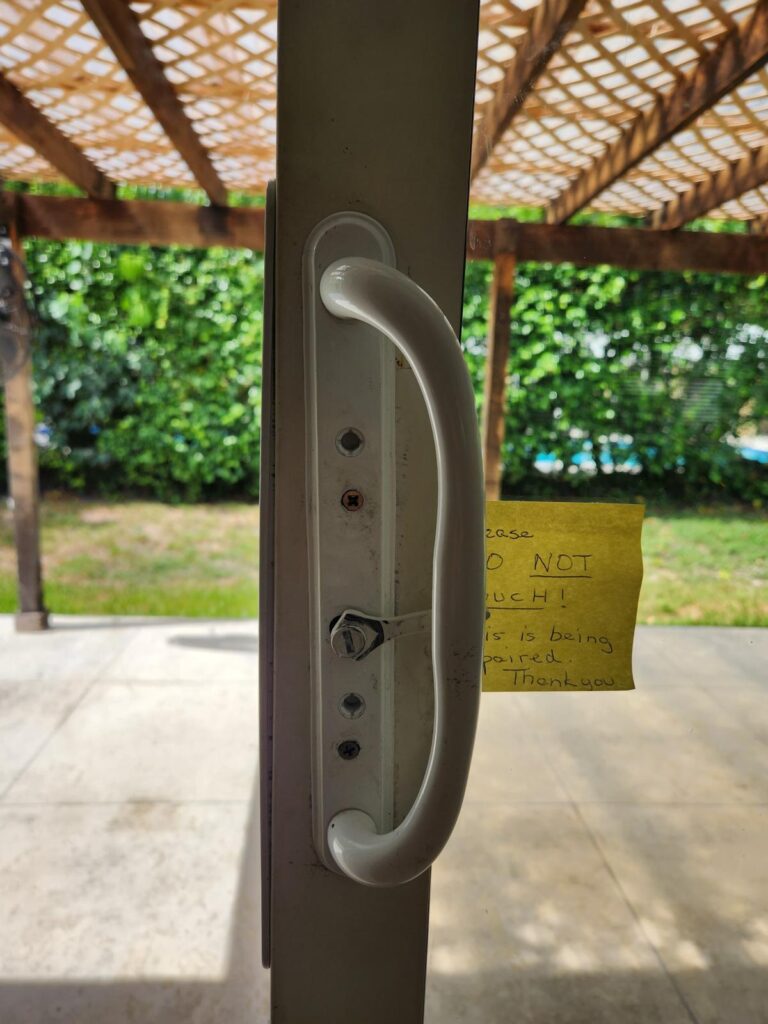
Are Sliding Glass Door Rollers Universal?
The short answer is no — and understanding exactly why can save you from a costly installation mistake. Here's what actually varies between rollers and how to find the right one for your door.
- Why Rollers Are Not Universal
- The Five Specs That Vary Between Rollers
- Aluminum vs. Vinyl Frame Rollers
- Brand-Specific Roller Systems
- Standard vs. Impact-Rated Rollers
- What Happens When You Install the Wrong Roller
- How to Find the Right Roller for Your Door
- Getting the Right Part in Bonita Springs and Southwest Florida
- Frequently Asked Questions
Walk into a hardware store looking for sliding door rollers and you'll find a wall of options that all look roughly the same — small wheel-and-housing assemblies in various sizes with no obvious way to tell which one goes with which door. This visual similarity is what leads most homeowners to assume they're interchangeable. They are not. Sliding glass door rollers vary across at least five distinct specifications, and getting any one of them wrong causes problems that range from annoying to expensive.
This matters especially in Southwest Florida, where the combination of heavy impact glass, high-salt coastal air, and homes built across four decades of evolving door standards means the range of roller types in active use is wider than almost anywhere else in the country. Whether you're searching for a replacement roller for a home in Bonita Springs, a waterfront condo near the Gulf, or a house built in the 1990s with an older aluminum-frame door, A1 Sliding Doors has the breakdown on what to look for and why it matters.

Rollers that look similar on the surface can have completely different specs underneath — wheel diameter, housing shape, and axle type all vary by brand and model.
Why Rollers Are Not Universal
The assumption that sliding door rollers are universal comes from the fact that they all do the same basic job — a wheel on an axle inside a housing that rolls along a track. But that surface-level similarity conceals significant variation in the engineering details that determine whether a roller will work correctly in a specific door.
Door manufacturers don't use a standardized roller specification for a simple commercial reason: they want their door systems to use their own components. Proprietary roller designs mean replacement parts come from authorized channels, ensure the roller is matched to the door's weight rating and track geometry, and allow manufacturers to maintain quality control over the full system. The result is a market where the same apparent function — a rolling wheel in a housing — comes in dozens of variations that are not interchangeable across brands or even across model lines within the same brand.
Beyond manufacturer specifications, the range of door types in South Florida adds further complexity. Standard residential glass, impact laminated glass, aluminum frames, vinyl frames, single-wheel rollers, tandem rollers, adjustable rollers, fixed rollers — each combination requires a specific component. Understanding the five main variables that differ between rollers is the foundation for getting the replacement right.
The Five Specs That Vary Between Rollers
The outer diameter of the rolling wheel. Common sizes run from 3/4 inch (19mm) to 1-1/4 inch (32mm). Even a 1mm difference in diameter changes the door's operating height, affecting seal quality and lock alignment.
The overall height and width of the cartridge body that fits into the door rail cavity. A housing that's too wide won't fit; one that's too narrow rocks in the channel and causes wobble and uneven wear.
The diameter of the hole through the center of the wheel that accepts the axle pin. This determines the bearing size and directly affects the roller's load capacity and rotational smoothness.
Some housings are flat on top; others have a lip, hook, or tab that secures them to the door rail channel. The same wheel diameter in two different housing profiles produces rollers that can't be swapped for each other.
Rollers are rated for specific door panel weights. Standard rollers handle 80 to 150 pounds. Impact glass doors require rollers rated for 150 to 250 pounds. Using an undersized roller under a heavy panel causes premature bearing failure.
Most residential doors use single-wheel rollers. Heavier panels — large impact glass doors, commercial sliders — use tandem (double-wheel) rollers that distribute the load across two contact points. These are never interchangeable.
When removing the old roller for measurement, take photos from multiple angles before pulling it out. The housing orientation, retaining tab position, and profile shape are easy to miss when measuring with calipers but obvious in a photo. Bring both the old roller and the photos when sourcing the replacement.
Aluminum vs. Vinyl Frame Rollers
Frame material is the first and most fundamental split in roller compatibility. Aluminum-frame doors and vinyl-frame doors use completely different roller systems — not just different sizes of the same design, but fundamentally different component architectures.
| Specification | Aluminum Frame Rollers | Vinyl Frame Rollers |
|---|---|---|
| Housing material | Metal (steel or zinc alloy) | Reinforced plastic or nylon |
| Track channel width | Wider profile | Narrower profile |
| Weight capacity | Higher — suited for heavier panels | Lower — lighter door systems |
| Common in South Florida | Pre-2005 construction, coastal homes | Post-2005 newer builds, inland communities |
| Interchangeable? | No — never interchangeable | |
Installing aluminum-spec rollers in a vinyl frame door places a metal housing against plastic rail walls that weren't designed to handle the contact pressure. Over time this cracks the rail channel from the inside — damage that isn't visible from the outside until the door begins to derail. Installing vinyl rollers in an aluminum frame provides insufficient structural support for the panel weight and will fail within months under normal use.
Brand-Specific Roller Systems
Even within the same frame material category, major door manufacturers use proprietary roller designs that differ from the general market and from each other. Knowing your door brand is often the fastest path to the correct roller.
PGT (PGT Innovations)
One of the most common door brands in Southwest Florida — PGT has manufactured sliding glass doors in Venice, Florida since the 1980s and supplies a large percentage of the residential door market across Collier and Lee counties. PGT uses proprietary roller cartridges with specific housing geometries that differ across their WinGuard, Eze-Breeze, and standard residential product lines. A PGT WinGuard impact roller is not interchangeable with a PGT standard residential roller even if the wheel diameter looks the same.
CGI (CGI Windows & Doors)
CGI is another widely installed brand in South Florida's hurricane-zone market, particularly in impact-rated door systems. CGI uses tandem roller assemblies on their heavier door lines, and the cartridge housing design is proprietary to their track profile. Cross-brand substitution with PGT or Milgard parts will not produce a correct fit.
Milgard, Andersen, Simonton
These national brands each maintain their own roller specifications. Milgard in particular has undergone several product line changes since their acquisition by JELD-WEN, meaning that rollers for older Milgard doors may require cross-referencing to find current equivalent parts. An experienced sliding door technician maintains cross-reference knowledge for these transitions; a hardware store employee typically does not.
Generic and Older Doors
Many homes in Southwest Florida — particularly those built in the 1980s and early 1990s — have sliding doors from manufacturers that no longer exist or whose brand identity has been absorbed into larger companies. For these doors, identification relies on direct measurement of the existing roller rather than brand lookup. This is where having a technician who carries a broad inventory of roller types becomes genuinely valuable.
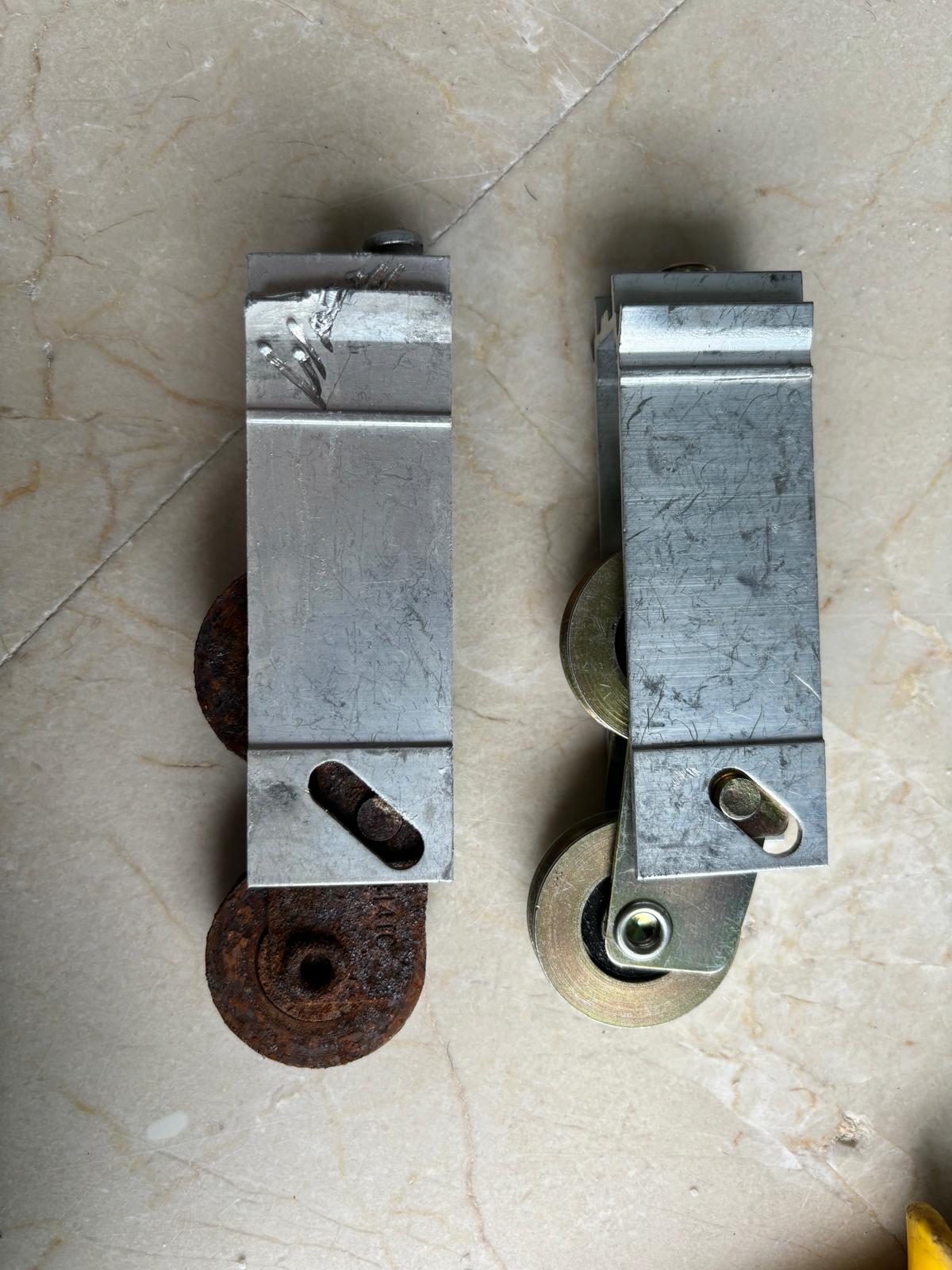
Removing the old roller for identification — housing shape and dimensions tell the full story.

Correct replacement matched to the door's exact specs — ready for installation.
Standard vs. Impact-Rated Rollers
This distinction is critical for Southwest Florida homeowners and one that's easy to overlook when ordering parts online. The Florida Building Code designates much of Collier and Lee County as a High Velocity Hurricane Zone (HVHZ), which means that impact-rated door openings must maintain their certified performance specifications — including the components that support the glass panel.
Impact-rated rollers are engineered to higher tolerances than standard residential rollers, load-tested for the heavier panel weights that come with laminated impact glass, and certified to perform under the dynamic pressure loads of a hurricane event. Standard residential rollers are not rated for any of this. Installing standard rollers under a certified impact door panel is a building code violation, voids the door's impact certification, and may affect homeowners insurance claims for storm damage.
If your home has impact-rated sliding doors — which is the standard for most post-2005 construction in Collier and Lee County — confirm that any replacement rollers carry the appropriate Florida Product Approval (FPA) rating for your door system. A reputable sliding door technician will provide documentation of the roller specification and approval number on request.
Not Sure Which Roller Your Door Needs?
We carry rollers for every major door brand installed across Bonita Springs, Naples, Fort Lauderdale, Pompano Beach, and all of South Florida. One call and we'll identify the right part and have your door working the same day.
What Happens When You Install the Wrong Roller
Understanding the consequences makes the importance of correct part identification concrete rather than abstract. Here's what actually happens when a close-but-wrong roller gets installed.
- Wrong wheel diameter: The door sits at the wrong height. A roller 1mm too small drops the door enough that the latch misses the strike plate. A roller 1mm too large pushes the door into the header, causing binding at the top of the frame on every open-close cycle.
- Wrong housing width: A housing that's too narrow rocks in the rail channel, causing the door to shimmy laterally during operation. This rocks the axle back and forth with each cycle and causes premature bearing failure — typically within one to two years rather than ten to fifteen.
- Wrong weight rating: An undersized roller under a heavy impact glass panel compresses the ball bearings unevenly on every cycle. The bearing race develops flat spots and rough patches, the roller loses smooth rotation, and the door becomes progressively stiffer until the roller fails entirely — far ahead of its rated service life.
- Wrong frame type: As described above, cross-installing aluminum and vinyl rollers damages the rail channel of the receiving frame type, often invisibly until the door derails or the rail cracks.
How to Find the Right Roller for Your Door
There are three reliable methods for identifying the correct roller, in order of preference.
Method 1 — Manufacturer Identification
Check the door frame for a manufacturer stamp, model number, or sticker (bottom rail, header, or door stile edge). If you can identify the brand and model, a sliding door parts supplier or specialist technician can cross-reference the correct roller directly. This is the fastest and most reliable method when the information is available.
Method 2 — Direct Measurement
Remove one roller cartridge from the door and measure the wheel outer diameter, housing height and width, and axle hole diameter. Note whether it has one or two wheels and photograph the housing shape from multiple angles. Bring the old roller and these measurements to a specialist. Our earlier guide on sliding door roller replacement covers the full measurement process in detail.
Method 3 — Professional Identification
Call a local sliding door technician and have them identify the roller on-site. An experienced technician serving Southwest Florida will recognize the door brand and model on sight in most cases and carry the correct replacement in their vehicle. This is the most efficient approach for older or unbranded doors where manufacturer information isn't available and measurement alone doesn't produce a clear match.
Getting the Right Part in Bonita Springs and Southwest Florida
For homeowners in Bonita Springs and the surrounding Southwest Florida communities, the local door inventory skews heavily toward PGT and CGI impact systems installed since the mid-2000s, alongside a large stock of older aluminum-frame doors in communities that were built out in the 1980s and 1990s along Bonita Beach Road, Imperial Parkway, and the Estero corridor. Both categories require brand-specific rollers, and both are well outside the range of what a general hardware store keeps on the shelf.
The practical implication is that sourcing the correct roller locally — rather than ordering online based on approximate measurements — is almost always faster and more reliable in this market. A specialist who services Bonita Springs and Lee County regularly will have the right part on the truck, complete the identification and installation in a single visit, and back the work with a warranty. If you're ready to stop guessing and get the right roller installed correctly, get a free estimate and we'll have it handled same day.
Get the Exact Right Roller — Installed Right
Serving Bonita Springs, Naples, Marco Island, Fort Lauderdale, Pompano Beach, and all of South Florida. Same-day service, flat-rate pricing, warranty on every job.
Frequently Asked Questions
No. Sliding glass door rollers vary by wheel diameter, housing size, axle type, frame material compatibility, and weight rating. A roller that looks similar to the original but isn't an exact match will cause the door to sit at the wrong height, bind against the frame, or damage the track. Always match the replacement to your specific door brand and model.
No. Wheel diameters range from approximately 3/4 inch to 1-1/4 inch across different door brands and models. Housing height, width, and axle hole diameter also vary. Two rollers with the same wheel diameter can have completely different housing shapes that make them incompatible with each other's door systems.
No. You need a roller that matches your door's manufacturer specifications — including wheel diameter, housing dimensions, frame material type, and weight rating. Using an unmatched roller causes binding, track damage, lock misalignment, and premature failure of the new roller.
Aluminum frame doors use metal-housing rollers with wider profiles built to support heavier glass panels. Vinyl frame doors use plastic-housing rollers sized for narrower rail grooves. They are not interchangeable — installing the wrong type can crack the rail channel or provide insufficient support for the panel weight.
Yes. Major manufacturers like PGT, CGI, and Milgard use proprietary roller cartridge designs that only fit their own systems. Roller quality also varies — cheap generic rollers use lower-grade bearings that fail much faster in South Florida's salt air and humidity, even when they fit correctly.
A close-but-wrong roller causes the door to sit at the wrong height, making the lock misalign and creating uneven frame gaps. It puts abnormal stress on the track, gouges the channel over time, and accelerates wear on the new roller. In the worst case it causes the door to derail entirely.