How Do Burglars Break In Through Sliding Doors?
Understanding exactly how sliding doors are bypassed is the fastest path to knowing which security upgrades actually matter — and which ones are security theater.
- Why Sliding Doors Are a Primary Target
- Method 1 — Defeating the Latch Lock
- Method 2 — Lifting the Door Off the Track
- Method 3 — Breaking the Glass
- Method 4 — Shimming the Latch
- Method 5 — Exploiting a Worn or Corroded Lock
- Method 6 — Screen Door Bypass
- Countermeasures That Work
- Sliding Door Security in Pompano Beach
- Frequently Asked Questions
Sliding glass doors are the entry point of choice for a significant portion of residential burglaries in Florida — not because they're structurally weak, but because most homeowners secure them with the factory latch alone, which experienced intruders can defeat in under a minute. Knowing how this is done isn't alarming — it's actionable. Each vulnerability has a specific countermeasure that eliminates it, and most of those countermeasures cost between $20 and $100.
This guide covers every realistic method used to bypass sliding doors, the specific physical mechanism being exploited in each case, and the countermeasure that addresses it. For sliding door lock installation and security upgrades across South Florida, same-day service is available.

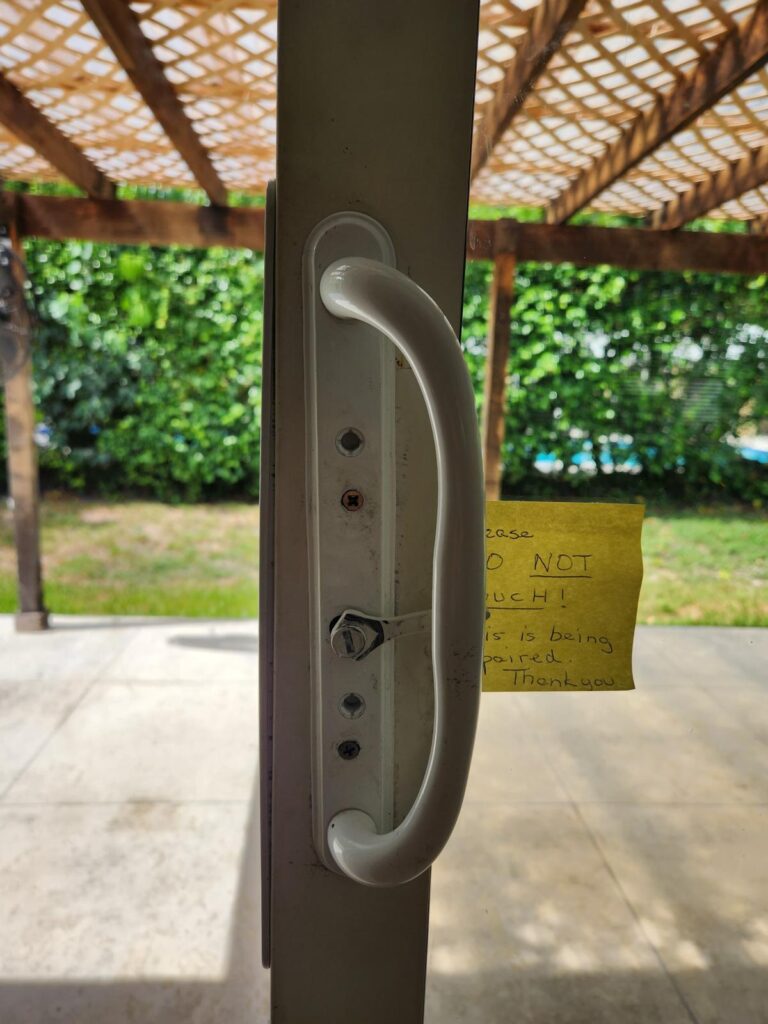
A standard factory latch — the first and most commonly exploited vulnerability on any sliding glass door.
Why Sliding Doors Are a Primary Target
Several factors combine to make sliding doors an attractive entry point for intruders. First, they typically face a private outdoor space — a pool deck, screened lanai, or backyard — that's shielded from street view, giving an intruder time to work without being observed. Second, the factory latch is the only security device on the majority of residential sliding doors in South Florida, and it's a relatively simple mechanism. Third, the door's horizontal sliding mechanism creates specific vulnerabilities — notably the ability to lift the panel — that swinging doors don't share. Fourth, many South Florida homes have sliding doors as the primary everyday access point between the interior and the pool or patio, meaning the door is opened many times daily and the lock gets significant wear.
In Pompano Beach, where a large portion of properties back onto private pool decks and screened enclosures along the Federal Highway corridor and Intracoastal waterfront, the private-access problem is particularly relevant. A sliding door on the pool side of a Pompano Beach home is often the least visible entry point on the property.
Method 1 — Defeating the Latch Lock
The standard sliding door latch engages a hook or bolt into a strike plate on the door frame. From the outside, an intruder can insert a thin, rigid tool — a flathead screwdriver, a slim jim, or a purpose-made shim — into the gap between the door panel and the frame at the latch location. By applying upward pressure against the latch hook while simultaneously pushing the door panel, the latch disengages and the door slides open.
This technique works on the majority of factory latches installed before 2010 and on many current-model doors because the gap between the panel and frame is wide enough to accept a thin tool. It requires no special skills — videos demonstrating the technique are widely available online, which means it's accessible to opportunistic burglars with minimal preparation.
Method 2 — Lifting the Door Off the Track
A sliding glass door panel is removed from its track by the same process a homeowner uses for maintenance — tilt the bottom toward you and lift upward. From the exterior, if the door panel isn't prevented from upward movement, an intruder can replicate this process: tilt the bottom of the panel toward the exterior and lift the panel out of the track entirely, bypassing every horizontal sliding lock in the process.
This vulnerability exists when the header track's anti-lift pin is missing, worn down, or was never present. Anti-lift pins are small tabs or screws in the header track channel that limit how far the door panel can be raised. When they fail — which happens gradually through wear, or never existed in older door systems — the door can be lifted free from the outside.
To test whether your door can be lifted: open the door panel partway, then try to lift the bottom of the panel upward while it's in the open position. It should stop after less than half an inch of upward travel. If it lifts further — or lifts out of the track entirely — the anti-lift protection is missing or has failed.
Method 3 — Breaking the Glass
Standard tempered glass — which shatters into small, relatively harmless pieces — breaks with significant noise and creates a distinctive sound that carries clearly in a quiet neighborhood. Most opportunistic burglars avoid it because the noise exposure risk is high. However, a determined intruder with more time or in a less-observed location may break the glass, particularly on a rear-facing door sheltered by a screened lanai or privacy hedge.
Impact-resistant laminated glass — increasingly standard in South Florida impact door systems — is a completely different proposition. Impact glass is designed to absorb repeated blows without breaking through, requiring sustained attack with specialized tools that creates significant noise and time exposure. For practical purposes, impact glass eliminates the glass-breaking entry method.
Method 4 — Shimming the Latch
Shimming is a variant of latch defeat that works specifically on hook-style latches. Rather than pushing the latch hook down to disengage it, the intruder inserts a thin flexible shim — a credit card-width strip of plastic or metal — between the door panel and the strike plate area and slides it downward until it presses against the latch hook, pushing it backward into the door and releasing the engagement. This technique is quieter than mechanical latch defeat methods and works on a range of latch designs.
Older doors with larger gaps between the panel and frame — common in Pompano Beach homes built in the 1980s and 1990s along the Atlantic Boulevard corridor — are more susceptible to shimming because the tool entry gap is wider. Doors with tighter frame tolerances and heavier-duty latch mechanisms resist shimming better.
Method 5 — Exploiting a Worn or Corroded Lock
In South Florida's salt air environment, sliding door lock hardware deteriorates significantly faster than in most of the country. Zinc die-cast housings corrode. Steel latch hooks rust and lose their engagement depth. Spring mechanisms weaken and allow the latch to disengage under relatively light pressure. A lock that appears functional from the inside — the handle turns, the latch appears to engage — may provide no actual security because the mechanism has corroded to the point where it yields under minimal force.
This is a particularly insidious vulnerability because homeowners don't know the lock has degraded until either the door fails to secure during a test or an intruder exploits it. Properties near the Pompano Beach Pier, along the Intracoastal, or in oceanfront communities along A1A are in the highest-corrosion-risk zone for lock hardware degradation.

Corroded lock housing — this mechanism provides minimal actual security despite appearing functional.
New lock with proper latch engagement — the correct replacement for a corroded mechanism.
Method 6 — Screen Door Bypass
Many South Florida homeowners feel that having a screen door as the outermost layer provides some security. It doesn't. A screen door is not a security device — the screen can be cut, the frame can be lifted off its track, and the latch mechanism provides essentially no resistance. An intruder who has cleared the screen door faces the main door latch as the first real security challenge.
The screen door does create a slight time delay and adds a layer of awareness — someone cutting a screen makes noise and is more visible than someone simply working a latch. But it should never be considered a primary or even supplemental security device.
Ready to Close These Vulnerabilities?
Same-day sliding door lock installation, replacement, and security upgrades across Pompano Beach, Fort Lauderdale, Boca Raton, and all of South Florida.
Countermeasures That Work
Now that each vulnerability is clear, here's the priority order for addressing them — from highest-impact to lowest cost per security gain.
Priority 1 — Add a Secondary Mechanical Lock
A Charlie bar, foot bolt, or pin lock eliminates Methods 1 and 4 completely. The latch can be defeated and the door still won't open. Cost: $20 to $80. This is the single highest-return security upgrade available for a sliding door.
Priority 2 — Check and Fix the Anti-Lift Protection
Test whether your door can be lifted off the track as described above. If it can, install a loop lock or have the anti-lift pin in the header track checked and replaced. Eliminates Method 2 completely. Cost: $15 to $40.
Priority 3 — Inspect and Replace a Corroded Lock
If the door is more than 5 to 7 years old in a coastal location, have the lock mechanism tested. A corroded lock that yields under light pressure should be replaced with a marine-grade equivalent. Eliminates Method 5. Cost: $40 to $150 installed.
Priority 4 — Security Film or Impact Glass
For non-impact doors, security film adds meaningful resistance to Method 3. For properties planning any upgrade, impact glass eliminates it entirely. Security film: $200 to $500 professionally installed. Impact door replacement: $1,500 to $3,500+.
Priority 5 — Physical Deterrents and Visibility
Adequate exterior lighting at the pool or patio level, visible security system signage, and clear sightlines from the street or neighbors to the door area all reduce the attractiveness of the door as an entry point by increasing intruder exposure risk. These don't eliminate vulnerabilities but they change the risk calculation for an opportunistic burglar.
Sliding Door Security in Pompano Beach
Pompano Beach's property mix creates several specific contexts where sliding door security deserves particular attention. Condominiums along the Pompano Beach Pier corridor and the Atlantic shoreline have ground-floor and first-floor units whose patio-facing sliding doors are accessible from shared pool decks — a semi-public space that provides cover for latch-defeat attempts. Single-family homes in the Lighthouse Point area and along the Hillsboro Inlet, many of which back onto canals or waterways, have pool-side sliding doors that face largely private outdoor spaces with minimal street visibility.
For all of these property types, the combination of a functioning keyed latch, a secondary mechanical lock, and a verified anti-lift mechanism covers the three most common entry methods. For properties with older doors showing lock corrosion, a lock replacement with marine-grade hardware is the most impactful single improvement available. Our sliding door lock service covers assessment, replacement, and secondary lock installation across the full Pompano Beach area — get a free estimate and we'll assess your specific door's vulnerabilities on the same visit.
Don't Wait Until It's Too Late
Same-day lock assessment and security upgrades across Pompano Beach, Fort Lauderdale, Deerfield Beach, Boca Raton, and all of South Florida. Free estimates, warranty on every job.
Frequently Asked Questions
The most common methods are defeating the latch lock with a screwdriver or shim, lifting the door panel off the track by exploiting a missing anti-lift pin, breaking the glass, and exploiting worn or corroded lock mechanisms. Each method has a specific countermeasure — adding a secondary lock and checking the anti-lift protection addresses the two most common vulnerabilities.
A sliding door with only the factory latch can be defeated by an experienced intruder in under 60 seconds. Adding a secondary mechanical lock raises the time and effort required significantly. Adding impact glass eliminates the glass-breaking entry method entirely.
Yes, if the anti-lift pin in the header track is missing or worn. The door panel can be tilted and lifted out of the track from the exterior, bypassing all sliding locks. A loop lock or functioning anti-lift pin eliminates this vulnerability.
Yes. A properly deployed Charlie bar provides strong mechanical resistance that prevents the door from sliding even if the latch is defeated. It can't be picked, shimmed, or bypassed with basic tools and is one of the most effective and affordable secondary security devices available.
Less often than most homeowners assume. Standard tempered glass breaks noisily and draws attention. Impact laminated glass is extremely difficult to break quickly. Most residential burglars prefer to exploit locking mechanism weaknesses rather than break glass.
The most vulnerable is one with only the factory latch, a missing or worn anti-lift pin, standard non-impact glass, and a partially obscured location facing a private pool deck or screened lanai. Adding a secondary lock and verifying the anti-lift mechanism are the two highest-priority improvements.