What Are the Types of Sliding Locks?
A complete reference guide to every sliding door lock type — how each one works, what it's best for, and how they work together for layered security in South Florida homes.
- Why Understanding Lock Types Matters
- Type 1 — Factory Latch Lock
- Type 2 — Keyed Patio Deadbolt
- Type 3 — Foot Bolt
- Type 4 — Charlie Bar (Security Bar)
- Type 5 — Loop Lock (Anti-Lift Device)
- Type 6 — Pin Lock (Frame Pin)
- Type 7 — Smart and Electronic Locks
- Full Comparison — All Types Side by Side
- Best Lock Combinations by Situation
- Lock Types in Context — Naples and Collier County
- Frequently Asked Questions
Sliding door locks aren't a single category — they're a family of seven distinct device types, each addressing a specific vulnerability and operating through a different mechanical principle. Understanding all of them is the starting point for making informed decisions about what your door actually needs, because the best security outcome almost always involves combining two or three types rather than relying on any single lock.
This guide covers every sliding door lock type in detail — how it works, what it secures against, its strengths and limitations, and where it fits in a layered security approach for South Florida homes. For professional sliding door lock installation across the region, same-day service is available.

A properly secured sliding door uses a primary lock plus at least one secondary device from the seven types covered in this guide.
Why Understanding Lock Types Matters
The factory latch that comes standard on virtually every residential sliding door in South Florida is one of seven lock types available — and it's the weakest one. Most homeowners secure their sliding door with only this single device, leaving five or six other options unused that could significantly raise the difficulty and time required for forced entry.
Each lock type addresses the sliding door security problem from a different angle. Some prevent horizontal sliding. Some prevent vertical lifting. Some require a key to defeat. Some require no installation at all. Understanding what each one does makes it straightforward to identify which gaps exist in your current setup and which combination of types closes them. For Naples homeowners managing seasonal vacancy and Gulf Coast salt air, that combination looks different than for a year-round family home in an inland Collier County community.
Type 1 — Factory Latch Lock
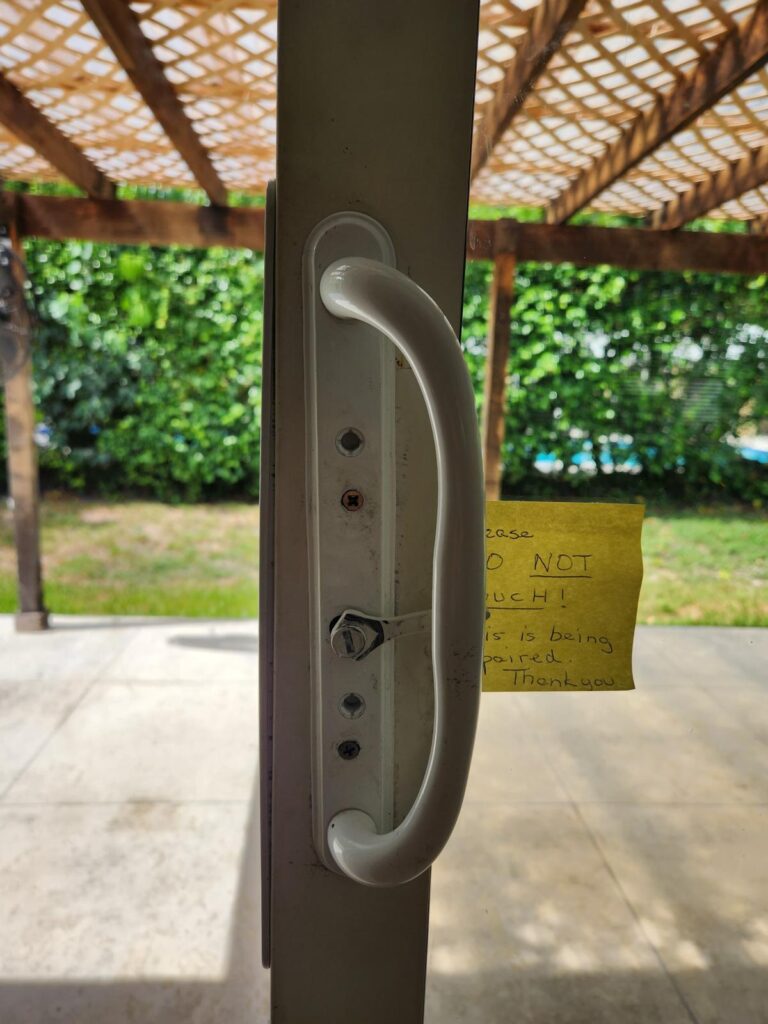
The factory latch is a spring-loaded hook mechanism integrated into the door's handle assembly. When the handle is turned or lifted, the hook extends into a strike plate on the door frame. It engages automatically as the door slides to the closed position on most designs — no deliberate locking action required.
The latch serves primarily as a closure device — it keeps the door in the closed position against wind pressure and incidental contact. As a security device it has significant limitations: the gap between the door panel and frame is wide enough on most doors to accept a thin tool that can depress or disengage the hook, and the hook's shallow engagement depth means it provides limited resistance to forced lateral movement.
In South Florida's coastal environment, the zinc die-cast housing and mild steel hook on most factory latches begin corroding within 5 to 7 years, progressively reducing the already modest security the mechanism provides. Coastal properties near Naples' Vanderbilt Beach or the Gulf Shore Boulevard corridor should inspect latch function annually once the door reaches 5 years of age.
Type 2 — Keyed Patio Deadbolt
A keyed patio deadbolt replaces or supplements the standard latch with a cylinder lock mechanism — the same principle as a front door deadbolt but designed for the sliding door format. The bolt extends horizontally into the door frame strike plate and requires a key to retract from the outside. The interior side typically uses a thumb-turn for keyless exit, as required by the Florida Building Code for emergency egress.
The key distinction from the factory latch is that the deadbolt's bolt cannot be shimmed or depressed with a tool — it requires the correct key to retract. Combined with deeper bolt engagement into a reinforced strike plate, a keyed deadbolt provides meaningfully stronger resistance than any spring-latch design. For any sliding door that serves as a primary entry or exit point, a keyed deadbolt is the appropriate primary lock specification.
For Naples coastal properties, specify 304 or 316 stainless steel cylinder and bolt. Standard brass and zinc cylinders corrode in Gulf Coast salt air within 3 to 5 years, making the lock progressively harder to operate and reducing its security effectiveness simultaneously.
Keyed patio deadbolt — a significant security upgrade over the standard spring latch.

Latch and strike plate — the engagement depth and bolt hardness are the key security variables.
Type 3 — Foot Bolt
A foot bolt is mounted at the bottom of the sliding door frame and drops a bolt vertically into a receiver set in the threshold when engaged. Unlike horizontal sliding locks, the foot bolt locks the door against both sliding movement and vertical lifting simultaneously — two vulnerabilities with one device.
The operating mechanism is a lever that the user kicks down with a toe to engage and lifts with a foot to release. No bending required, which makes it the fastest secondary lock to deploy in daily use. For pool-access doors in Naples waterfront communities — doors that may be cycled 10 to 15 times a day during the Gulf Coast summer season — the foot bolt's speed advantage over the Charlie bar is significant. Wet feet, hands full, kids running through: the toe-kick operation works in all of these situations.
The threshold receiver requires drilling during installation but the mechanism itself is typically marine-grade compatible and holds up well in coastal conditions when specified in stainless steel.
Type 4 — Charlie Bar (Security Bar)
The Charlie bar is a horizontal metal bar that sits in a bracket mounted on the door frame and braces across the width of the door panel when deployed, preventing the door from sliding regardless of the condition of any other lock on the door. The bracket is screwed into the frame; the bar pivots up out of the way when the door needs to open and drops back into position to secure it.
The Charlie bar operates on pure mechanical resistance — it cannot be picked, shimmed, or electronically bypassed. An intruder who defeats the latch, overcomes the deadbolt, and breaks the frame pin still cannot open a door with a properly deployed Charlie bar without physically destroying the bar or its bracket mounting. This is the highest mechanical resistance available in the secondary lock category.
For seasonally vacant homes in Naples communities like Pelican Bay, Port Royal, and Mediterra, the Charlie bar is the priority secondary device. It requires no power, no connectivity, no battery — it simply sits in position for the duration of the unoccupied period and provides resistance that no remote access or power-related failure can compromise.
A cut-down wooden dowel or broom handle placed in the track channel works on the same principle as a Charlie bar and costs almost nothing. The limitation is that it requires bending to deploy and can shift if the door is shaken forcefully. A properly installed Charlie bar bracket eliminates both of these limitations and is the preferred solution for any property where security is a genuine priority.
Type 5 — Loop Lock (Anti-Lift Device)
The loop lock addresses a vulnerability that no horizontal sliding lock can cover: the ability to remove the door panel entirely by lifting it off the track. A door panel is installed and removed using the same process — tilt the bottom toward you and lift upward. If the header track doesn't prevent this upward movement, every sliding lock on the door can be bypassed in one motion.
The loop lock is a bracket or hook device mounted in the header track that limits how far the door panel can be raised. With a loop lock in place, the door panel cannot be lifted far enough to clear the bottom track, regardless of what happens with the horizontal locks. It's the only lock type that specifically addresses the lift-off entry method.
Many South Florida doors installed before 2005 don't have this protection — either because the anti-lift pin in the header was never installed or because it has worn down over years of operation. The test is simple: with the door open, try to lift the bottom of the panel. If it raises more than half an inch, the anti-lift protection is insufficient.
Type 6 — Pin Lock (Frame Pin)
A pin lock involves drilling a downward-angled hole through the inner door frame at the point where it overlaps the outer frame when the door is closed, and inserting a hardened steel pin or bolt. With the pin in place, the inner frame cannot slide past the outer frame because the pin bridges the two and prevents relative movement.
The pin lock is the lowest-cost security addition available — a hardened steel bolt costs a few dollars and the installation requires only a drill and the correct bit. The resistance it provides is surprisingly strong: defeating it from the outside requires either removing the pin (which requires interior access) or shearing the pin (which requires significant force and creates noise).
Its primary limitation is user discipline — the pin must be deliberately inserted each time, and leaving it out negates the security entirely. For this reason it works best as a third layer in a combination rather than as a primary or sole secondary device.
Type 7 — Smart and Electronic Locks
Smart and electronic locks for sliding doors include keypad-operated deadbolts, app-controlled locking mechanisms, Bluetooth or Z-wave enabled handles, and door sensor systems that detect opening and alert the homeowner remotely. They address the primary lock function (access control) plus add monitoring capability that purely mechanical locks can't provide.
For short-term rental properties in Naples — Airbnb and VRBO listings in communities from Old Naples to Lely Resort — keypad locks eliminate the physical key management problem across multiple guest changeovers and allow the owner to change access codes between bookings without a site visit. The remote notification capability means any door opening generates an immediate alert regardless of where the owner is.
The critical limitation for South Florida coastal properties is power and connectivity dependency. A smart lock with a dead battery, a connectivity outage, or a power failure provides no security at those moments. Any smart lock installation should include a mechanical backup — at minimum a Charlie bar that functions independently. Additionally, choose only outdoor-rated or marine-rated electronic components for any installation within 500 feet of saltwater.
Need Any of These Lock Types Installed?
Same-day sliding door lock service across Naples, Marco Island, Bonita Springs, and all of Southwest and South Florida. Free estimates, warranty on every job.
Full Comparison — All Types Side by Side
| Lock Type | Prevents Sliding | Prevents Lifting | Requires Key | Works Without Power | Cost |
|---|---|---|---|---|---|
| Factory Latch | Partially | No | No | Yes | Included |
| Keyed Deadbolt | Yes | No | Yes | Yes | $40–$150 |
| Foot Bolt | Yes | Yes | No | Yes | $25–$75 |
| Charlie Bar | Yes | No | No | Yes | $30–$80 |
| Loop Lock | No | Yes | No | Yes | $15–$40 |
| Pin Lock | Yes | No | No | Yes | Under $10 |
| Smart Lock | Yes | No | Optional | No | $80–$300+ |
Notice that no single lock type in the table above checks all five columns. The only way to prevent both sliding and lifting, require a key, and work without power is to combine at least two types — typically a keyed deadbolt plus a foot bolt or loop lock. This is why layered security is the consistent recommendation from both security professionals and law enforcement crime prevention programs.
Best Lock Combinations by Situation
For a High-Frequency Daily-Use Door
Keyed patio deadbolt (Type 2) + foot bolt (Type 3) + loop lock (Type 5). The deadbolt provides strong primary security, the foot bolt is fast enough for daily cycling, and the loop lock closes the lift-off vulnerability.
For a Seasonally Vacant Naples Home
Keyed patio deadbolt (Type 2) + Charlie bar (Type 4) + loop lock (Type 5). The Charlie bar provides the strongest mechanical resistance for unoccupied periods without any dependency on power or batteries. The loop lock ensures the door can't be lifted free regardless of the other locks.
For a Rental Property
Smart keypad lock (Type 7) + Charlie bar (Type 4) as guest overnight security + loop lock (Type 5). The keypad manages guest access efficiently; the Charlie bar provides backup mechanical security that guests can deploy without technical knowledge.
Budget Build — Maximum Security Per Dollar
Factory latch (Type 1, already present) + pin lock (Type 6, under $10) + track rod or cut dowel as temporary Charlie bar alternative. Total cost under $15, covers both the sliding vulnerability and adds a basic anti-shim layer at the latch point.
Lock Types in Context — Naples and Collier County
The lock type combination that makes the most sense for a Naples property depends heavily on which of the city's distinct residential profiles the home falls into. A waterfront single-family home in Port Royal or Aqualane Shores has different requirements than a seasonal condo near Crayton Cove or Tin City, and both differ from a year-round occupied home in an inland North Naples community.
For the waterfront and near-waterfront properties along Naples' Gulf Shore Boulevard and the Vanderbilt Beach corridor, every lock type in the combination needs to be marine-grade specified. Salt air degradation is the dominant failure mode for any standard hardware within a mile of the Gulf, and a corroded lock of any type provides far less security than its design specification. Type 2 (keyed deadbolt) and Type 5 (loop lock) hardware should specifically call out 316 stainless steel components at these locations.
For the seasonal-vacancy profile that represents a significant portion of Collier County's residential inventory, Type 4 (Charlie bar) is non-negotiable as the secondary device. A property that sits empty from May through October needs a lock that functions through power outages, connectivity failures, and battery depletion — the Charlie bar's purely mechanical operation addresses all of these scenarios simultaneously. If you're ready to install the right combination for your specific Naples property, our sliding door lock service covers assessment and installation in a single same-day visit. Schedule a free estimate today.
Know the Type — Now Get It Installed Right
Serving Naples, Marco Island, Bonita Springs, Fort Lauderdale, Pompano Beach, and all of South Florida. Same-day lock installation, free estimates, warranty on every job.
Frequently Asked Questions
The seven main types are: the factory latch lock, keyed patio deadbolt, foot bolt, Charlie bar, loop lock (anti-lift device), pin lock, and smart electronic locks. Most South Florida homeowners benefit from combining two or three types — no single lock type addresses all sliding door vulnerabilities on its own.
A standard latch uses a spring-loaded hook that engages automatically. A deadbolt uses a bolt that must be deliberately turned and cannot be depressed without the key — it can't be shimmed or tool-manipulated the way a spring latch can. For sliding doors, a keyed patio deadbolt provides meaningfully stronger resistance than the standard hook latch.
A foot bolt mounts at the bottom of the door frame and drops a bolt vertically into the threshold when engaged by a toe kick. It prevents both horizontal sliding and vertical lifting simultaneously, and its toe-operated mechanism makes it the fastest secondary lock to deploy for high-frequency daily-use doors.
A loop lock mounts in the header track and prevents the door panel from being lifted upward out of the track. It specifically addresses the lift-off vulnerability — the ability to remove the door panel entirely, bypassing all horizontal sliding locks. It's one of the most overlooked but most important security additions for any sliding door.
The Charlie bar is the best secondary lock for Naples vacation homes with extended vacant periods — it provides strong mechanical resistance without relying on power or batteries. Combined with a marine-grade keyed primary latch and a loop lock anti-lift device, this combination secures the door through months of unoccupied periods without any maintenance or monitoring requirement.
Yes — and it's exactly what security professionals recommend. A primary lock handles the main closure function. A secondary lock provides an independent second barrier. A loop lock addresses the lift-off vulnerability separately. All three operate independently, so defeating one doesn't help with the others.