What Door Locks Do Police Recommend for Sliding Glass Doors?
Law enforcement crime prevention programs are consistent on this — here's exactly what they recommend, why it works, and how it applies to homes in Naples and Collier County.
- What Law Enforcement Actually Recommends
- The CPTED Framework — How Police Think About Door Security
- Recommendation 1 — Secondary Mechanical Lock
- Recommendation 2 — Anti-Lift Device
- Recommendation 3 — Keyed Primary Lock
- Recommendation 4 — Impact or Reinforced Glass
- Recommendation 5 — Exterior Lighting
- What Law Enforcement Says Doesn't Work
- The Right Priority Order for Your Budget
- Police Recommendations in Context — Naples and Collier County
- Frequently Asked Questions
Law enforcement crime prevention programs — from local sheriff's offices to the FBI's residential burglary research — are remarkably consistent in what they recommend for sliding glass door security. The recommendations aren't brand-specific or product-driven; they're principles derived from studying how residential break-ins actually happen and what physical barriers stop them. Understanding these principles gives homeowners a framework for evaluating any security product or upgrade against what the evidence shows actually works.
This post translates those law enforcement recommendations into practical action for South Florida homeowners — specifically for properties in Naples and Collier County, where the combination of high property values, seasonal vacancy, and Gulf Coast exposure creates a specific security context. For professional sliding door lock installation that aligns with these recommendations, same-day service is available.

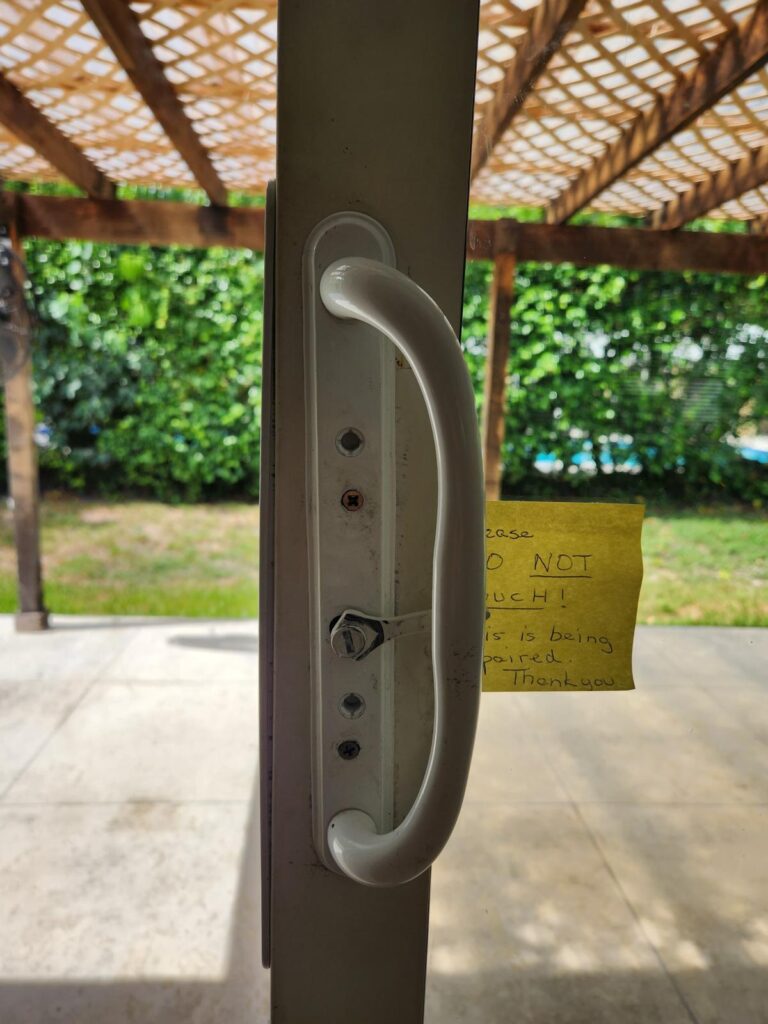
A properly secured sliding door follows the layered security approach that law enforcement crime prevention programs consistently recommend.
What Law Enforcement Actually Recommends
Police crime prevention units — including the Collier County Sheriff's Office, the Broward County Sheriff's Office, and the Florida Department of Law Enforcement — publish residential security guidance that consistently identifies sliding glass doors as one of the primary entry points exploited in residential burglaries. Their recommendations align closely across agencies and are grounded in the same evidence: most residential break-ins are opportunistic, most intruders have limited time, and most abandon an entry attempt when they encounter meaningful resistance.
The core principle across all of these programs is layered security — not a single superior lock, but multiple independent mechanisms that each require a separate defeat. An intruder who bypasses the latch still faces the secondary lock. One who defeats the secondary lock still faces the anti-lift device. The cumulative time and noise required to work through multiple layers is what converts a target from attractive to unattractive.
No law enforcement agency recommends relying solely on the factory latch that comes standard on residential sliding doors. Every crime prevention program that addresses sliding door security specifically identifies the need for at least one additional layer beyond the manufacturer-installed hardware.
The CPTED Framework — How Police Think About Door Security
Crime Prevention Through Environmental Design — CPTED — is the formal framework most law enforcement crime prevention professionals use when assessing residential security. It organizes physical security into three principles that apply directly to sliding doors.
The door should be visible from the street, from neighboring properties, or from a common area — making an intruder working at the door visible to others. A rear-facing pool-side door shielded by fencing, hedges, or a screened enclosure scores poorly on natural surveillance and needs stronger mechanical security to compensate for reduced observer deterrence.
The door should require meaningful effort and time to defeat — multiple independent locking mechanisms, a functional anti-lift device, and glass that resists quick breach. Access control is the mechanical layer of CPTED and the one most directly addressed by lock upgrades.
Lighting, landscaping, and visible security indicators signal that the property is actively occupied and monitored. Timers on interior lights, motion-activated exterior lights, and maintained landscaping all contribute to this signal — particularly important for Naples' significant seasonal-vacancy population during the summer months.
Recommendation 1 — Secondary Mechanical Lock
This is the single most universally emphasized recommendation across all law enforcement crime prevention programs that address sliding doors. A secondary mechanical lock makes the primary latch's defeat irrelevant — the door still can't be opened because a second independent mechanism holds it closed.
Law enforcement specifically favors mechanical locks over electronic ones for this application because they function without power, without batteries, and without network connectivity. In a power outage — not uncommon in Naples during hurricane season — a Charlie bar still works. An electronic device with a dead battery does not.
Recommendation 2 — Anti-Lift Device
Crime prevention programs consistently flag the lift-off vulnerability — the ability to remove the door panel from the track entirely — as a frequently overlooked weakness. All sliding locks are defeated simultaneously when the panel is lifted free, making this a high-priority vulnerability to close.
The fix is quick and inexpensive: test whether the door panel lifts more than half an inch in the open position. If it does, install a loop lock in the header track or have a technician check the anti-lift pin. Either solution takes under 30 minutes and costs $15 to $40.

Secondary lock installation — the first and most impactful recommendation from every law enforcement crime prevention program.

The anti-lift check takes 30 seconds and closes a vulnerability that bypasses all sliding locks simultaneously.
Recommendation 3 — Keyed Primary Lock
Law enforcement recommends replacing the standard hook latch with a keyed patio deadbolt as the primary lock on any sliding door used as a main entry/exit point. A keyed deadbolt requires a key to defeat from the outside — a significantly higher bar than the standard latch, which can be shimmed with common tools.
For coastal Naples properties, specify stainless steel or marine-grade keyed hardware. Standard zinc cylinder locks corrode in Gulf Coast salt air within a few years and provide progressively less security as the mechanism degrades. The cost premium for marine-grade is modest — typically $20 to $40 more — and extends the reliable service interval significantly.
Recommendation 4 — Impact or Reinforced Glass
Law enforcement programs consistently recommend addressing the glass vulnerability — the ability to break the panel and enter without defeating any lock. In South Florida, this recommendation aligns with the Florida Building Code's hurricane protection requirements in High Velocity Hurricane Zones, which makes impact glass a dual-purpose investment covering both security and storm resistance.
For homes not currently planning a door upgrade, professionally installed security film provides meaningful improvement. It holds the glass panel together after impact, requiring sustained attack at the same point rather than a single strike to create an opening. The noise and time required are enough to deter most opportunistic entry attempts.
Recommendation 5 — Exterior Lighting
Every law enforcement crime prevention program that covers residential security includes exterior lighting as a foundational recommendation. For sliding doors facing private outdoor spaces — pool decks, lanais, rear patios — motion-activated lighting eliminates the cover of darkness that makes working at the door lower-risk for an intruder.
The light doesn't need to be blinding — adequate illumination of the door area and approach path is sufficient. A motion sensor that activates when someone steps onto the pool deck or patio area provides the combination of deterrence and alerting that law enforcement programs highlight as most effective.
Install What Law Enforcement Recommends — Today
Same-day sliding door security upgrades across Naples, Marco Island, Bonita Springs, and all of Southwest Florida. Free estimates, warranty on every job.
What Law Enforcement Says Doesn't Work
Crime prevention professionals are equally clear about what provides a false sense of security without meaningful deterrence.
- The factory latch alone. No law enforcement crime prevention program considers the standard sliding door latch sufficient on its own. It is a baseline closure device, not a security device.
- Security stickers and alarm company signs without a functioning alarm. These may provide marginal deterrence for the most casual opportunist but are routinely ignored by more experienced intruders.
- Screen doors as security barriers. A screen door is not a security device. Its frame lifts off the track and its screen can be cut. It delays entry by seconds at most.
- Electronic locks without backup mechanical security. A smart lock with a dead battery provides no security. Any electronic primary lock should be paired with a mechanical secondary device that functions independently of power.
- Visible valuables near the door. While not a lock recommendation, law enforcement programs uniformly note that leaving valuables visible through glass creates the motivation that converts a casual passerby into an intruder. This is particularly relevant for Naples waterfront homes where pool-side living areas are visible from the water.
The most practical test of your sliding door's compliance with law enforcement recommendations is a 60-second self-assessment: Can you insert a credit card at the latch and work it toward the hook? Can you lift the door panel more than half an inch? Can the door be seen from the street or a neighbor's property? Each "yes" is a gap that one of the five recommendations above closes.
The Right Priority Order for Your Budget
If the complete upgrade list isn't possible all at once, law enforcement priority guidance consistently ranks these interventions in the following order.
- First: Secondary mechanical lock ($20 to $80). Highest impact per dollar spent — eliminates the most common entry method immediately.
- Second: Anti-lift device check and fix ($0 to $40). Closes the lift-off vulnerability that bypasses all other locks simultaneously.
- Third: Primary lock upgrade to keyed deadbolt ($40 to $150). Strengthens the first line of defense that an intruder must encounter.
- Fourth: Exterior lighting ($30 to $150). Eliminates cover-of-darkness advantage and activates neighbor awareness.
- Fifth: Glass reinforcement — film or impact ($200 to $3,500+). Addresses the remaining entry method; cost varies widely by solution chosen.
Police Recommendations in Context — Naples and Collier County
The Collier County Sheriff's Office crime prevention program — operating in one of Florida's wealthiest counties with one of the state's highest concentrations of seasonally vacant properties — places particular emphasis on the mechanical lock layer for exactly the reason that Naples' demographics suggest: a property empty for five months of the year needs security that doesn't depend on anyone being home to notice a problem.
Communities across Naples from the Crayton Cove waterfront through Pelican Bay, Mediterra, and the Vanderbilt Beach corridor all share a common profile: high value, substantial seasonal vacancy, and Gulf Coast salt air that accelerates lock hardware degradation. The sheriff's crime prevention guidance for this profile consistently emphasizes the Charlie bar above all other single upgrades, marine-grade hardware for any coastal property, and smart monitoring for vacant properties managed remotely.
For a property security assessment that aligns with these recommendations, our sliding door lock service covers a complete evaluation of the door's current security posture and a prioritized upgrade recommendation in a single visit. Schedule a free estimate and we'll give you a clear picture of where your door stands against each of the five law enforcement recommendations above.
Security That Meets the Standard Law Enforcement Recommends
Serving Naples, Marco Island, Bonita Springs, Estero, and all of Southwest Florida. Same-day service, free estimates, warranty on every job.
Frequently Asked Questions
Law enforcement crime prevention programs consistently recommend a layered approach: a functioning primary latch or keyed deadbolt, a secondary mechanical lock (Charlie bar, foot bolt, or pin lock), an anti-lift device, and adequate exterior lighting. The single most emphasized recommendation is the secondary lock that makes latch bypass irrelevant.
Yes. The Charlie bar is one of the most frequently cited recommendations in law enforcement crime prevention materials. It provides mechanical resistance that can't be bypassed with standard tools, requires no power or batteries, and remains effective regardless of the condition of the primary latch.
CPTED — Crime Prevention Through Environmental Design — is the framework law enforcement uses to reduce crime through physical space design. For sliding doors it translates to natural surveillance (door visibility from street or neighbors), access control (multiple lock layers), and territorial reinforcement (lighting and landscaping that signals active monitoring).
Yes, for the opportunistic and semi-skilled intruders that represent the large majority of residential burglaries. A security bar can't be picked, shimmed, or removed with common tools — it requires destroying it or breaking the glass, both of which create significant noise and time exposure that cause most intruders to abandon the attempt.
The Collier County Sheriff's Office crime prevention program recommends the layered approach: secondary mechanical lock plus anti-lift device as the foundation, with impact-resistant glass as the highest-value upgrade for hurricane zone properties. For Naples' seasonal-vacancy population, they specifically highlight mechanical locks that function without power during extended unoccupied periods.
Yes. A keyed patio deadbolt requires a key to defeat from the outside rather than a tool, and its bolt has more engagement depth into the strike plate. However, even a keyed lock should be combined with a secondary mechanical lock — no single device provides comprehensive sliding door security on its own.