What Is the Best Thing to Use on Sliding Door Tracks?
The complete guide to cleaning and lubricating sliding door tracks in South Florida — the right products, the wrong ones, the correct routine, and why the coastal climate changes the equation.
- The Two-Step Answer
- Best Products for Sliding Door Tracks
- Products to Avoid — and Why
- Dry vs. Wet Lubricants in South Florida
- Why Cleaning Matters as Much as Lubricating
- The Correct Maintenance Routine
- How Often to Clean and Lubricate
- When Products Alone Won't Fix It
- Track Maintenance in Miami-Dade County
- Frequently Asked Questions
Ask ten South Florida homeowners what they put on their sliding door track and you'll get ten different answers — WD-40, cooking spray, candle wax, olive oil, baby oil, and a few things that probably shouldn't go near aluminum at all. Most of these work for a few days before making the problem worse. The correct answer is simpler and cheaper than most people expect, but it comes with one non-negotiable prerequisite: the track has to be clean before anything goes on it.
This guide covers every product category that gets used on sliding door tracks — the ones that work, the ones that don't, and the ones that actively cause damage. It also covers the correct routine for maintaining a sliding door track in South Florida's demanding coastal environment, where salt air, fine beach sand, and year-round humidity make track maintenance more critical than in most other parts of the country. A1 Sliding Doors services doors across the full region and sees the consequences of poor track maintenance every day — here's the complete picture.
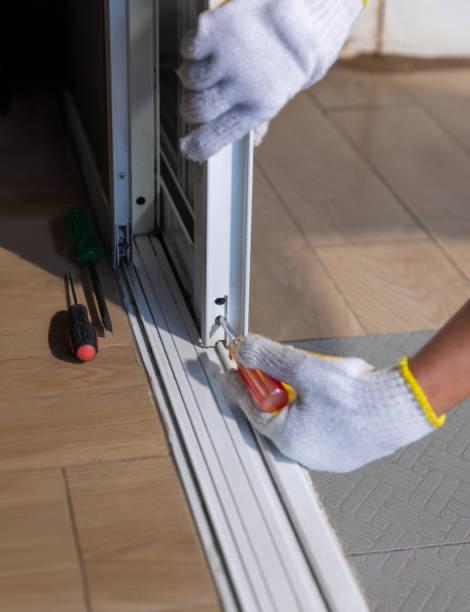
A clean track ready for silicone spray — the correct product on a properly prepared surface.
The Two-Step Answer
The best thing to use on a sliding door track is actually two things used in the right order: a thorough cleaning followed by silicone-based spray lubricant. The cleaning is not optional — applying lubricant to a dirty track seals debris into the channel and makes the problem worse. The order matters as much as the products.
Step one removes everything that's accumulated in the track — sand, salt deposits, grit, leaf debris, old lubricant residue. Step two protects the clean surface and reduces friction between the roller wheel and the track rail. Done correctly every 3 to 4 months, this two-step routine keeps most South Florida sliding doors operating smoothly for the full life of the rollers and track without any additional intervention. It's one of the highest-return maintenance routines available for any component in a South Florida home.
Best Products for Sliding Door Tracks
Applies as a dry film that stays slick for months. Doesn't attract debris. Safe for aluminum, vinyl, and rubber weatherstripping. Available at any hardware store. The standard recommendation for all residential sliding door tracks in South Florida.
Similar to silicone spray but leaves an even more debris-repellent dry coating. Slightly more expensive than silicone. Excellent for coastal properties where sand accumulation is very fast — the PTFE coating keeps the track cleaner between maintenance sessions.
Diluted dish soap on a damp cloth works well for removing salt deposits and general grime from the track surface. Use for cleaning only — rinse and dry the track before applying any lubricant. Not a lubricant itself.
Useful for removing WD-40 or petroleum residue left by previous incorrect lubrication. Apply on a cloth, wipe the track thoroughly, allow to dry completely, then apply silicone spray. Do not use as a lubricant.
A solvent and water displacer, not a lubricant. Attracts debris, degrades rubber weatherstripping, and makes the door stiffer within 1 to 2 weeks of application. One of the most common causes of accelerated track wear in South Florida.
3-in-1 oil, axle grease, motor oil, and similar products attract sand and create an abrasive paste. They also degrade rubber components and are nearly impossible to remove completely once embedded in the track channel.
Products to Avoid — and Why
The list of products that South Florida homeowners have tried on sliding door tracks is longer than the list of products that actually work. Here's what to avoid and the specific reason each one causes problems.
WD-40
Covered in detail in our post on whether to use WD-40 on sliding glass doors, but the short version: WD-40 is a petroleum-based solvent and water displacer. It provides a few days of lubrication before its residue begins actively attracting and bonding debris to the track surface. In South Florida's salt-air and sand environment, this process happens faster than anywhere else — the door is typically harder to operate two weeks after a WD-40 application than it was before. Repeated use creates compounding damage to both the track surface and the roller wheels.
Cooking Sprays and Vegetable Oils
Olive oil, candle wax, cooking spray, and similar household products are organic materials that break down quickly under Florida's UV exposure and heat. They go rancid within weeks, creating a sticky residue that bonds aggressively to sand and grit. They also attract insects — a particularly unpleasant side effect in South Florida. The smell alone is reason enough to avoid them, but the debris-bonding effect is the real problem.
Petroleum Jelly (Vaseline)
Vaseline provides decent short-term lubrication but is a wet lubricant that attracts particulates. In a dry environment it might be acceptable for occasional use, but in coastal Florida's sand-laden air, the track channel coated in petroleum jelly becomes a sand trap. It's also extremely difficult to remove once embedded in the track corners and weep holes.
Candle Wax
Some homeowners rub a candle along the track rail, which works briefly as a dry lubricant. The problem is that paraffin wax becomes brittle in temperature extremes and breaks into particles that pack into the track channel and weep holes. It also provides no protection against corrosion on the aluminum surface. Silicone spray produces the same dry-lubricant effect with none of these drawbacks.
Automotive Lubricants
Products like white lithium grease and chain lube are designed for high-load metal-to-metal applications under far higher pressures than a sliding door track experiences. They're thick, highly attractive to debris, and almost impossible to remove completely from an aluminum channel. Using them on a sliding door track is applying the wrong solution to a problem that requires a light, clean product.
If petroleum-based products have been applied to your track — WD-40, grease, oils — clean the track with isopropyl alcohol or a degreasing solution before applying silicone spray. Applying silicone over petroleum residue traps the residue and reduces the silicone's effectiveness. The degreasing step is essential for a clean reset.
Dry vs. Wet Lubricants in South Florida
The dry vs. wet lubricant distinction is more important in South Florida than in most other environments, and it's why the correct product recommendation differs here from what might work in a drier inland climate.
Dry Lubricants
Silicone spray and PTFE spray are dry lubricants — they apply as a liquid that quickly dries to a thin, slick film on the surface. Once dry, they don't attract or hold particulates. A roller wheel running on a silicone-treated track in a coastal environment picks up minimal additional debris on each pass. The lubricant doesn't get diluted or displaced by debris contact — it maintains its slick surface over many open-and-close cycles before needing reapplication.
Wet Lubricants
Oils, greases, and petroleum-based products are wet lubricants — they stay in a liquid or semi-liquid state on the surface. In an enclosed, high-load, controlled environment like a machine bearing, this can be beneficial. In an open track channel at floor level in coastal Florida, it's a recipe for a sand-and-salt paste. The wet surface acts as an adhesive for every particle that enters the track, and the accumulated debris builds up quickly into a layer that dramatically increases rolling resistance.
NOAA climate data shows Southeast Florida's coastal areas consistently rank among the highest in the U.S. for salt deposition rates and fine particulate presence in the air. This environment specifically favors dry lubricants over wet ones — the absence of a tacky surface is as important as the lubrication itself.
Why Cleaning Matters as Much as Lubricating
The single most common track maintenance mistake in South Florida is applying lubricant to a dirty track. It feels counterintuitive — you're trying to help the door and you're adding something to the problem. But here's what actually happens when you spray silicone on a track that hasn't been cleaned first.
The silicone spray coats both the clean aluminum surface and the debris already present in the channel. The debris — sand grains, salt crystals, compacted grit — is now held in place by the silicone coating rather than sitting loose where it could theoretically be displaced by the roller. You've effectively glued the abrasive material to the track surface. The roller then grinds over this debris-in-silicone layer on every cycle, wearing the track and roller wheel faster than if you'd applied nothing at all.
The correct sequence is always clean first, then lubricate. The cleaning removes the debris. The lubrication protects the now-clean surface and reduces friction on the next operating cycle. In that order, the combination works. In reverse, it doesn't.
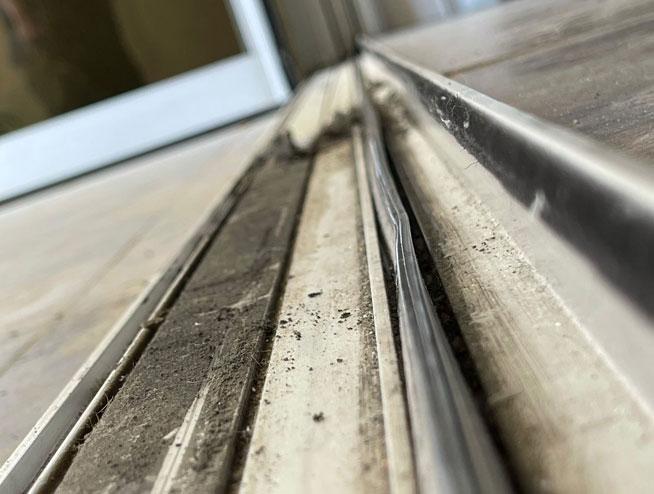
Before cleaning — applying lubricant here would seal this debris into the channel.
After cleaning — now the track is ready for silicone spray application.
The Correct Maintenance Routine
Here is the complete routine — cleaning and lubricating — done in the correct order with the right products.
Use a vacuum with a narrow crevice attachment to remove loose sand, debris, and material from the full length of the main door track and the screen door track if present. Work both inner and outer channels.
Use a stiff-bristle brush to dislodge compacted debris from the channel floor and walls. An old toothbrush handles the corners. Apply firm pressure — coastal sand compacts tightly and doesn't release easily with light scrubbing.
Wipe the track with a damp cloth to pick up loosened material. For salt deposits, use a mild dish soap solution. Rinse with a clean damp cloth. Allow the track to dry completely — 5 to 10 minutes in South Florida's heat is typically enough.
While the track is accessible, check the weep holes at the base of the channel. Insert a thin wire or use compressed air to clear any blockages. This takes 30 seconds and prevents water pooling that accelerates corrosion.
Hold the silicone spray can 6 to 8 inches from the track and apply a light, even coat along the full length of the rail surface. Don't over-apply — a thin film is more effective than a heavy coat. Slide the door back and forth several times to distribute the lubricant evenly across the roller contact area.
Track Still Stiff After Cleaning and Lubricating?
If the correct routine doesn't restore smooth operation, the track or rollers need professional attention. Same-day service across Miami-Dade, Broward, Palm Beach, and all of South Florida.
How Often to Clean and Lubricate
The right frequency depends on your specific location and how much the door is used, but here are clear guidelines for South Florida conditions.
- Coastal properties within 1 mile of the ocean or Intracoastal: Every 3 months. Salt deposition and sand accumulation are at their fastest this close to the water. Skipping a cycle here means the next cleaning is twice as difficult.
- Inland communities 1 to 5 miles from the coast: Every 4 months. Still faster accumulation than most of the country but manageable with quarterly attention.
- Further inland areas: Every 4 to 6 months. Less salt exposure but summer rainstorm debris and pollen accumulation still warrants regular maintenance.
- After any storm: Clean within 48 hours regardless of when the last maintenance was done. Storm-driven sand and debris packs under pressure and bonds quickly if left to dry.
- After hurricane season (November): Always do a full clean and lubrication at the end of hurricane season to remove the cumulative salt and debris from the June-through-November exposure period.
Set a phone reminder for track maintenance every 3 months. It's a 10-minute job that most people do once a year — or never — until the door stops working. The cost of that 10 minutes every quarter is approximately zero. The cost of ignoring it for three years is a new track, new rollers, and a professional repair bill. The math is straightforward.
When Products Alone Won't Fix It
Cleaning and lubricating are maintenance tools — they maintain a functional system. When the system has already failed, no product will restore it. There are clear signs that the track needs professional repair or replacement rather than another cleaning and lubrication cycle.
- Door improves only slightly after a thorough clean and silicone treatment: The track rail surface is damaged — deep grooves or corrosion pitting that the lubricant can't bridge.
- Door returns to stiff operation within a week of maintenance: The rollers are worn past their serviceable life and the increased friction they generate overrides even a properly lubricated track.
- Door jolts at one specific spot regardless of lubrication: A physical dent or bent section in the track that the lubricant can't smooth over.
- The door has been properly maintained for years and recently started degrading rapidly: Corrosion has advanced to the point where the track material itself is failing — replacement is the correct next step.
For any of these situations, professional sliding door track service is the right path. A technician can assess the track and roller condition together in a single visit and confirm exactly what the door needs — whether that's a track repair, track replacement, roller replacement, or a combination. If you're unsure which situation you're in, get a free estimate and we'll give you a straight answer before any work begins.
Track Maintenance in Miami-Dade County
Miami-Dade County's coastal environment presents the full range of track maintenance challenges in concentrated form. The combination of Biscayne Bay salt air from the east, the Atlantic Ocean a few miles offshore, intense year-round UV radiation, and some of the highest humidity readings in the continental U.S. creates conditions where sliding door tracks degrade faster than almost anywhere else in Florida.
In waterfront communities along Brickell, Coconut Grove, Key Biscayne, and South Beach, track maintenance every 3 months isn't just a recommendation — it's the minimum interval for keeping a door functional between service calls. Further inland in communities like Kendall, Doral, and Hialeah, the salt exposure is lower but the heat and humidity still demand regular attention. For sliding door maintenance and repair throughout Miami-Dade County, same-day service is available across the full area — call if maintenance alone isn't getting the job done.
Done Maintaining — Still Not Sliding? We'll Fix It.
Serving Miami-Dade, Broward, Palm Beach, Naples, and all of South Florida. Same-day track repair and replacement, free estimates, warranty on every job.
Frequently Asked Questions
The best approach is a two-step routine: clean the track thoroughly with a stiff brush, vacuum, and damp cloth, then apply a light coat of silicone-based spray lubricant to the clean, dry track surface. Silicone spray stays slick without attracting debris, is safe for all track materials, and holds up in South Florida's heat and humidity.
No. Cooking oils and sprays go rancid, attract insects, and leave a sticky residue that bonds sand and debris to the track. They also degrade rubber weatherstripping. Silicone spray is inexpensive, widely available, and produces dramatically better and longer-lasting results.
Every 3 to 4 months in South Florida, more frequently for coastal properties within a mile of the ocean. Always clean after any storm. Never apply lubricant over a dirty track — clean first, then lubricate.
For cleaning: a stiff brush, vacuum, and mild dish soap solution work well. For lubrication, there are no effective household substitutes for silicone spray. Common alternatives like cooking oil or petroleum jelly either attract debris, degrade components, or produce only very short-term results.
Yes — cleaning thoroughly before lubricating is as important as the lubricant itself. Applying silicone spray over a dirty track seals sand and salt debris into the channel rather than removing it. Always clean completely before lubricating.
In South Florida's coastal environment, yes. Dry lubricants like silicone and PTFE spray don't attract the fine sand and salt particles constantly present in coastal air. Wet lubricants — oils and greases — pick up particulates immediately and create an abrasive paste in the track channel within days.