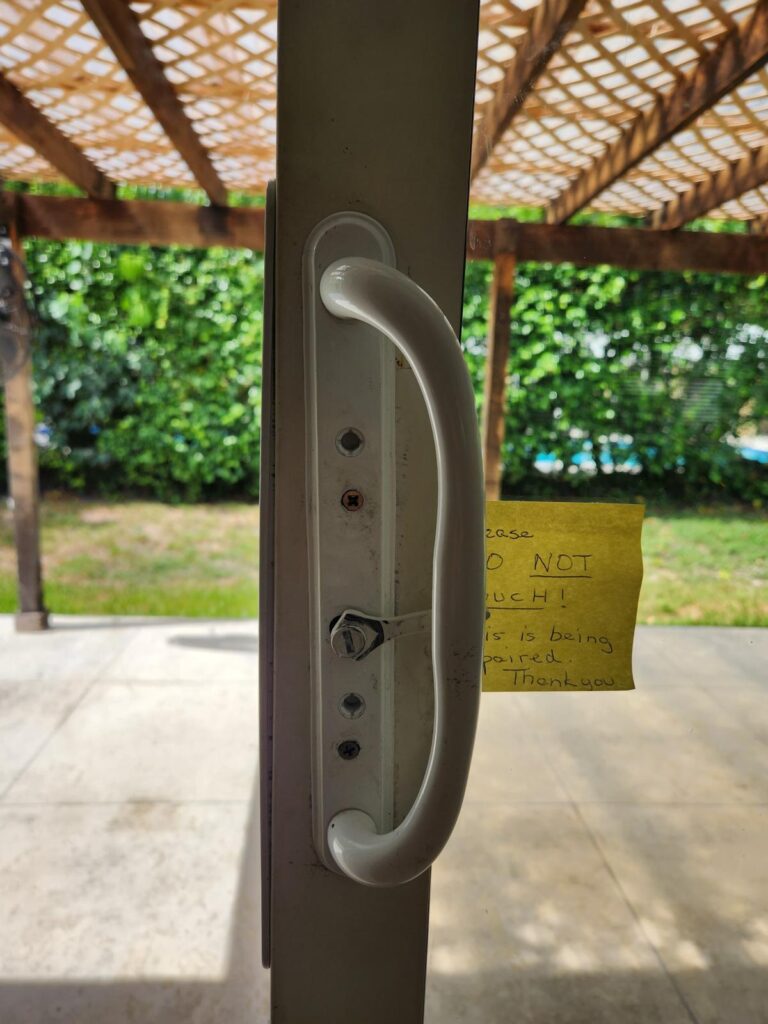
Should I Use WD-40 on a Sliding Glass Door?
No — and here's exactly why. What WD-40 actually does to your door, why the problem always comes back worse, and the right way to lubricate a sliding glass door in South Florida.
- The Answer Is No — Here's Why
- What WD-40 Actually Is
- What Happens When You Put WD-40 on a Sliding Door
- Why the Door Gets Stiff Again — Faster
- The Cumulative Damage WD-40 Causes
- What to Use Instead
- The Correct Lubrication Routine for South Florida
- Already Used WD-40? Here's What to Do
- When Lubrication Isn't Enough
- Frequently Asked Questions
WD-40 is one of the most recognized products in any hardware store, and its reputation as a fix-all for squeaking, sticking, and sluggish moving parts is deeply embedded in home maintenance culture. So it's completely understandable that when a sliding glass door gets stiff or starts dragging, reaching for the WD-40 seems like the logical first step. The door loosens up almost immediately — which feels like confirmation that you made the right call.
Then two weeks later it's stiff again. And a few weeks after that it's worse than before you started. So you apply more WD-40. The cycle repeats, the door keeps degrading, and eventually you're dealing with a grinding, barely-functional door that needs a professional repair. This pattern plays out in homes across Broward County and throughout South Florida every day — and WD-40 is almost always part of the backstory. Here's exactly what's happening and what to do instead.

A track that has been treated with WD-40 repeatedly — the petroleum residue has bonded sand and salt debris into a gritty paste that dramatically increases friction.
The Answer Is No — Here's Why
WD-40 should not be used on sliding glass door tracks, rollers, or any part of the sliding door mechanism. It is not a lubricant. It will make your door feel better for a few days and then measurably worse over the following weeks. In South Florida's coastal environment — with its fine beach sand, salt air, and year-round humidity — the negative effects happen faster and compound more aggressively than in drier climates.
The correct lubricant for sliding glass door tracks is silicone-based spray, applied to a clean track after thorough brushing and vacuuming. That's the whole answer. Everything below explains why in detail — including what to do if WD-40 has already been applied to your door's track.
What WD-40 Actually Is
The name WD-40 stands for Water Displacement formula #40 — the 40th attempt by the Rocket Chemical Company in 1953 to develop a formula that would displace water from metal surfaces and prevent corrosion on aerospace components. It was designed to protect metal, displace moisture, and loosen corroded fasteners. It was not designed as a lubricant, and the manufacturer has never marketed it as one for ongoing mechanical lubrication.
WD-40 is primarily a petroleum distillate — a light mineral spirit with some anti-corrosion additives. It has mild lubricating properties in the immediate aftermath of application because the petroleum base creates a thin slick film on surfaces. But those properties are short-lived, and the petroleum residue left behind after the volatile components evaporate is where the problems start.
WD-40 is genuinely useful for several things: loosening corroded bolts, removing sticker residue, displacing water from electrical contacts, and freeing seized mechanisms. Using it as a track lubricant on a sliding glass door that you need to operate smoothly for the next six months is simply the wrong tool for the job.
What Happens When You Put WD-40 on a Sliding Door
Here's the sequence of events that follows a WD-40 application on a sliding door track, broken down day by day.
Day 1 — The Door Feels Great
The petroleum solvent penetrates the debris and salt deposits in the track and temporarily reduces friction between the roller wheel and the track surface. The door slides more freely. This is the moment that creates the false confidence in WD-40 as a solution. It genuinely works — for a very short time.
Days 2 to 5 — The Residue Sets
The lighter volatile components of WD-40 evaporate, leaving a petroleum-based residue on the track surface. This residue is tacky rather than slick. In any environment, this is not ideal. In South Florida's coastal climate — where fine beach sand and salt particles are constantly present in the air — the tacky residue begins immediately collecting and bonding particulate matter to the track surface.
Days 5 to 14 — The Abrasive Paste Forms
Within a week to two weeks, the petroleum residue has combined with accumulated sand, salt, and debris to form a gritty paste coating the inside of the track channel. The roller wheel is now rolling through this paste on every open-and-close cycle. The abrasive action on the wheel surface is significantly worse than it would have been on a dry, dirty track — because the paste adheres to the wheel and the track simultaneously, creating continuous grinding contact rather than just surface contamination.
Week 3 Onward — The Door Is Harder to Operate Than Before
By this point the door is typically stiffer than it was before the WD-40 application. The homeowner applies more WD-40. The cycle restarts, but each iteration leaves more residue and bonds more debris. Over months, this process significantly accelerates wear on the roller wheel surface and deposits a layer of contamination in the track that becomes increasingly difficult to remove.
WD-40 also degrades rubber weatherstripping. The petroleum solvent breaks down the rubber compound's flexibility over time, causing the weatherstripping to stiffen, crack, and shrink. Once weatherstripping shrinks away from the door frame, your door's seal against water, air, and insects is compromised — and weatherstripping replacement adds to the total repair cost.
Why the Door Gets Stiff Again — Faster
The reason the stiffness returns faster after each WD-40 application is that each application builds up the petroleum residue layer in the track. The first application leaves a thin layer that takes two weeks to bond enough debris to cause problems. The second application adds to the existing layer, creating a thicker base that bonds debris more quickly and holds it more firmly. By the fourth or fifth application cycle, some homeowners are back to a stiff door within days of treatment.
This is the clearest signal that WD-40 is the wrong solution. A correct lubricant — silicone spray — actually makes successive applications more effective because it doesn't attract debris. A correctly maintained track gets easier to operate over time, not harder.
The Cumulative Damage WD-40 Causes
Beyond the immediate cycle of temporary improvement and worsening stiffness, repeated WD-40 use causes three categories of cumulative damage that aren't reversible without repair or replacement.
Roller Wheel Surface Wear
The abrasive paste that forms in a WD-40-treated track grinds the roller wheel surface on every cycle. Over months, this removes material from the wheel, creating flat spots and surface roughness that cause the door to bump and skip as it moves. Once a roller wheel has flat spots, it needs to be replaced — track cleaning and correct lubrication won't restore the wheel surface.
Track Surface Damage
The same abrasive paste damages the aluminum track channel surface. Fine scratches accumulate into grooves that create additional resistance points and affect how the roller seats in the channel. A heavily grooved track may need replacement even after the underlying roller and lubrication issues are corrected.
Weatherstripping Degradation
As noted above, the petroleum solvent in WD-40 actively degrades rubber weatherstripping. In South Florida, where weatherstripping plays a critical role in keeping out humidity, insects, and water intrusion during the rainy season and hurricane season, this damage has real practical consequences. Replacing weatherstripping on a standard sliding patio door adds $50 to $150 to the repair cost.
What to Use Instead
The correct lubricant for sliding glass door tracks is silicone-based spray lubricant. It's available at any hardware store — look for products labeled "silicone spray," "dry lubricant," or "silicone lubricant." The price is comparable to WD-40.
- Water displacer, not a lubricant
- Petroleum residue attracts debris
- Creates abrasive paste in track
- Degrades rubber weatherstripping
- Door gets stiffer within 2 weeks
- Damage compounds with each use
- True dry lubricant for surfaces
- Doesn't attract sand or debris
- Safe for metal, vinyl, rubber
- Holds up in Florida heat and humidity
- Keeps working for 3 to 6 months
- Gets better with regular use
Other products to avoid alongside WD-40: petroleum-based greases (Vaseline, axle grease, 3-in-1 oil), cooking sprays (PAM and similar), household oils (olive oil, vegetable oil), and automotive lubricants. All of these attract debris, degrade rubber, and create similar or worse problems than WD-40 in a sliding door track environment.
Dry PTFE (Teflon) spray is another excellent alternative to silicone spray for sliding door tracks. It leaves an ultra-slick dry film that repels debris even more effectively than silicone in very sandy environments. It's slightly more expensive but lasts longer between applications — a good choice for coastal properties where track contamination is particularly fast.
The Correct Lubrication Routine for South Florida
The right approach to keeping a sliding glass door track lubricated in South Florida involves three steps done in the right order. Skipping the cleaning step and applying lubricant directly is one of the most common maintenance mistakes — it seals debris into the track rather than removing it.
Use a vacuum with a narrow attachment to remove loose sand, debris, and accumulated material from the full length of the track channel — both the main door track and the screen door track if present.
Use a stiff-bristle brush to dislodge compacted debris along the track walls and floor. Follow with a damp cloth to pick up loosened material. For salt residue, a mild soap solution works better than plain water. Allow the track to dry completely before lubricating.
Hold the can 6 to 8 inches from the track and apply a thin, even coat along the full length of the channel. Slide the door back and forth several times to distribute the lubricant evenly across the roller wheel contact area. Don't over-apply — a light coat is more effective than a heavy one.
In South Florida, this routine should be performed every 3 to 6 months. Coastal properties within a mile of the ocean — anywhere along Broward County's beachfront, from Hallandale Beach north through Fort Lauderdale and Deerfield Beach — should do this every 3 months. After any major storm, clean the track within a few days. Storm-driven sand packs into the track under pressure and bonds quickly if left to dry.
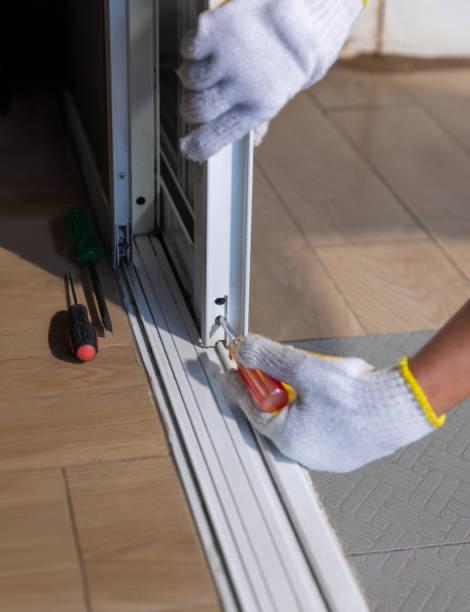
Clean track ready for silicone spray — always clean before lubricating.

Well-maintained roller — correct lubrication extends lifespan significantly in coastal Florida.
Door Still Stiff After Cleaning and Lubricating?
If your door doesn't improve after a proper clean and silicone treatment, the rollers need replacing. Same-day service across Broward County, Fort Lauderdale, Pompano Beach, and all of South Florida.
Already Used WD-40? Here's What to Do
If WD-40 has already been applied to your door's track, the priority is removing the petroleum residue before it bonds any more debris. Here's how to reset the track correctly.
Step 1 — Degrease the Track
Apply a household degreasing cleaner — a diluted dish soap solution works well — to the track channel and scrub with a stiff brush. The goal is to break down and lift the petroleum residue that WD-40 has left on the track surface. Rinse with clean water and dry thoroughly.
Step 2 — Remove Bonded Debris
If debris has become strongly bonded to the track surface, a plastic scraper or old credit card can help dislodge it without damaging the aluminum. Do not use metal tools on the track — they scratch the surface and create new friction points.
Step 3 — Apply Silicone Spray
Once the track is completely clean and dry, apply silicone spray lubricant as described above. The door should feel noticeably smoother on the first slide after correct lubrication on a clean track.
Inspect the Rollers
If the door has been through multiple WD-40 cycles and the abrasive paste has been present for months, inspect the rollers for flat spots or surface damage. If the door still isn't smooth after a proper track cleaning and silicone treatment, the roller wheel surface has likely been compromised and the rollers need to be replaced. Lubrication — even the correct kind — can't restore a roller wheel that has been physically worn by abrasive contact.
When Lubrication Isn't Enough
Lubrication — whether WD-40 or the correct silicone spray — is a maintenance tool, not a repair tool. It reduces friction on a functioning system. When the system has failed — worn rollers, damaged track, bent housing — no lubricant will restore smooth operation. The door will remain stiff, grind when moving, sit unevenly, or fail to lock regardless of what's applied to the track.
The clearest indicator that lubrication alone isn't going to solve the problem is a door that improves only slightly after a thorough track cleaning and correct lubrication, or one that reverts to stiff operation within a few days even on a clean track. Both of these patterns point to worn rollers as the underlying cause. Our earlier posts on what causes rollers to fail and how to recognize roller problems cover the diagnostic process in detail.
If your door is at that point, get a free estimate from a local sliding door specialist. In Broward County and across South Florida, same-day roller replacement is the standard, and the result is a door that glides with one finger — no lubricant required to make it functional.
Ready for a Door That Actually Works?
Serving Fort Lauderdale, Hollywood, Coral Springs, Pompano Beach, Deerfield Beach, and all of Broward County and South Florida. Same-day roller replacement, free estimates, warranty on every job.
Frequently Asked Questions
No. WD-40 is a water displacer and solvent, not a lubricant. On sliding glass door tracks it removes protective coatings, attracts and holds sand and debris, and makes the door harder to operate within days of application. The correct product is silicone-based spray lubricant applied to a clean, dry track.
WD-40 provides very short-term lubrication before its solvent properties take over. It leaves a petroleum residue on the track that attracts and bonds sand, salt, and debris — especially in South Florida's coastal environment. Within days the track is coated in a gritty paste that increases friction and makes the door stiffer than before.
Silicone-based spray lubricant is the correct product. It applies as a light film that stays slick without attracting debris, is safe for aluminum, vinyl, and rubber weatherstripping, and holds up in Florida's heat and humidity. Apply it to a clean, dry track after thorough brushing and vacuuming.
Use silicone-based spray lubricant or dry PTFE (Teflon) spray — both available at any hardware store. Do not use petroleum greases, cooking sprays, or household oils. These all attract debris and degrade rubber weatherstripping. Silicone spray is clean, effective, and safe for all sliding door components.
In South Florida, lubricate the track every 3 to 6 months after a thorough cleaning. Coastal properties within a mile of the ocean should lubricate every 3 months due to faster salt and sand accumulation. Always clean the track first — applying lubricant over a dirty track seals debris into the channel and worsens friction.
Yes, over time. WD-40 degrades rubber weatherstripping, removes the protective oxidation layer from aluminum track surfaces, and accelerates abrasive roller wear by bonding debris into the track channel. A single application won't destroy anything, but repeated use causes cumulative damage across all three failure modes.