What Are the Common Roller Door Problems?
Every symptom your sliding door shows has a cause — and most of them trace back to the rollers. Here's how to read what your door is telling you and what to do about it.
- Problem 1 — Grinding or Scraping Noise
- Problem 2 — Door Is Hard or Impossible to Slide
- Problem 3 — Door Sits Unevenly in the Frame
- Problem 4 — Lock Won't Engage Properly
- Problem 5 — Door Keeps Coming Off the Track
- Problem 6 — Door Wobbles or Shakes When Sliding
- Problem 7 — Visible Gap at Top or Bottom When Closed
- Why Naples Homeowners See These Problems Sooner
- How to Confirm the Rollers Are the Problem
- Frequently Asked Questions
Sliding glass doors are reliable by design — but when something goes wrong, the symptoms can be confusing. Is it the rollers? The track? The frame? The lock? For most homeowners in Naples, Bonita Springs, Marco Island, and across Southwest Florida, the answer is almost always the rollers. These small wheel-and-bearing assemblies carry the full weight of the door panel across thousands of cycles every year, and when they start to fail, the door makes sure you know about it — usually in several ways at once.
This guide covers every common roller door problem, what's causing each one at a mechanical level, and what the fix looks like. Whether you're dealing with a grinding door, a lock that won't catch, or a panel that keeps jumping the track, A1 Sliding Doors has the full picture here. Start with whichever symptom matches what you're seeing.

Most sliding door problems have the same root cause — worn or failed roller components.
Problem 1 — Grinding or Scraping Noise
The noise appears when the door starts moving, continues throughout the slide, or occurs only at certain points along the travel path.
What's Causing It
Grinding is the sound of metal or worn plastic making contact with a surface it shouldn't be touching. Three things produce this in a sliding door system. First, the roller wheel surface has worn down to the point where the axle housing or a flattened section of the wheel is dragging against the track. Second, debris — sand, grit, hardened salt residue — has packed into the track and the roller is rolling over it on every cycle. Third, corroded ball bearings have seized or roughened to the point where the wheel is no longer rotating smoothly and is instead skidding along the track.
In Naples and the surrounding Collier County coast, the third cause is especially common. Salt air oxidizes steel ball bearings faster than almost any other residential environment in the country. A roller that sounds fine at installation can develop audible bearing roughness within a few years without preventive maintenance.
The Fix
Start with a thorough track cleaning to rule out debris as the source. If the grinding continues on a clean track, the rollers need to be inspected. A worn wheel surface or seized bearing means replacement — there's no lubricant that restores a damaged bearing race. Our guide on sliding door roller replacement covers what the process involves and how long it takes.
A grinding noise that appears suddenly after a period of smooth operation usually means debris has entered the track — clean it first. A grinding noise that has developed gradually over weeks or months and worsens over time is bearing deterioration — that requires roller replacement, not just cleaning.
Problem 2 — Door Is Hard or Impossible to Slide
What used to open with one finger now takes two hands. Or the door moves a few inches and then stops. Or it simply won't budge from its closed position.
What's Causing It
Stiffness is a resistance problem — something is generating friction that the door's rolling mechanism can't overcome. At the early stage, compacted track debris is often the main culprit. As the problem progresses, the underlying cause is almost always rollers that have worn to the point where they're no longer rolling freely — dragging instead of gliding, or seized entirely in their housing.
A door that won't move from its closed position has often had the rollers fail completely on one side, causing the bottom rail to drop onto the track surface. The door is now sitting directly on aluminum rather than on wheels, and the friction is simply too great to overcome by hand.
The Fix
Clean the track first. If the door improves significantly, debris was the primary cause — lubricate with silicone spray and maintain the track regularly. If the door is still stiff after a thorough cleaning, or if it won't move at all, the rollers need replacing. Do not force the door — forcing a seized door risks bending the track and cracking the frame, which compounds the repair significantly.
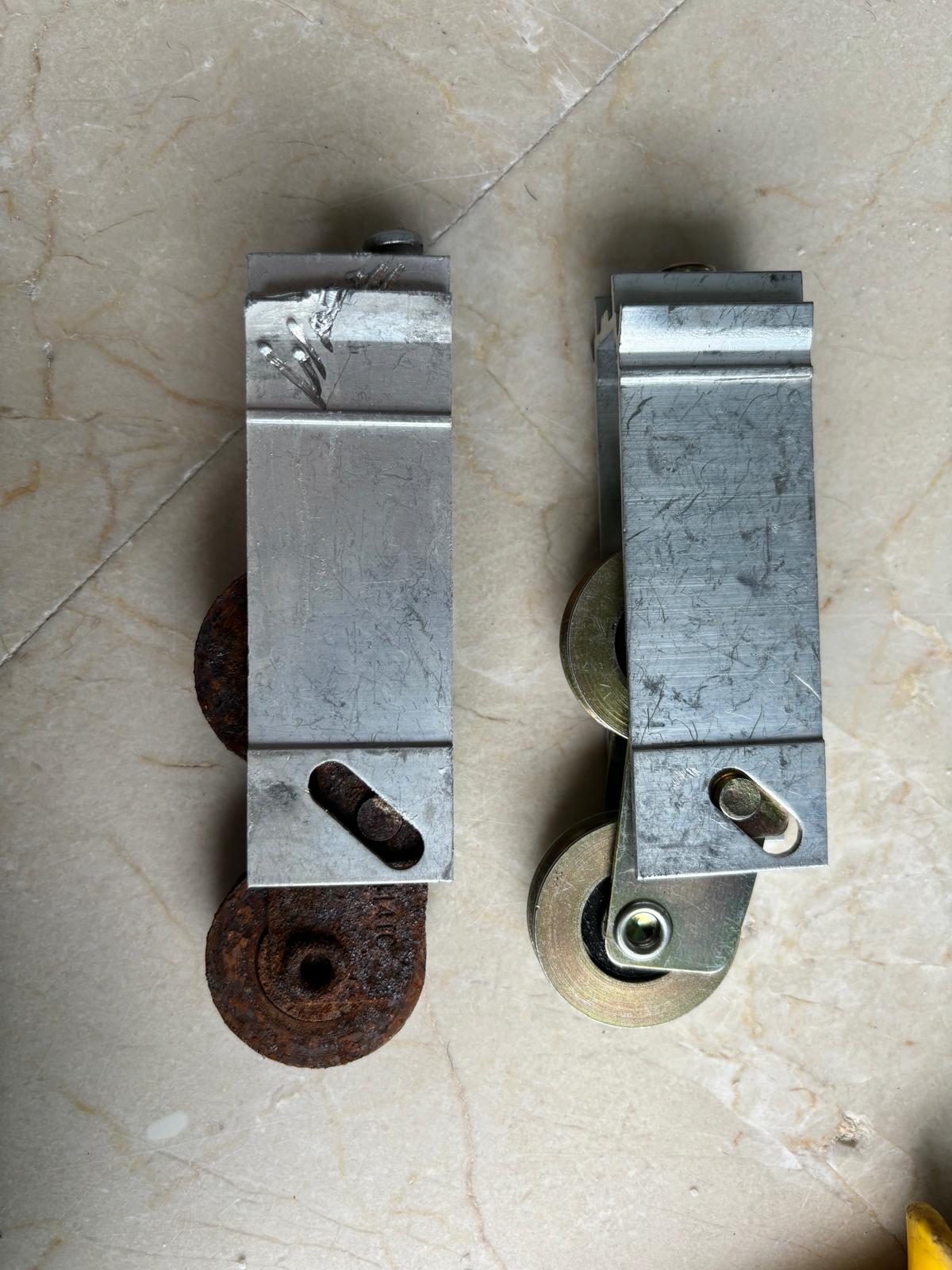
Seized roller removed from a Naples home — the wheel had stopped rotating entirely.

Debris-packed track — cleaned before new rollers were installed.
Problem 3 — Door Sits Unevenly in the Frame
The door panel tilts noticeably when closed. There's more space at the top on one side than the other, or the door scrapes the frame at one corner.
What's Causing It
When rollers wear unevenly — which is common when one side of the door sees more load or more debris than the other — the door drops more on the worn side. The result is a visible tilt. This also happens when one roller has been replaced previously but the other hasn't, leaving mismatched wheel diameters that create a height difference between the two ends of the door.
The Fix
Start with a height adjustment using the adjustment screws in the bottom rail. Turn the screw on the low side clockwise to raise it until the door sits level. If the adjustment screw has reached its maximum extension and the door is still uneven, the roller has worn beyond its adjustable range and needs to be replaced. When replacing rollers due to uneven wear, replace both sides simultaneously — even if only one roller has failed, the other is close behind.
Problem 4 — Lock Won't Engage Properly
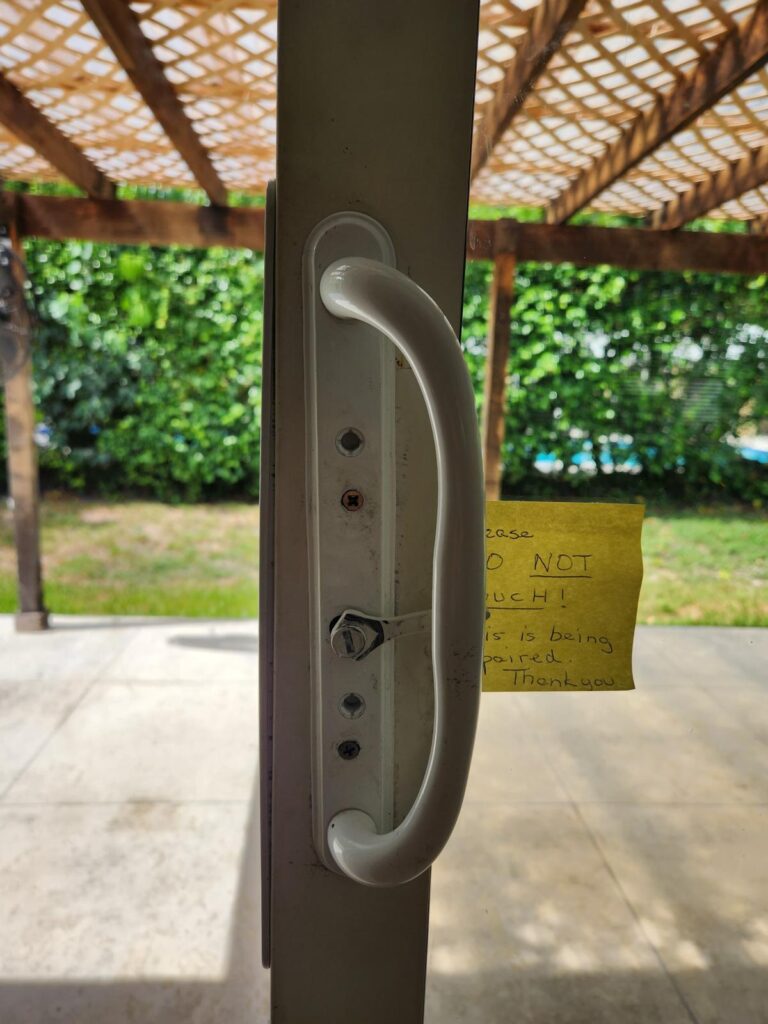
The lock handle turns but the latch misses the strike plate entirely, or the door only locks when lifted slightly from the bottom.
What's Causing It
This is one of the most security-critical roller problems and one that often surprises homeowners because it looks like a lock issue rather than a roller issue. The sliding door latch and strike plate are designed to align at a specific door height. When the rollers wear down and the door sags — even by a small amount — the latch drops below the strike plate and can no longer engage it cleanly.
The fact that lifting the door slightly from the outside allows it to lock is the clearest diagnostic sign that roller wear is the cause. The door is showing you exactly how much height it has lost.
The Fix
Adjust the roller height using the adjustment screws to raise the door back to the correct position. Test the lock after each quarter-turn adjustment. If the door can be raised high enough to lock correctly through adjustment alone, the rollers still have some service life left — but monitor them closely and plan for replacement within the next year or two. If adjustment doesn't bring the door high enough to lock correctly, the rollers need replacing.
A sliding door that cannot be fully locked is a serious security vulnerability. Do not leave the door in this condition overnight or when the home is unoccupied. If height adjustment doesn't resolve the lock issue immediately, schedule a same-day repair. This is not a problem to defer.
Recognize Any of These Problems?
Our technicians serve Naples, Marco Island, Bonita Springs, Fort Lauderdale, Pompano Beach, and all of South Florida. Same-day roller repair, flat-rate pricing, warranty on every job.
Problem 5 — Door Keeps Coming Off the Track
The bottom of the door panel pops out of the track channel, sometimes when reaching the fully open position, sometimes mid-slide. It has happened more than once.
What's Causing It
A door that repeatedly derails has lost the correct seating relationship between the roller wheel and the track channel. When rollers wear down, the door drops closer to the track floor. The bottom rail then sits low enough that the lip of the track channel — the raised edge that normally keeps the door seated — no longer contains the panel properly. A slight lift at the end of the slide, a gust of wind through an open door, or a hard push is all it takes to pop the panel free.
A bent or damaged anti-lift bracket — a small clip near the top of the door frame that prevents the panel from being lifted out — can also contribute, particularly if the door has been derailed and reinstalled multiple times without addressing the root cause.
The Fix
If the door has just come off the track once and the rollers appear functional, carefully reinstall the panel and inspect the track and roller condition. If it has happened repeatedly, roller replacement is the solution. Check the anti-lift bracket at the top of the frame as well — if it's bent or missing, it should be replaced alongside the rollers to prevent recurrence.
Problem 6 — Door Wobbles or Shakes When Sliding
Instead of gliding cleanly along the track, the door panel moves with a noticeable lateral wobble. It may also produce a rattling sound when the house is windy.
What's Causing It
A wobbling door has lost its stable seating in the track. This happens when the roller housing has loosened its fit in the door rail cavity — either because the housing has worn down or because it was never the correct size for the door. It also occurs when a roller wheel develops a flat spot, creating a point in each rotation where the door drops slightly and then recovers, producing the rocking motion. A bent track section that causes the roller to jump briefly also creates this symptom.
The Fix
Inspect the track for visible bends or damage first. If the track looks clean and straight, the rollers are the cause — either worn housings, flat-spotted wheels, or incorrectly sized replacements from a previous repair. Replacement with correctly specified rollers resolves this completely.
Problem 7 — Visible Gap at Top or Bottom When Closed
There's a visible gap between the door panel and the frame when the door is fully closed. The weatherstripping is in place but the door isn't seated close enough to the frame for it to seal properly.
What's Causing It
An uneven gap — wider at one end than the other — indicates the door has tilted due to uneven roller wear. A uniform gap along the full height of the door usually means the door has dropped on both sides and needs to be raised with height adjustment. Both causes are roller-related. The weatherstripping itself is rarely the primary issue — even new weatherstripping can't bridge a gap caused by a door sitting at the wrong height.
In Naples and Southwest Florida, this problem has real consequences beyond comfort. An air gap in a door seal allows humid, salt-laden outside air into the home continuously, which accelerates corrosion on door hardware and can contribute to mold growth in the door cavity. During hurricane season, even a small gap in the door seal undermines the door's ability to maintain pressure resistance.
The Fix
Height adjustment first — raise the door using the roller adjustment screws until the gap closes evenly. If the door can't be raised enough to seal properly, the rollers need replacement. After roller replacement and correct height setting, the weatherstripping should seal cleanly without modification in most cases.
Why Naples Homeowners See These Problems Sooner
Every one of the problems above can occur in any climate, but Naples homeowners see them earlier and more frequently than most. The Gulf Coast environment delivers the full spectrum of accelerating factors in combination: salt air from the Gulf of Mexico, fine sand that works into every crevice, year-round heat and UV exposure, and a hurricane season that puts extreme pressure on door seals and hardware from June through November.
NOAA climate data consistently ranks the Southwest Florida coast among the highest-humidity regions in the continental United States, with relative humidity averaging above 75% year-round. For sliding door repairs in Naples specifically, the standard advice for most of the country — clean the track once a year — simply isn't adequate. Coastal Naples properties need track cleaning every 3 to 4 months and roller inspection every 5 to 7 years to stay ahead of the problems described in this guide.
How to Confirm the Rollers Are the Problem
If you're seeing one or more of the symptoms above, here's a simple diagnostic process to confirm the rollers are the cause before calling for a repair.
- Clean the track thoroughly and test the door. If all symptoms resolve completely, track debris was the sole cause. Maintain the track going forward.
- Lubricate with silicone spray after cleaning and test again. If the door improves but not fully, or if it's smooth for a few days and then stiffens again, the rollers are failing.
- Look at the door from outside. If the door tilts visibly, or if there's an uneven gap at the top of the frame, the rollers are worn unevenly.
- Test the lock. If the latch misses the strike plate or the door needs to be lifted to lock, the rollers have dropped the door below its correct operating height.
- Listen when the door moves. A clean, well-maintained door with good rollers is nearly silent. Grinding, scraping, or rattling all point to roller wear.
If any of the above confirm roller involvement, the next step is deciding whether to adjust, replace, or call a professional. For a door with impact glass, significant weight, or multiple problems occurring simultaneously, scheduling a free estimate with a local sliding door specialist is the fastest and most reliable path to a complete fix.
Any of These Problems Sound Familiar?
Same-day roller repair across Naples, Marco Island, Bonita Springs, Fort Lauderdale, Pompano Beach, and all of South Florida. Free estimates, warranty on every job.
Frequently Asked Questions
Grinding is almost always caused by worn roller wheel surfaces dragging against the track, debris packed into the track acting as an abrasive, or corroded ball bearings that have lost smooth rotation. Clean the track first — if grinding continues on a clean track, the rollers need replacing.
A door that repeatedly derails has rollers worn down enough that the door sits too low, allowing the bottom rail to lift over the track lip. A bent track or damaged anti-lift bracket can also contribute. Roller replacement resolves repeated derailment in the vast majority of cases.
The latch and strike plate are aligned to work at a specific door height. When rollers wear down and the door sags, the latch no longer meets the strike plate. The fix is usually a roller height adjustment or roller replacement — not a lock replacement.
Wobble during operation means the roller housing has loosened its fit in the door rail cavity, the roller wheel has developed a flat spot, or the track has a bent section. All three causes produce the same lateral rocking motion. Replacement with correctly specified rollers resolves this completely.
An uneven gap indicates the door has tilted due to uneven roller wear. A uniform gap along the full height usually means the door has dropped on both sides and needs a height adjustment. Both are roller-related issues resolved with adjustment or replacement.
If cleaning and lubricating the track does not fully resolve the issue, the rollers are almost certainly the cause. Specific indicators include a door that sits unevenly, requires lifting to lock, grinds loudly, wobbles during operation, or repeatedly comes off the track. Any of these after a track cleaning points directly to roller wear.