What Causes Sliding Door Rollers to Fail?
Understanding why rollers wear out is the first step toward preventing premature failure — and knowing when a repair is overdue before the problem gets expensive.
Most sliding glass door rollers don't fail because of one catastrophic event. They fail because of a slow accumulation of conditions that chip away at the components over months and years. By the time a door is grinding or barely moving, the damage has usually been building for a while. Understanding the root causes not only explains why your current door is struggling — it gives you a clear picture of what to do differently after the repair to make the new rollers last as long as possible.
In Southwest Florida, the failure timeline is compressed compared to most other parts of the country. The combination of salt air, year-round heat, coastal sand, and heavy rainfall during hurricane season creates one of the harshest operating environments for sliding door hardware in the United States. Homeowners in Naples, Marco Island, Bonita Springs, and the surrounding Collier County communities typically see roller wear appear faster than homeowners even 30 miles inland. Here's exactly why — and what you can do about it. If your rollers have already reached the point of failure, our team handles sliding door repairs throughout Naples and the surrounding area.

A neglected track packed with sand and salt residue — one of the leading causes of premature roller failure in coastal Florida.
Normal Wear — The Baseline Cause
Every mechanical component wears out eventually, and sliding door rollers are no exception. Even under ideal conditions — clean track, correct installation, proper lubrication, reasonable use — the ball bearings inside a roller cartridge will eventually lose their smooth rotation. The wheel surface will develop micro-abrasions from millions of contact cycles with the track. The housing will gradually loosen its fit in the door rail cavity.
Under normal residential use, quality rollers are designed to last 15 to 20 years. That timeline assumes a typical door being opened and closed perhaps 6 to 10 times per day. In a household with children, pets, or a door that sees heavier traffic — a pool entrance, for example — that cycle count climbs quickly, and the practical lifespan drops toward 10 to 12 years even with good maintenance.
Normal wear is the baseline cause, but in South Florida it rarely operates alone. Almost every premature roller failure involves at least one of the accelerating factors described below working alongside the wear baseline.
Salt Air and Coastal Corrosion
This is the single biggest accelerating factor for roller failure in coastal Florida communities, and it's one that most homeowners significantly underestimate. Salt air — the fine aerosol of sodium chloride particles that moves inland from the Gulf of Mexico and the Atlantic — is highly corrosive to exposed metal components. It doesn't take ocean spray hitting the door directly. Simply being within several miles of the coast exposes every metal surface on the door to ongoing salt deposition.
Inside a roller cartridge, the ball bearings and axle are the most vulnerable components. Standard steel bearings begin to oxidize within a year or two of coastal exposure. The oxidation increases friction, reduces the bearing's ability to rotate cleanly, and causes the roller to drag rather than roll freely. Once corrosion is established in the bearing race, it accelerates — the rough surface attracts and holds more salt and moisture, and the degradation compounds itself.
Distance from the Coast Matters
Homeowners within a mile of the Gulf or ocean shoreline — beachfront properties on Naples' Gordon Drive corridor, waterfront homes on Marco Island, or bayfront condominiums near Pelican Bay — will see roller corrosion appear in as little as 3 to 5 years with standard steel components. Properties further inland, in communities like Lely Resort or Golden Gate Estates, may get 10 to 12 years from the same rollers. This is why the material choice at replacement time matters so much: stainless steel axles and sealed bearing cartridges resist salt-air corrosion substantially longer than standard steel components.
When replacing rollers in any coastal Florida home, always specify stainless steel axles and sealed ball bearings. The cost difference over standard components is minimal — typically $5 to $15 per cartridge — but the lifespan difference in salt air can be 5 to 8 years. It's one of the highest-value upgrades available on a roller replacement job.
Sand, Grit, and a Neglected Track
The bottom track of a sliding glass door is essentially a channel that sits at floor level, open to whatever blows in from outside. In Florida, that means fine coastal sand, dirt, leaf debris, dead insects, and salt residue — all of it funneling directly into the groove where the roller wheel makes contact with the track surface.
The effect is straightforward: grit in the track acts as an abrasive against the roller wheel on every single open-and-close cycle. A door opened ten times a day runs its rollers over that abrasive surface 3,650 times a year. Over three or four years without track cleaning, the accumulated grit can remove measurable material from the wheel surface, create flat spots that cause the door to bump and skip as it moves, and pack into the bearing housing where it accelerates internal corrosion.
A badly fouled track also increases rolling resistance significantly. When homeowners feel their door getting heavier and push harder to open it, that extra force transmits directly to the roller axle — which compounds the wear from the debris already present. It becomes a self-reinforcing cycle: dirty track creates resistance, resistance causes forcing, forcing accelerates bearing damage, bearing damage makes the door harder to move, and the cycle continues until the roller fails entirely.
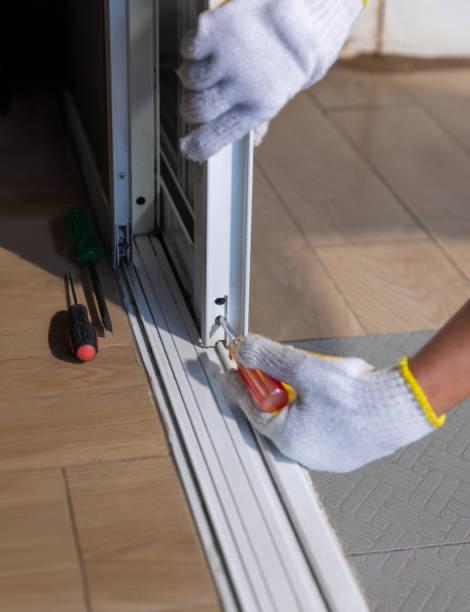
Sand and debris-packed track — a direct cause of accelerated roller wear.
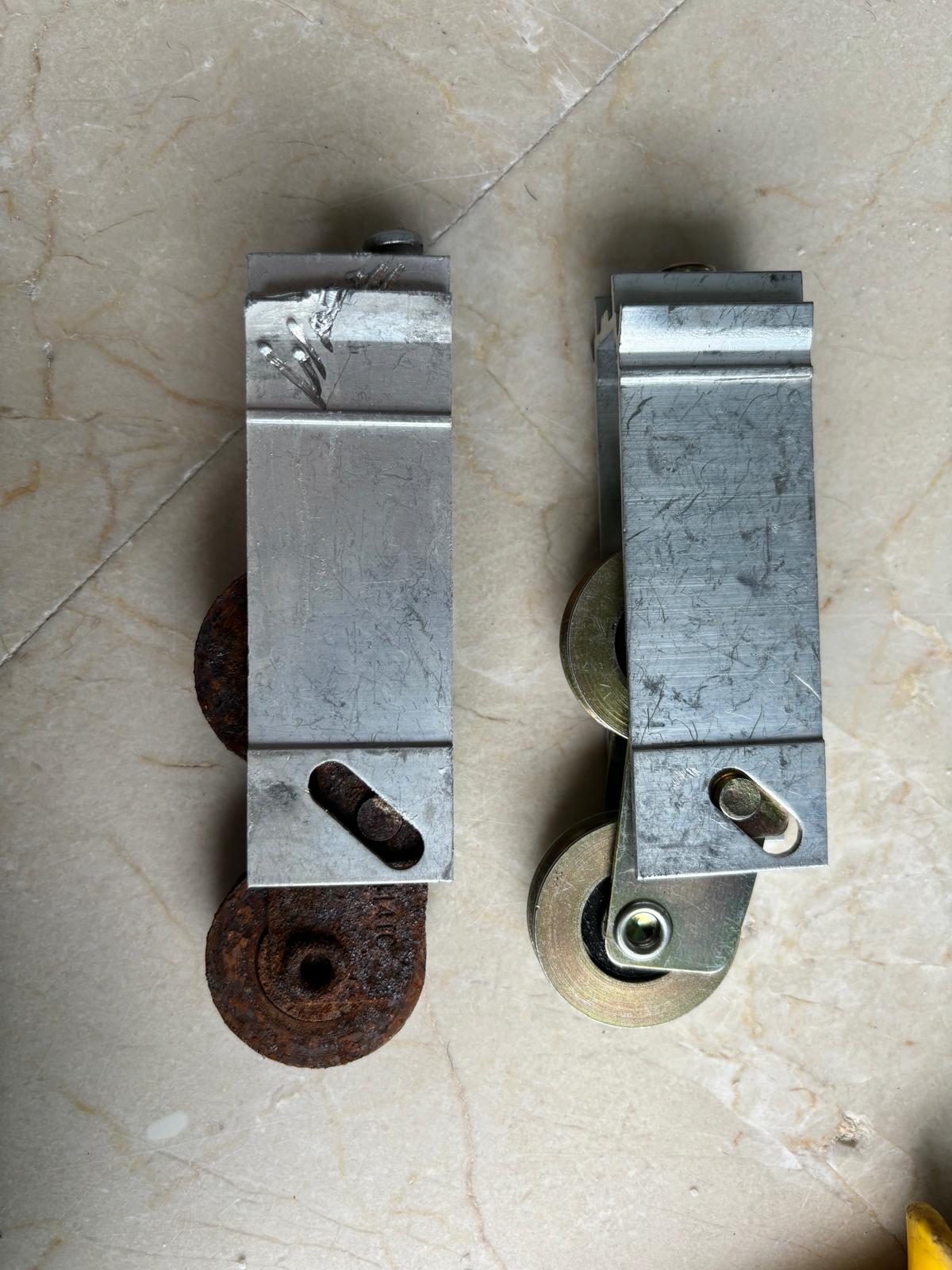
Roller wheel showing flat spot and surface damage from years of grit contact.
Forcing a Stiff Door
When a door starts to feel heavy or sticky, the instinctive response is to push harder. It's understandable — especially if the door leads to the pool, the patio, or the main outdoor living area and needs to be opened dozens of times a day. But forcing a stiff door is one of the fastest ways to turn a manageable roller repair into a more serious problem.
The physics are simple. A sliding door is designed to move freely on rolling bearings, where the force required to open it is minimal. When the rollers are worn or the track is dirty and the door's resistance increases, a hard push bypasses the rolling mechanism and essentially tries to drag the door across the track. That lateral force loads the roller axle sideways — a direction it was never designed to handle — which bends the axle, cracks the housing, and compresses the ball bearings unevenly.
Repeated forcing also applies stress to the door frame itself. Aluminum frames are durable but not immune to fatigue at stress concentration points, particularly the corners where the rails meet the stiles. A warped or cracked frame adds significantly to the cost of a repair that started as a simple roller replacement.
If your sliding door has become noticeably harder to open, stop forcing it and schedule a repair. The cost of a roller replacement is $75 to $200. The cost of a roller replacement plus track repair or frame straightening is significantly higher — and the damage from continued forcing escalates quickly.
Florida Heat and UV Exposure
South Florida's climate is punishing for polymer and plastic components in a way that most northern homeowners never have to think about. Sustained UV exposure from year-round sunshine degrades the nylon and plastic materials used in roller wheels faster than in cooler climates. Over several years of direct sun exposure — particularly for doors on south or west-facing walls that receive afternoon sun — plastic wheels can become brittle, develop surface cracking, or flatten slightly at the contact point where they rest on the track overnight.
Heat cycling is a related issue. Florida temperatures regularly swing from the high 60s overnight to the low 90s by afternoon. Metal components — roller housings, axles, track extrusions — expand and contract with these temperature changes daily. Over years, this thermal cycling gradually loosens the precision fit between the roller cartridge and the door rail cavity, introducing play in the system that causes the door to wobble and the roller to wear unevenly.
The practical countermeasure is choosing replacement rollers with UV-stabilized wheel materials and specifying metal housings rather than plastic where the door weight permits. A good technician familiar with Southwest Florida conditions will factor this into the replacement recommendation automatically.
Rollers Worn Out? We Know Exactly Why — and How to Fix It.
Serving Naples, Marco Island, Bonita Springs, Fort Lauderdale, Pompano Beach, and all of South Florida. Same-day roller replacement with parts built for the coastal climate.
Impact Glass Weight Overload
This is a cause of roller failure that's specific to Florida and other hurricane-zone states, and it catches a surprising number of homeowners off guard. When impact-resistant glass was retrofitted into existing door frames during the wave of hurricane hardening that swept through Southwest Florida after the 2004 and 2005 storm seasons, many homes ended up with significantly heavier glass panels riding on rollers that were originally specified for standard glass.
Impact laminated glass is typically 40 to 60 percent heavier than the standard glass it replaced. A roller rated for a 100-pound door panel that is now supporting a 150-pound impact glass panel is operating well above its design specification on every single cycle. The ball bearings compress and flatten prematurely, the axle experiences higher bending loads, and the housing wears against the door rail channel more aggressively than intended. The result is roller failure years earlier than the manufacturer's rated lifespan would suggest.
If your home had impact glass installed as a retrofit — rather than as original equipment on a door designed for it from the factory — it's worth having a technician confirm that the rollers currently in place are impact-rated and sized correctly for the panel weight. Upgrading to tandem or impact-rated rollers at that point is an inexpensive correction that significantly extends the system's service life.
Wrong Rollers Installed
Rollers that don't match the door's specifications cause premature failure even when they appear to fit. A roller with a wheel diameter that's slightly too small sits the door too low, causing the bottom rail to drag on the track on every cycle. A housing that's slightly too narrow rocks in the door rail cavity, putting lateral stress on the axle. A roller rated for a lighter door fails ahead of schedule under the actual panel weight.
This is most commonly a DIY installation problem — a homeowner orders a visually similar roller online without confirming the exact specifications — but it also happens when a general handyman without specific sliding door experience installs whatever's available at the local hardware store. For a detailed guide on identifying the correct roller for your specific door, our post on how to know what rollers you need covers the full identification process.
Lack of Lubrication
Modern sealed ball bearing rollers are largely self-contained and don't require frequent lubrication. But the track surface itself benefits significantly from periodic treatment. A clean track with a light application of silicone spray lubricant reduces rolling friction, keeps sand and debris from bonding to the surface, and minimizes the abrasive wear on the roller wheel.
What homeowners should avoid is using WD-40 or petroleum-based lubricants on sliding door tracks or roller components. WD-40 is a water displacer and light solvent, not a true lubricant. It removes the thin protective coating from metal surfaces, attracts and holds dust and debris, and can actually accelerate wear rather than reduce it. Silicone-based spray lubricant is the correct product — it stays slick, doesn't attract particulates, and is safe for both metal and vinyl components.
Clean the track with a stiff brush and damp cloth every 3 to 6 months. Follow up with a light application of silicone spray lubricant along the track surface. This simple routine takes about five minutes and can add years to the life of your rollers by keeping the abrasive debris cycle from establishing itself.
How to Prevent Premature Roller Failure
Understanding the causes makes the prevention strategy straightforward. Here's a practical maintenance routine that extends roller life in South Florida's coastal environment.
- Clean the track every 3 to 6 months. Use a stiff brush to dislodge compacted debris, vacuum out loose material, and wipe down the channel with a damp cloth. Pay extra attention after storms, which blow significant sand and debris into the track.
- Apply silicone spray lubricant after each cleaning. A light coat on the track surface keeps the roller wheel gliding smoothly and reduces debris adhesion. Never use WD-40.
- Never force a stiff door. If the door is noticeably harder to open than usual, that's the signal to schedule a repair — not to push harder. Addressing the problem early saves significant cost.
- Choose corrosion-resistant components at replacement time. Stainless steel axles and sealed ball bearings are not optional extras in a coastal climate. They are the baseline for a repair that lasts.
- Confirm roller ratings after impact glass installation. If your home had impact glass retrofitted, have a technician verify that the current rollers are rated for the panel's actual weight.
- Schedule a professional inspection every 5 to 7 years for coastal properties. A technician can identify early bearing wear, track damage, and housing play before any of these become the full-failure symptoms that bring most homeowners to call.
Don't Wait for a Full Failure — Get Ahead of It
Same-day roller inspections and replacements across Naples, Marco Island, Bonita Springs, Fort Lauderdale, Pompano Beach, and all of South Florida. Call now for a free estimate.
Frequently Asked Questions
The most common causes are normal wear over time, salt air corrosion on ball bearings and axles, sand and debris buildup in the track, lack of lubrication, forcing a stiff door, and the added weight stress of heavy impact glass panels. In coastal Florida, these factors work together to shorten roller lifespan significantly compared to inland or drier climates.
Salt air causes oxidation on the steel axles and ball bearings inside the roller cartridge. Once corrosion takes hold, the bearing loses its smooth rotation and the roller begins to drag rather than roll freely. In coastal areas like Naples, Bonita Springs, and Marco Island, this process happens significantly faster than in inland locations.
Yes. Sand, grit, and debris in the bottom track act like sandpaper against the roller wheel surface on every open-and-close cycle. Over time this grinds down the wheel material, causes flat spots, and accelerates bearing wear. Regular track cleaning is one of the most effective ways to extend roller lifespan.
Yes, and significantly. Forcing a door transmits lateral stress to the roller axle and housing — a direction they were never designed to handle. Repeated forcing bends the axle, cracks the housing, and compresses the ball bearings unevenly. It also risks damaging the track and door frame.
Sustained UV exposure degrades plastic and nylon wheel materials faster than in cooler climates, causing brittleness and flat spots. Daily heat cycling also loosens housing tolerances over years, introducing play in the system that causes uneven wear. Choosing UV-resistant wheel materials at replacement time mitigates this significantly.
Yes. Impact glass panels are 40 to 60 percent heavier than standard glass. If a door was retrofitted with impact glass without upgrading the rollers to impact-rated components, the undersized rollers are carrying more weight than they were designed for — shortening their lifespan considerably and risking premature failure.