How Do I Know What Rollers I Need for My Sliding Glass Door?
A complete South Florida homeowner's guide to identifying, measuring, and matching the right replacement rollers for any sliding glass door.
- Why Getting the Right Roller Matters
- Step 1 — Find Your Door's Manufacturer
- Step 2 — Measure the Roller Housing
- Step 3 — Know Your Frame Material
- Types of Sliding Door Rollers Explained
- How South Florida Climate Affects Your Choice
- What Happens If You Use the Wrong Roller
- DIY vs. Hiring a Pro in Pompano Beach
- Frequently Asked Questions
South Florida homeowners deal with sliding glass doors every single day — and most of them don't think twice about those small wheels underneath the door until the whole panel starts grinding, dragging, or refusing to move. If you live in Pompano Beach, Fort Lauderdale, or Boca Raton, you already know how punishing the coastal humidity and salt air can be on anything with moving metal parts. Rollers are no exception. When it's time to replace them, the first challenge most people run into is a simple but surprisingly tricky question: what rollers do I actually need?
The answer isn't always obvious. Walk into a hardware store and you'll find a wall of roller options with no clear labeling for your specific door. Order online and you risk getting something that looks right but fits completely wrong. The good news is there's a straightforward process for identifying exactly what you need — and once you know the four things to check, you'll either find the right part yourself or know exactly what to tell a technician when you schedule a repair. Let's walk through it.

A typical sliding glass door roller assembly — wheel diameter, housing size, and axle type all vary by door brand and model.
Why Getting the Right Roller Matters
Sliding door rollers are not a one-size-fits-all part. They vary by wheel diameter, housing height and width, axle design, weight rating, and whether they're built for aluminum or vinyl frames. A roller that's even a few millimeters off in diameter will sit the door at the wrong height, causing it to drag on the track, bind at the frame, or sit noticeably uneven when closed.
Beyond fit, using the wrong roller puts uneven stress on the track and the door frame itself. Over time, this leads to bent or grooved tracks that are significantly more expensive to fix than a simple roller swap. For homeowners near the water — anywhere from Pompano Beach Pier down the coast toward Fort Lauderdale's A1A corridor — you're also dealing with salt air that accelerates wear on inferior ball bearings. Getting the right roller from the start means it lasts longer and works better throughout hurricane season when those doors need to seal tight and operate reliably every time.
The good news: replacing just the rollers is one of the most cost-effective repairs you can make to a sliding glass door. You don't need to replace the track, the glass, or the frame. You just need the right part.
Step 1 — Find Your Door's Manufacturer
Before you measure anything, try to identify who made your door. This alone can narrow down your roller options dramatically. Most major sliding glass door manufacturers — including PGT, CGI, Milgard, Andersen, Simonton, and Ply Gem — produce proprietary roller cartridges designed specifically for their door systems. The same wheel diameter in two different brands can have a completely different housing shape.
Where to Look for the Manufacturer Stamp
- Bottom rail: The horizontal aluminum piece at the bottom of the door panel. Run your finger along it and look for stamped letters, a model number, or a brand name pressed into the metal.
- Header frame: The top horizontal piece of the outer frame. Some manufacturers stamp here instead.
- Door stile: The vertical side edge of the door panel. Check both the lock side and the handle side.
- Interior door cavity: If there's a sticker inside the door cavity near the roller access cover, that often has the full model and series information.
If the door is older or the stamps have worn off — which happens frequently in South Florida homes that have been through multiple hurricane seasons — move on to the measurement method below.
Take a photo of any stamped numbers or stickers before you do anything else. Even partial model numbers can help a technician cross-reference the correct replacement roller in under two minutes.
Step 2 — Measure the Roller Housing
If you can't identify the manufacturer, the next step is to remove one roller from the door and measure it directly. Here's how to do that safely and what to measure once you have it in hand.
How to Remove a Roller for Measurement
- Open the door panel to the center of the opening.
- Look along the bottom rail for a small access hole or a plastic cap covering the roller adjustment screw.
- Turn the adjustment screw counterclockwise (usually a Phillips head) until the roller retracts up into the door.
- Tilt the bottom of the door panel toward you and lift it off the track. Have a second person hold the panel — these doors are heavy.
- Remove the roller cartridge from the bottom rail cavity by unscrewing the retaining screw or pressing the release tab.
What to Measure
- Wheel diameter: The outer diameter of the rolling wheel itself. Common sizes range from 3/4 inch (19mm) to 1-1/4 inch (32mm).
- Housing height and width: The overall size of the metal or plastic cartridge that holds the wheel.
- Axle hole diameter: The hole through the center of the wheel. This determines what size axle pin the housing accepts.
- Number of wheels: Single-wheel rollers are most common. Tandem (two-wheel) rollers are used on heavier door panels, typically 200 pounds or more.
- Housing shape: Some housings are flat on top, some have a lip or hook that catches the door rail channel. Note the shape carefully.
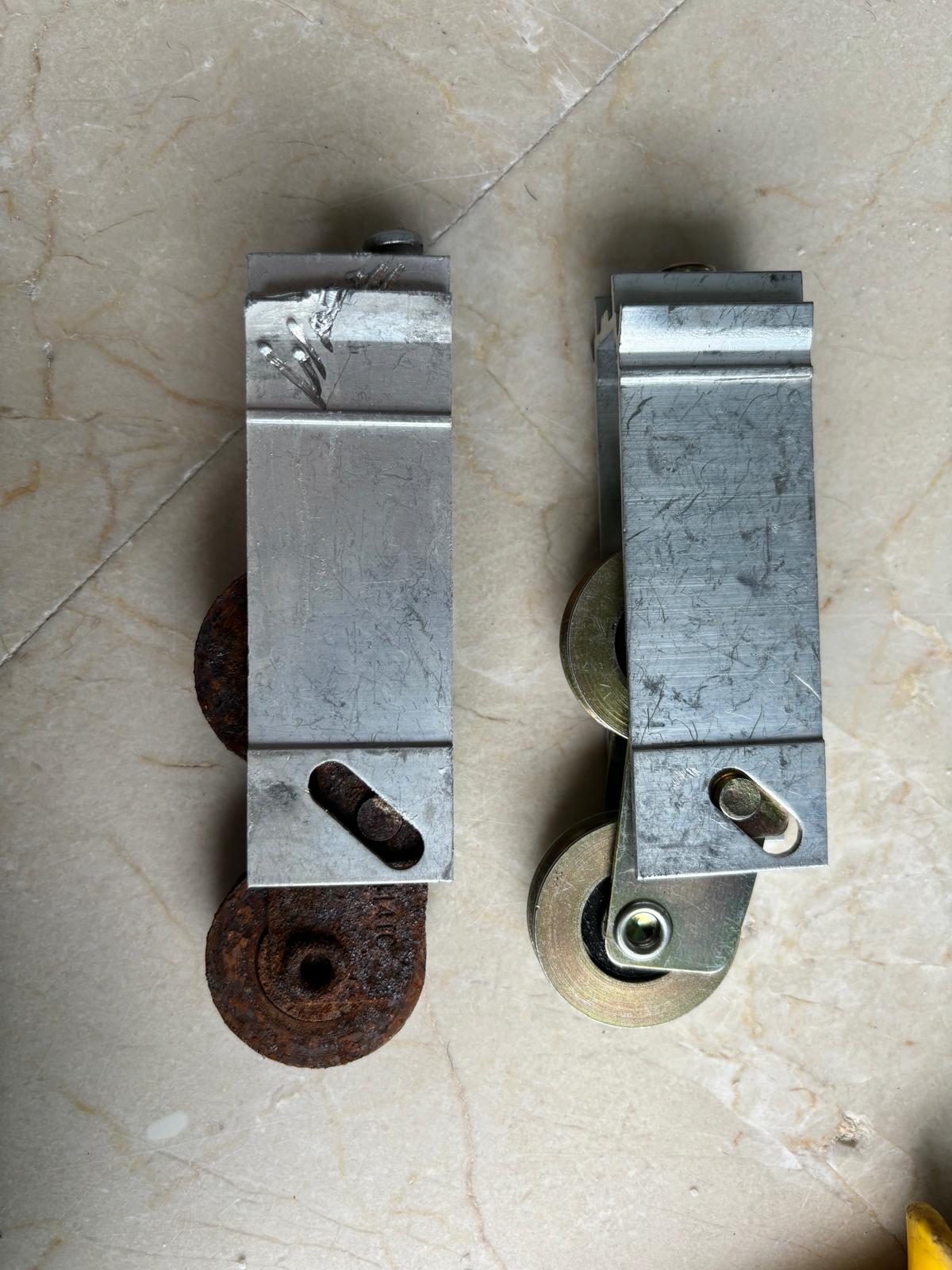
Worn roller removed for measurement and identification.

New replacement rollers ready for installation.
Never attempt to remove the door panel alone. A standard sliding glass door panel weighs between 80 and 200 pounds. Dropping it can shatter the glass, damage the frame, or cause serious injury. Always have a second person assist with lifting.
Step 3 — Know Your Frame Material
Your door frame material determines the entire roller system. Aluminum-frame doors and vinyl-frame doors use different rollers that are not interchangeable, even when the wheel diameter looks the same.
Aluminum Frame Doors
The most common type in South Florida, especially in homes built before 2010. Aluminum-frame doors are heavier and typically use metal-housing roller cartridges. The track channel is wider and the rollers have a more robust housing to support the door's weight. Many homes near the Pompano Beach Pier, in the Hillsboro Beach area, and along the Deerfield Beach coastline have aluminum-frame sliders that have been in place for 20 or 30 years.
Vinyl Frame Doors
More common in newer construction, particularly in planned communities in Boca Raton like Broken Sound or in newer builds in Coral Springs. Vinyl-frame doors use plastic-housing rollers that fit narrower rail grooves. They're lighter and the rollers are typically smaller in overall footprint, though they can still have the same wheel diameter as aluminum counterparts.
If you're not sure what your frame is made of, press a magnet against it. Aluminum is not magnetic. If the magnet doesn't stick and the frame feels rigid, it's aluminum. If it flexes slightly under hand pressure at the corners, it's vinyl.
Types of Sliding Door Rollers Explained
Once you know your door brand, frame material, and measurements, it helps to understand the different roller categories so you can confirm you're ordering the right type.
Single-Wheel Ball Bearing Rollers
The standard for most residential sliding glass doors. A single rubber or nylon wheel mounted on a stainless steel axle with sealed ball bearings. These work well for doors up to about 150 pounds. The ball bearing design reduces friction significantly compared to older bushing-style rollers, making the door noticeably smoother to operate.
Tandem (Double-Wheel) Rollers
Used on heavier panels — typically large patio doors with thick impact-resistant or hurricane-rated glass. Tandem rollers distribute the door's weight across two contact points, which reduces track wear and provides more stable, level operation over years of use. If your door is 200 pounds or heavier, it almost certainly came with tandem rollers from the factory.
Adjustable Rollers
Most modern rollers are adjustable, meaning you can raise or lower the door height after installation by turning an adjustment screw. This is important for maintaining a proper seal at the top and bottom of the door frame, especially after Florida's hurricane season when homes can shift slightly on their foundations. Non-adjustable rollers exist but are generally found only in very old door systems.
Impact-Rated Rollers
Required by the Florida Building Code for impact-resistant sliding doors used in high-velocity hurricane zones. These rollers are built to heavier tolerances and are tested to support the added weight of laminated or tempered impact glass. If your home has impact-rated sliding doors — which is increasingly common in South Florida — make absolutely sure any replacement rollers are rated to match. Using standard residential rollers under an impact door panel is a code violation and a safety hazard.
Not Sure Which Roller Your Door Needs?
Our technicians carry a full inventory of rollers for all major South Florida door brands. We'll identify the right part, replace it on the spot, and have your door gliding smoothly — same day.
How South Florida Climate Affects Your Roller Choice
Roller selection isn't just about fit. In South Florida, the operating environment matters as much as the dimensions. NOAA data consistently shows that the Southeast Florida coastal corridor — from Miami-Dade County up through Broward and Palm Beach County — experiences some of the highest relative humidity levels in the continental United States, averaging above 75% year-round. Combine that with salt air, year-round sun exposure, and a hurricane season that runs June through November, and you have an environment that degrades standard steel and low-quality plastic components faster than almost anywhere else in the country.
When replacing rollers, look specifically for:
- Stainless steel axles rather than standard steel — these resist corrosion significantly longer in salt air environments.
- Sealed ball bearings that prevent moisture intrusion. Open-bearing rollers pick up salt and grit from the track and wear out much faster.
- UV-resistant nylon or reinforced plastic wheels if your door gets direct sun exposure for long portions of the day. Standard plastic wheels can crack or flatten under prolonged Florida heat.
- Weight-appropriate rollers — hurricane-rated glass is significantly heavier than standard glass, and undersized rollers will fail prematurely under the added load.
This is part of why a local technician familiar with South Florida conditions will often recommend a slightly higher-grade roller than what came with the door originally. The upgrade cost is minimal, but the difference in lifespan can be five or more years in this climate.
What Happens If You Use the Wrong Roller
This is worth covering in detail because it's a common and costly mistake. Installing the wrong rollers — even ones that seem close — can cause a cascade of problems.
- The door sits unevenly. A roller that's too small in diameter will cause the door to sag. A roller that's too tall will push the door up into the header, causing binding and making it nearly impossible to lock.
- The track gets damaged. Rollers with the wrong wheel width or profile will gouge the aluminum track channel. Track replacement is a more involved repair than roller replacement — and more expensive.
- The door jumps off the track. An improperly housed roller can derail the door, which risks the glass panel falling or the frame cracking.
- The lock won't engage properly. The sliding door latch and strike plate are positioned to work at a specific door height. The wrong roller height throws that alignment off, leaving the door unlocked or requiring excessive force to lock.
- The glass panel can crack. Under an impact door, a roller that can't support the panel's full weight puts localized stress on the glass, particularly during high-wind events.
Under the Florida Building Code, impact-rated openings must be maintained to their original design specifications. Installing non-rated rollers under an impact glass panel can void your hurricane protection certification and may affect your homeowners insurance coverage for storm damage.
DIY vs. Hiring a Pro in Pompano Beach
Once you've identified the correct roller, the next question is whether to replace it yourself or hire a local sliding door technician. Here's an honest breakdown.
When DIY Makes Sense
If you've already removed the old roller, you have an exact match for the replacement, the door panel is light enough to lift safely with a partner, and you're comfortable working with adjustment screws and track alignment — this is a manageable DIY project. Parts typically run $15 to $50 depending on the roller type. Budget about 1 to 2 hours for a first-time repair.
When You Should Call a Professional
Call a pro if the door panel is large or heavy (anything with impact glass), you can't identify the manufacturer or measure the roller accurately, the track shows signs of damage alongside the worn rollers, or the door has other issues like a bent frame, failed weatherstripping, or a lock that's not aligning. An experienced technician in the Pompano Beach area will typically complete a roller replacement in under an hour, including door removal, replacement, and full height adjustment. Same-day service is standard for most sliding door repairs in Pompano Beach and surrounding Broward County communities.
For most homeowners, the time savings, safety, and guarantee of correct installation make hiring a local specialist the better value — especially when you factor in the cost of replacing a track or glass panel if something goes wrong during a DIY attempt. If you're ready to get it done right, get a free estimate and we'll take it from there.
Get the Right Rollers Installed Today
Serving Pompano Beach, Fort Lauderdale, Boca Raton, Deerfield Beach, Coral Springs, and all of South Florida. Call now for same-day sliding door roller replacement.
Frequently Asked Questions
Check the bottom rail for a manufacturer stamp or model number, note your frame material (aluminum or vinyl), and measure the roller housing diameter and wheel count. If you can remove one roller, bring it to a hardware store for a direct match. A licensed technician can identify the correct replacement on the spot.
No. Rollers vary by wheel diameter, housing size, axle type, and frame material compatibility. Using the wrong roller can cause binding, track damage, or derailment. Always match the replacement to your exact door brand and model.
Remove one roller cartridge and measure the wheel's outer diameter, the housing height and width, and the axle hole diameter. Note whether it has one or two wheels. Bring the old roller and these measurements to a hardware store or share them with your technician for exact matching.
Check the bottom rail, the header frame at the top, or the vertical edge of the door stile. It may also appear on a sticker inside the door cavity near the roller access cover. Brands like PGT, CGI, Milgard, and Andersen typically stamp this directly into the aluminum frame.
Aluminum frame doors use metal-housing rollers built for heavier panels. Vinyl frame doors use plastic-housing rollers sized for narrower rail grooves. They are not interchangeable — installing the wrong type can crack the rail or cause the door to bind.
The door can sit unevenly, grind on the track, refuse to lock properly, or jump off the rail entirely. In serious cases, a mismatched roller under a heavy impact glass panel can cause the glass to crack. Always verify the spec before installation.