Why Is My Sliding Door So Hard to Slide When I've Already Cleaned the Track?
You cleaned the track and it's still grinding. That means the problem was never the track. Here's exactly what's actually wrong — and what to do about it today.
You've done everything right. You cleaned the track, vacuumed out the debris, maybe even wiped it down with a cleaner — and your sliding glass door is still stiff, heavy, and grinding every time you try to open it. This is one of the most frustrating situations homeowners in Pompano Beach, Naples, Fort Lauderdale, Boca Raton, and Coral Springs describe when they call us. And there's a good reason for it: in most cases, the track was never the main problem to begin with.
A dirty track is an easy first step — it's visible, it's simple, and it sometimes makes a small difference. But in South Florida's coastal environment, the real causes of a hard-to-slide door are almost always hiding inside the roller housing or in the hardware itself — places no amount of track cleaning will reach. This guide identifies every cause that keeps a door stiff after the track has been cleaned and tells you exactly what to do next. If you're ready to stop guessing and get it fixed, call our team now for a free same-day assessment in Pompano Beach, Naples, and throughout South Florida.
Why Cleaning the Track Is Often Not Enough
The track channel in the floor guides the door — but it doesn't power the movement. The rollers do. Those small ball-bearing wheels inside the bottom of your door panel are what the door actually rides on, and when they corrode, seize, or collapse, no amount of track cleaning changes anything about how the door feels when you slide it. In South Florida's environment — whether you're near Pelican Bay in Naples, the oceanfront communities along Pompano Beach Pier, or the Intracoastal waterways of Fort Lauderdale — salt air, humidity, and coastal grit attack roller bearings constantly and silently.
The result is a door that feels like it's getting worse despite your maintenance efforts — because the visible problem (dirty track) was masking the real problem (failing rollers) the whole time. Cleaning the track removes surface friction. It doesn't restore bearings that have corroded inside their housing. Understanding this distinction is what separates a successful repair from an endless cycle of cleaning, lubricating, and still struggling with a heavy door every morning.
The 5 Real Causes When the Track Is Already Clean
🔩 Worn Roller Bearings
Corroded or shattered ball bearings inside the roller housing create internal friction that no external cleaning reaches. The #1 cause of persistent door stiffness in all coastal South Florida communities.
Fix: Roller Replacement📉 Dropped Panel
The door panel has lost roller height and now drags directly on the track surface rather than riding above it. Cleaning removes debris but doesn't lift the panel back to its correct height.
Fix: Roller Height Adjustment🛤️ Bent Track Surface
A deformation in the aluminum track creates a raised section that the rollers catch on every pass — no matter how clean the surrounding track is. Common in older Naples and Pompano Beach homes.
Fix: Track Repair or Replacement🧴 Wrong Lubricant
If WD-40 or a petroleum-based product was used previously, it has left a sticky residue inside the roller housing and on the track surface that attracts new debris immediately — making the door feel worse after each cleaning.
Fix: Degrease + Silicone Spray📐 Frame Warp or Expansion
South Florida's thermal cycling — intense sun followed by air-conditioned interior — causes aluminum frames to expand and contract daily. Over years, this creates subtle frame warp that creates friction points the rollers can't overcome.
Fix: Professional Assessment🌊 Salt Corrosion Build-Up
In Gulf Coast Naples and Atlantic-facing Pompano Beach properties, salt deposits form a crystalline layer inside the roller housing and on the track rail surface — deeper than visible debris — that standard cleaning doesn't remove.
Fix: Vinegar Desolve + Roller CheckCause 1 — Worn or Seized Roller Bearings
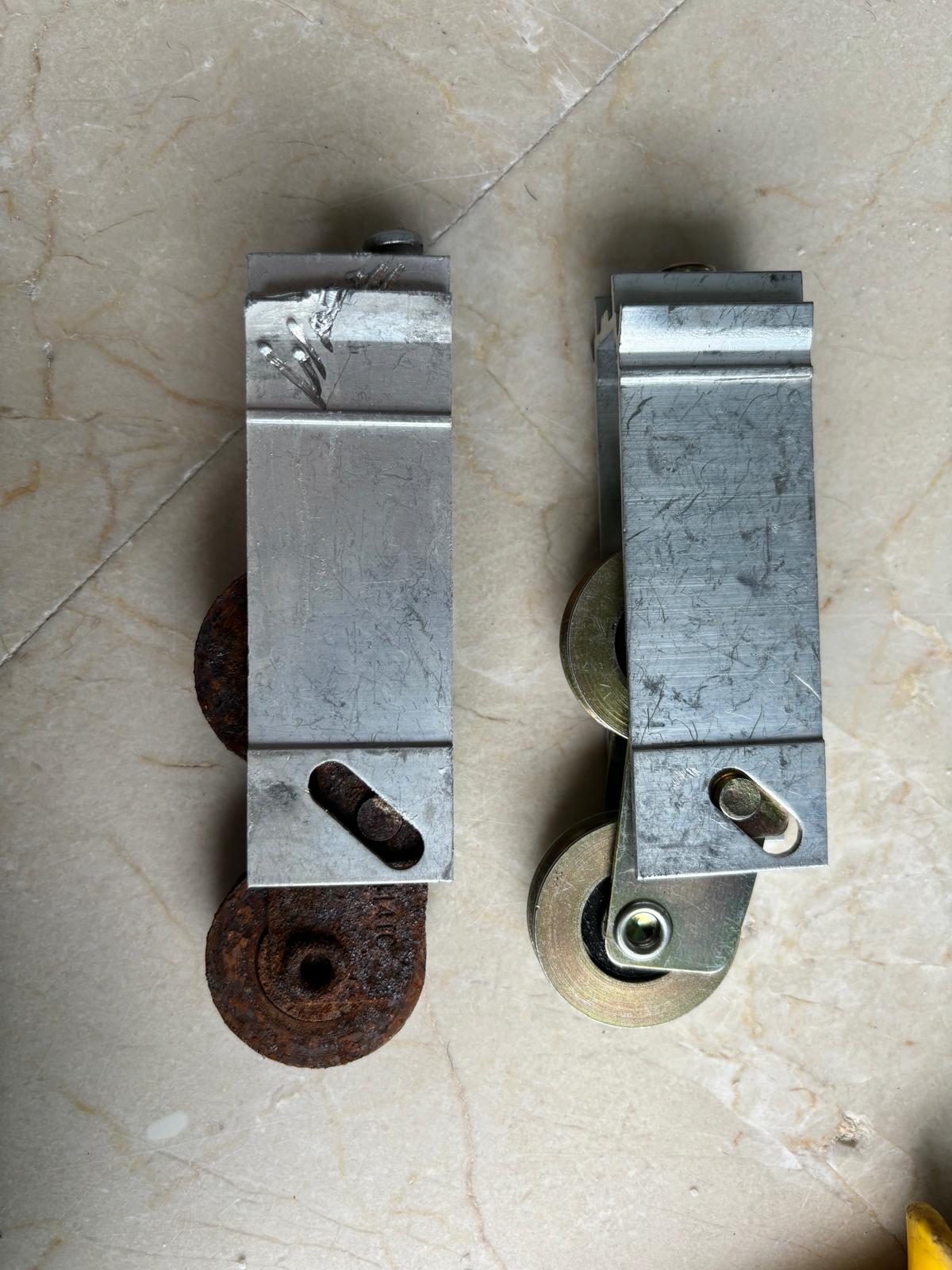
This is the cause behind the majority of "I cleaned it and it's still stiff" calls our technicians receive from homeowners near Vanderbilt Beach in Naples and along Atlantic Blvd in Pompano Beach. The rollers are small ball-bearing assemblies housed inside the bottom rail of the door panel. When those bearings corrode — which happens in 5–7 years in direct salt air exposure — they stop rolling and start dragging. The door doesn't glide on wheels anymore; it drags on seized metal.
Here's the key point: the bearing corrosion happens inside the sealed roller housing. It's invisible from outside the door and completely unaffected by track cleaning. You could clean that track every week and the seized bearings would still make the door feel like it weighs twice what it does. The only fix is roller replacement — a same-day service that costs $95–$250 and immediately restores one-finger operation. This single repair resolves the issue for 70–80% of the "already cleaned the track" calls we receive across South Florida.
The quickest field test for seized rollers: with the door closed, get down and look at the gap between the bottom of the door panel and the track surface. If the panel is sitting directly on the track with no visible gap, the rollers have either seized or collapsed entirely. If there's a consistent gap but the door still drags, it's more likely a track surface issue or dropped panel. Either way — call a local sliding door specialist for same-day service rather than continuing to clean a track that isn't the problem.

Cause 2 — Dropped Panel Rubbing on the Track
Even with a clean track, a door panel that has dropped out of its correct height position will drag on the track surface with every use. The panel should ride above the track on its rollers with a clearance of roughly 3–5mm — enough to glide without contact. When the roller adjustment screws loosen over time or the rollers wear down, the panel drops until it's sitting directly on the aluminum track surface. Cleaning removes loose debris, but the contact friction between the panel frame and the track surface remains.
This is particularly common in older homes near Marco Island and in established Fort Lauderdale neighborhoods near Las Olas Blvd where door systems have been in service for 15–20 years without a hardware check. The fix is a roller height adjustment — turning the adjustment screws clockwise to raise the panel back to its correct clearance above the track. If the screws are seized from corrosion (common in salt air environments), the roller assembly needs professional replacement. See our full guide on why sliding doors stop closing properly for more on dropped panel diagnosis.
Cause 3 — Bent or Corroded Track Surface
Cleaning the track removes loose debris — sand, salt crystals, hair, and dust. It doesn't fix a track that is physically bent, dented, or surface-corroded. A small raised section in the track aluminum — caused by foot traffic, furniture impact, or years of thermal expansion — creates a bump the roller catches on every single pass. From the homeowner's perspective, the door slides fine in most of its travel and then catches at one specific point. That catch point is the bend.
Similarly, surface corrosion on the track rail — the polished aluminum surface the rollers ride on — creates micro-roughness that increases rolling resistance even on a clean track. In Gulf Coast Naples communities near Port Royal and in Pompano Beach oceanfront properties, track surface corrosion from salt air is a consistent finding on service calls where track cleaning hasn't resolved the stiffness. Our track repair service handles both bent track reshaping and corroded track replacement with same-day availability on most jobs.
Still Stiff After Cleaning? We'll Find the Real Problem.
Our technicians diagnose the actual cause — not just the visible symptoms — and fix it same day. Serving Pompano Beach, Naples, Fort Lauderdale, Boca Raton, Marco Island, and all of South Florida. Free estimates, 24/7.
Cause 4 — Wrong Lubricant Making Things Worse
This is a cause that surprises most homeowners. If WD-40, cooking oil, or any petroleum-based product has been applied to the track or roller housing at any point in the past, it has almost certainly made your current cleaning efforts ineffective. WD-40 leaves a petroleum film that dries sticky within days in South Florida's heat. That film then bonds with the fine coastal sand and salt particles that immediately infiltrate the track — creating a grinding paste that is significantly more damaging than a simple dirty track.
The result: homeowners clean the visible debris, the door feels slightly better for a day or two, then quickly returns to the same stiffness — or worse. This cycle is common in homes along Deerfield Beach's Cove area and in Coral Springs neighborhoods near Wiles Road where well-intentioned DIY maintenance has used the wrong product over years. The fix requires a degreaser application to the track and roller housing access points to strip the petroleum residue, followed by a fresh application of dry silicone spray. If the wrong lubricant has penetrated deep into the roller bearing housing, roller replacement may be the only way to fully resolve the internal contamination. Read our full guide on how to lubricate sliding door rollers correctly to avoid this problem going forward.
Never apply WD-40 to a sliding door track or roller housing — not before cleaning, not after, not ever. It is a water displacer, not a lubricant. In South Florida's salt air and sand environment it creates a grinding compound inside your roller housing within days of application. Always use dry silicone spray or a Teflon-based lubricant. If WD-40 has already been used, degrease the track before applying anything else.
Cause 5 — Frame Warp or Thermal Expansion
South Florida's climate subjects aluminum door frames to some of the most extreme thermal cycling of any residential environment in the country. On a summer day in Naples or Pompano Beach, the exterior face of an aluminum door frame can reach 140–160°F in direct afternoon sun — while the interior side sits at air-conditioned 74°F. This differential causes the aluminum to expand and contract daily, and over years of repetition, it can create subtle frame warp that narrows the door opening or creates friction points that the rollers can't overcome regardless of how clean and lubricated the track is.
Frame warp is the least common cause on this list but the most serious — it's the one scenario where a professional assessment is essential before any further DIY work. If you've cleaned the track, replaced the lubricant, adjusted the roller height, and the door is still stiff — particularly if it binds at the same point every time and you can see the panel rubbing against the frame jamb — schedule a professional inspection. Our teams in Naples and Pompano Beach assess frame condition as part of every service call at no additional charge.
How to Diagnose Your Exact Problem in 5 Minutes
Work through these tests in order. Each one eliminates a cause and points you to the next step:
The Lift Test
Push up gently on the door panel while sliding it. If the resistance disappears immediately — the panel has dropped. Roller height adjustment or replacement is the fix. If lifting doesn't help, move to the next test.
The Gap Test
Look at the gap between the bottom of the door panel and the track surface. A consistent 3–5mm gap means the panel is at correct height. No gap — or the panel sitting on the track — means the rollers have collapsed or the panel has dropped. This confirms roller replacement is needed.
The Catch-Point Test
Slide the door slowly through its full travel and note where the resistance is greatest. If it catches at one specific location every time — there's a track bend at that point. If the resistance is consistent throughout the full travel — the rollers or lubricant are the issue, not a specific track defect.
The Lubricant History Check
Has WD-40 or any spray oil been used on this door in the past? If yes — degrease the track with a citrus degreaser, wipe clean, apply dry silicone spray, and retest. If the door improves significantly, the wrong lubricant was the primary cause.
The Frame Check
Stand back and look at the door frame. Are both vertical jambs plumb? Is the gap between the panel and the frame even on both sides when the door is closed? Visible asymmetry or the panel visibly rubbing against the jamb points to frame warp — call a professional at this point.
How to Get It Fixed Today
If you've worked through the diagnosis steps above and identified the cause, here's what to do next based on what you found:
- Roller replacement needed — call (877) 450-8772 now. Same-day roller replacement service is available across Pompano Beach, Naples, Fort Lauderdale, Boca Raton, and all surrounding areas. Cost: $95–$250. Time: under 2 hours.
- Roller height adjustment needed — this is DIY-accessible if the screws turn freely. If the screws are seized from salt air corrosion, call for professional service to avoid stripping the housing.
- Track bend identified — don't attempt to hammer it flat. Call for track repair service. Cost: $75–$400 depending on whether reshaping or replacement is needed.
- Wrong lubricant residue — degrease, wipe dry, apply silicone spray, and test. If the door still drags after a proper degreasing and re-lubrication, the roller bearings have internal contamination and need replacement.
- Frame warp suspected — schedule a professional inspection. Our teams assess frame condition on every call and give you a straight recommendation — repair, adjustment, or replacement.
For more context on what each repair costs before you call, see our full sliding door repair cost guide. And if you want the complete step-by-step fix guide for a stiff sliding door from scratch, our post on how to fix a sliding door that won't slide smoothly covers every scenario.

Stop Cleaning. Start Fixing. Call Now.
A1 Sliding Doors diagnoses and repairs the real cause — same day, free estimate, no obligation. Serving Pompano Beach, Naples, Fort Lauderdale, Boca Raton, Deerfield Beach, Marco Island, Coral Springs, and all of South Florida.
Sources: NOAA — South Florida Climate & Humidity Data | A1 Sliding Doors — Roller Replacement | A1 Sliding Doors — Track Repair | How to Fix a Sliding Door That Won't Slide Smoothly | How to Lubricate Sliding Door Rollers