What Is the Best Lubricant for Sliding Door Tracks?
A straight product-by-product comparison — how each lubricant type performs in South Florida's coastal climate, which one wins for your specific location, and exactly how to apply it correctly.
- Why Lubricant Choice Matters More in South Florida
- Every Lubricant Type Compared
- Silicone Spray — The Standard Recommendation
- PTFE Spray — The Coastal Upgrade
- Graphite Lubricant — Limited Use Case
- White Lithium Grease — Why It Fails in Tracks
- Petroleum-Based Products — Never on Tracks
- Which Lubricant for Which South Florida Location
- How to Apply Track Lubricant Correctly
- Lubricant Performance in Palm Beach County
- Frequently Asked Questions
Not all lubricants are created equal for sliding door tracks, and in South Florida the difference between the right product and the wrong one is measured in years of track lifespan. The coastal environment — fine beach sand, salt air aerosol, high humidity, and intense UV — exposes every lubricant's weaknesses in ways that simply don't apply in drier inland climates. A product that works adequately in Arizona performs very differently on a track in Boca Raton, Delray Beach, or Palm Beach.
This guide compares every major lubricant category against the specific demands of South Florida's track environment — not just which product is "best" in the abstract, but which product performs best for your specific location along the coast, how each one interacts with the aluminum track surface and rubber weatherstripping, and what the science behind the performance difference actually is. A1 Sliding Doors recommends lubricants to homeowners every day across the region — here's the complete picture.
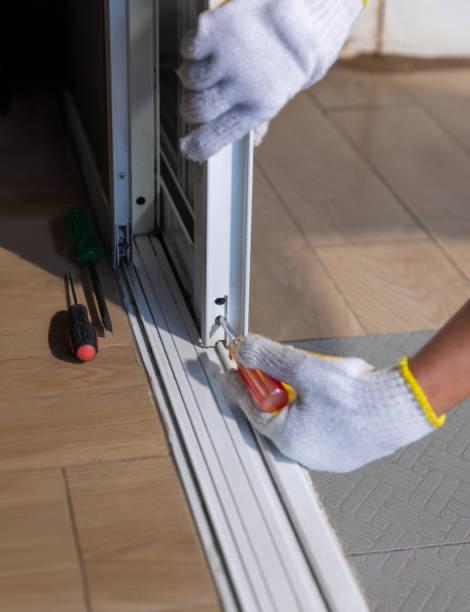
A properly cleaned track — the foundation without which no lubricant performs correctly.
Why Lubricant Choice Matters More in South Florida
In most climates, lubricant selection for sliding door tracks is a secondary concern — almost any product provides some benefit, and the difference between a good and a poor choice takes years to become apparent. In South Florida, the wrong lubricant actively accelerates track damage within weeks of application. Understanding why requires looking at what the South Florida environment actually does to lubricants.
NOAA climate data shows that Southeast Florida's coastal corridor averages relative humidity above 75% year-round with brief periods exceeding 90% during the summer rainy season. This high-moisture environment affects lubricant stability — some products emulsify, others become tacky, and wet lubricants lose their consistency under humidity stress. More importantly, fine coastal sand and salt aerosol particles are constantly present in the air. Any lubricant with surface tack — petroleum residue, oil film, grease — immediately begins collecting these particles and bonding them to the track surface.
The result is that lubricant choice in South Florida is not just about reducing friction — it's about selecting a product whose post-application surface characteristics don't create a sand-capture mechanism in the track channel. This single criterion eliminates the majority of lubricants that work acceptably in other environments and narrows the field to the dry lubricant category.
Every Lubricant Type Compared
| Product | Type | Debris Attraction | Duration (South FL) | Safe for Rubber | Verdict |
|---|---|---|---|---|---|
| Silicone Spray | Dry | None | 3–4 months | Yes | Best choice |
| PTFE (Teflon) Spray | Dry | Minimal | 4–5 months | Yes | Best for coastal |
| Graphite Spray | Dry | Low | 2–3 months | Mostly yes | Acceptable |
| White Lithium Grease | Wet | High | Days | Mostly yes | Avoid |
| WD-40 | Solvent | Very High | 1–3 days | No | Never use |
| Petroleum Oil/Grease | Wet | Very High | Days | No | Never use |
| Cooking Spray/Oil | Wet | Very High | Days | No | Never use |
Silicone Spray — The Standard Recommendation
Silicone spray applies as a liquid and dries to a thin, dry film on the track surface. Once dry, the silicone coating is non-tacky — it doesn't attract or hold the sand and salt particles present in South Florida's coastal air. A roller wheel passing over a silicone-treated track picks up minimal particulate contamination on each cycle, meaning the lubricant maintains its effectiveness over many open-and-close cycles before reapplication is needed.
Silicone is chemically inert — it doesn't react with aluminum, vinyl, or the rubber compounds used in door weatherstripping. This is critical because petroleum-based lubricants gradually degrade rubber weatherstripping, and in South Florida where weatherstripping integrity directly affects hurricane resistance and moisture infiltration, that degradation has real consequences.
On a properly cleaned track in South Florida conditions, silicone spray lasts 3 to 4 months before the lubricant film degrades enough to warrant reapplication. For most residential properties in Palm Beach County and Broward County, this means a quarterly maintenance routine covers the full year.
Buy silicone spray in the aerosol can format rather than the pump spray. The aerosol provides a finer, more even mist that coats the rail surface uniformly. Pump sprays tend to produce larger droplets that pool in track corners rather than coating the rail surface evenly. Any hardware store brand labeled "silicone spray" or "dry silicone lubricant" is appropriate — there's no need for an expensive specialty product.
PTFE Spray — The Coastal Upgrade
PTFE — the same material used in non-stick cookware — produces an even more debris-repellent dry coating than silicone. The PTFE film has an extremely low coefficient of friction and an essentially non-stick surface that repels fine particulates more effectively than silicone. For properties within a mile of the ocean or Intracoastal in Palm Beach County — particularly in communities along the A1A corridor in Palm Beach, Singer Island, or Juno Beach — PTFE spray's superior debris repellency produces measurably better performance between maintenance cycles.
PTFE spray is slightly more expensive than silicone — typically $8 to $14 versus $5 to $9 for silicone — and may not be carried at all hardware stores, though it's available online and at most automotive and industrial supply retailers. The additional cost is justified for high-sand oceanfront locations; for inland properties in Palm Beach County, silicone spray delivers equivalent practical results at lower cost.
Like silicone, PTFE is safe for aluminum, vinyl, and rubber. It can be applied using the same technique as silicone spray and requires a clean, dry track as the prerequisite for effective performance.
Graphite Lubricant — Limited Use Case
Graphite spray is a dry lubricant that has been used on sliding mechanisms for decades. It provides good initial lubrication and is less attractive to debris than wet lubricants. However, it has two specific limitations that make it a secondary choice for South Florida sliding door tracks compared to silicone and PTFE.
First, graphite leaves a dark residue that stains the track channel, the door frame, and anything that contacts the track including flooring near the threshold. In homes with light-colored tile or stone flooring — common in South Florida's warm-weather aesthetic — this staining is a practical drawback. Second, graphite particles are fine solids that can work into weep holes and contribute to blockage over time, particularly when combined with the sand and salt debris already present in coastal tracks.
Graphite spray is a reasonable choice if silicone or PTFE spray is unavailable, but it's not the preferred product for South Florida's specific track environment.
White Lithium Grease — Why It Fails in Tracks
White lithium grease is an excellent lubricant for what it was designed for — high-load metal-to-metal applications like hinges, wheel bearings, and garage door mechanisms where the lubricant is enclosed or semi-enclosed and not exposed to constant particulate contamination. A sliding door track in South Florida is precisely the wrong environment for it.
White lithium grease is a wet lubricant that stays in a thick, grease-like state on the track surface. In coastal Florida's sand-laden air, this surface immediately begins collecting fine particles. Within days, the grease layer in the track channel is saturated with fine sand and salt crystals that transform it into an abrasive paste. The roller wheel then grinds through this paste on every cycle, wearing both the wheel surface and the aluminum track rail simultaneously.
White lithium grease is also very difficult to remove from aluminum track channels once it has been applied and contaminated with debris — it adheres to the channel walls, corners, and weep hole interiors and requires degreaser and significant scrubbing to clear. For any homeowner who has applied white lithium grease to their track and wants to reset, the track cleaning process described in our post on sliding door track maintenance covers the removal procedure in detail.
Petroleum-Based Products — Never on Tracks
All petroleum-based products — WD-40, 3-in-1 oil, motor oil, axle grease, cooking spray, olive oil, and similar products — fail in sliding door track applications for the same fundamental reason: they leave a wet, tacky, or oily residue that immediately and aggressively collects the fine sand and salt particles present in South Florida's coastal air.
WD-40 has the additional problem of being a solvent that strips the aluminum track's natural oxide protective layer, accelerating corrosion initiation. Cooking oils and food-based sprays go rancid in Florida's heat, producing odors and a sticky residue that attracts insects alongside debris. Petroleum greases are effectively impossible to fully remove from track channels once embedded and their debris-bonding capacity is the highest of any lubricant category.
The complete picture of what WD-40 specifically does to track channels — including the weep hole blockage mechanism that causes accelerated corrosion — is covered in our detailed post on whether to use WD-40 on sliding glass door tracks. The conclusion applies equally to all petroleum-based alternatives: none of them belong in a sliding door track in South Florida.
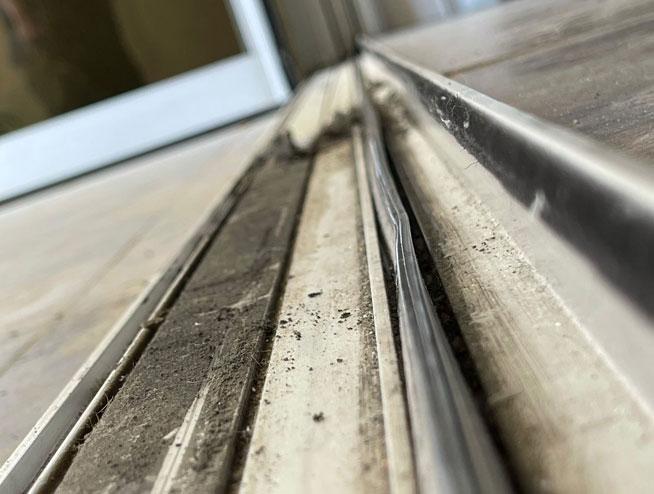
Track damage from repeated petroleum lubricant application — abrasive paste has worn grooves into the rail surface.
Same track type maintained correctly with silicone spray — clean, smooth, no debris bonding.
Track Damaged by the Wrong Lubricant? We'll Fix It.
Same-day track assessment, cleaning, and replacement across Palm Beach County, Broward County, Naples, and all of South Florida. Free estimates, flat-rate pricing.
Which Lubricant for Which South Florida Location
The best lubricant recommendation isn't the same for every property in South Florida. Distance from saltwater and sand exposure level both affect which dry lubricant produces the best practical results.
Oceanfront and Beachfront Properties
Properties directly on the Atlantic or Gulf coast, or within a few hundred feet of the beach: PTFE spray is the preferred choice. The highest sand and salt aerosol exposure in the region demands the most debris-repellent coating available. Apply every 3 months without exception, immediately after any storm event, and at the end of hurricane season in November.
Intracoastal and Canal-Front Properties
Properties on the Intracoastal Waterway, tidal canals, or other saltwater-adjacent locations throughout Palm Beach County: either PTFE or silicone spray is appropriate. Salt exposure is high but sand exposure is lower than direct oceanfront. PTFE provides slightly better performance; silicone is a very close second. Apply every 3 months.
Near-Coastal Residential Communities
Properties 1 to 5 miles from the coast — in inland communities of Boca Raton, Boynton Beach, Delray Beach, and western Palm Beach County: silicone spray is the correct and cost-effective choice. Salt exposure is meaningful but sand accumulation is lower. Apply every 4 months.
Inland Communities
Properties 5 or more miles from the coast — in western Palm Beach County communities and inland areas: silicone spray, applied every 5 to 6 months. Lower salt exposure means the lubricant maintains effectiveness longer between applications.
High-Traffic Doors
Any door used more than 15 to 20 times per day — pool access doors, primary entry/exit sliding doors in high-use households — should be maintained on the shorter end of each interval regardless of location. High cycle count accelerates lubricant film depletion independent of environmental factors.
How to Apply Track Lubricant Correctly
The correct application technique matters as much as the product itself. Applied incorrectly, even the best lubricant produces suboptimal results.
This is the non-negotiable prerequisite. Vacuum out loose debris, scrub the channel with a stiff brush, and wipe down with a damp cloth. Allow to dry completely. Applying lubricant over a dirty track seals debris in place rather than removing it.
Position the spray can 6 to 8 inches from the track surface. Too close concentrates the spray in one area and produces excess pooling. Too far and the spray disperses before reaching the track surface with useful coverage.
Move the spray can steadily along the full length of the rail surface in one smooth pass. The goal is a light, even film — not a heavy coat. Over-application pools in the track corners and can work into the weep holes without providing additional lubricating benefit.
Slide the door back and forth the full width of the opening 5 to 6 times. This distributes the lubricant film evenly across the entire roller contact area, including the sections of the track that were covered by the door panel during application.
Any lubricant that has migrated onto the threshold surface surrounding the track should be wiped up — it creates a slip hazard on smooth tile or stone flooring. The lubricant belongs on the rail surface, not on the surrounding threshold.
Never apply lubricant and then immediately try to use the door as the final test of effectiveness. Let the lubricant dry for 5 to 10 minutes before the final operational test — silicone and PTFE sprays need a brief drying period to form their protective film on the aluminum surface.
Lubricant Performance in Palm Beach County
Palm Beach County's geography creates three distinct lubrication environments within a relatively compact area — and understanding which zone your property falls in helps calibrate both product choice and maintenance frequency correctly.
The barrier island communities of Palm Beach, North Palm Beach, and Singer Island are in the highest-exposure category — direct ocean exposure on the east and Intracoastal exposure on the west, with fine quartz and coquina sand present in the air from both directions during onshore and offshore wind conditions. PTFE spray and a 3-month maintenance schedule are the appropriate choice here. These communities see lubricant film depletion faster than almost anywhere else in the county.
The mainland coastal communities — Palm Beach County's oceanside cities including Boynton Beach, Delray Beach, and Lake Worth Beach — fall in the near-coastal category where silicone spray and a 3 to 4 month schedule work well for most residential doors. Exceptions include homes directly on the Intracoastal, where PTFE is the better choice.
Western Palm Beach County communities including Wellington, Royal Palm Beach, and Loxahatchee are in the inland category. Silicone spray applied every 5 to 6 months is sufficient in these areas. The reduced salt exposure means lubricant films last longer and debris accumulation is driven primarily by organic matter and road dust rather than coastal sand. If your door in any of these areas is still rough after proper cleaning and lubrication, the track or rollers likely need professional attention — get a free estimate and we'll confirm what the door actually needs.
Lubricated Correctly — Still Not Sliding Smoothly?
Serving Boca Raton, Delray Beach, Boynton Beach, West Palm Beach, and all of Palm Beach County and South Florida. Same-day track repair, free estimates, warranty on every job.
Frequently Asked Questions
Silicone-based spray lubricant is the best all-around choice for South Florida. It dries to a clean, debris-repellent film, is safe for all track materials including vinyl and rubber weatherstripping, and lasts 3 to 4 months per application. For high-sand coastal properties, PTFE spray is an excellent upgrade with even better debris repellency.
Both are dry lubricants that outperform all wet alternatives in South Florida's coastal environment. Silicone spray is the correct choice for most residential applications — widely available and highly effective. PTFE spray provides a slightly more debris-repellent coating, making it the better choice for oceanfront or beachfront properties with the highest sand and salt exposure.
No. White lithium grease is a wet lubricant that immediately attracts and holds fine sand and salt particles in South Florida's coastal air, creating an abrasive paste in the track channel within days. It is also extremely difficult to remove once applied and embedded with debris.
Dry lubricants — silicone spray and PTFE spray — consistently outperform all wet lubricants in high-humidity coastal environments. Humidity itself doesn't degrade silicone or PTFE performance, and their non-tacky surface doesn't attract the particulates present in coastal air. Wet lubricants fail specifically because humidity combined with salt air particulates creates aggressive debris bonding to any tacky surface.
Clean the track completely first — vacuum, brush, and damp cloth. Allow to dry. Hold the spray can 6 to 8 inches from the surface and apply a thin, even coat along the full rail length. Slide the door back and forth 5 to 6 times to distribute the lubricant across the entire roller contact area. Wipe any overspray from the surrounding threshold.
Silicone spray on a clean track lasts 3 to 4 months in South Florida. PTFE spray may extend to 4 to 5 months for inland properties. Coastal properties within a mile of the ocean should reapply every 3 months regardless of product. WD-40 and petroleum lubricants last 1 to 3 days before debris bonding overrides their effectiveness.