How Long Do Sliding Door Tracks Typically Last?
The honest answer for South Florida homeowners — what affects track lifespan, how the coastal climate compresses it, and what you can do to get the most out of every track replacement.
- Typical Track Lifespan — The Numbers
- Lifespan by Location in South Florida
- What Shortens Track Lifespan
- Aluminum vs. Vinyl Track Lifespan
- Early Warning Signs the Track Is Aging
- Late-Stage Signs — When Replacement Is Overdue
- How to Extend Your Track's Lifespan
- The Right Maintenance Schedule for South Florida
- Track Lifespan Around Pompano Beach
- Frequently Asked Questions
Sliding door tracks don't come with an expiration date stamped on them, and most homeowners have no idea whether their track is 5 years old or 20 years old when a problem develops. Understanding typical track lifespan — and more importantly, the factors that shorten or extend it in South Florida's specific environment — gives homeowners a framework for knowing whether their door needs maintenance, repair, or replacement before it becomes a bigger problem.
The simple answer is that tracks last 15 to 25 years in most of the country. In South Florida, that number can drop to 8 to 12 years for coastal properties without regular maintenance, or extend to 20 years or more for well-maintained inland homes. The gap between those two outcomes isn't about the track itself — it's about the environment and the maintenance habits that work against or with it. A1 Sliding Doors has replaced thousands of tracks across Pompano Beach and the surrounding region — here's what the data looks like on the ground.
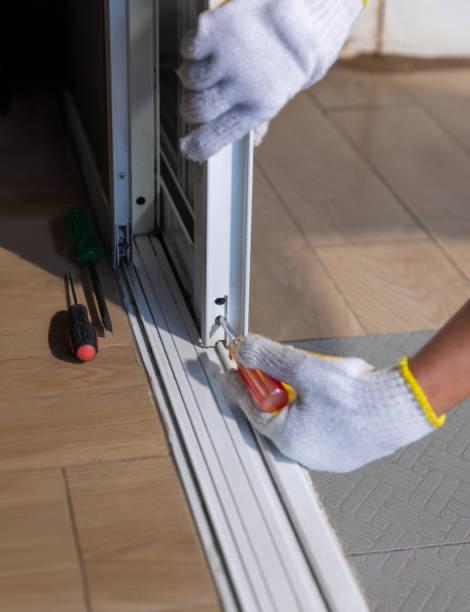
A track showing the early signs of age-related wear — caught early enough that cleaning and maintenance can still extend its life.
Typical Track Lifespan — The Numbers
Under controlled conditions — consistent maintenance, moderate use, clean environment — a quality aluminum sliding door track can last 20 to 25 years. That's the manufacturer's design life for most standard residential track extrusions installed correctly on a stable threshold.
Real-world conditions reduce that figure. In most of the continental U.S., tracks realistically last 15 to 20 years in average residential use. In South Florida, the realistic range narrows significantly based on location, and the maintenance variable carries much more weight than it does elsewhere. The table below provides a practical reference for what to expect in different South Florida scenarios.
| Location / Condition | Expected Track Lifespan | Primary Limiting Factor |
|---|---|---|
| Oceanfront or beachfront property | 5 – 10 years | Direct salt spray, maximum corrosion exposure |
| Within 1 mile of ocean or Intracoastal | 8 – 12 years | Salt air deposition, coastal sand abrasion |
| 1 to 5 miles from coast, maintained | 12 – 18 years | Reduced salt but still significant humidity |
| Inland (5+ miles), maintained | 15 – 22 years | Primarily mechanical wear and debris |
| Any location, unmaintained | 5 – 10 years | Debris abrasion accelerated by neglect |
| Any location, well-maintained | 15 – 25 years | Determined by material quality and salt exposure |
The most striking column in that table is the last two rows — the difference between an unmaintained and a well-maintained track in the same location can be 10 years or more in service life. Maintenance is the single most controllable variable in track longevity in South Florida.
Lifespan by Location in South Florida
South Florida's geography creates a strong correlation between distance from saltwater and track lifespan that isn't present in most other parts of the country. NOAA coastal weather monitoring data consistently shows that salt deposition rates — the amount of sodium chloride deposited per unit area per day — drop dramatically as you move inland from the coast, even over short distances.
Beachfront and Waterfront Properties
Homes directly on the ocean, on the Intracoastal Waterway, or on canals with direct tidal water access are in the harshest environment for aluminum track systems. Salt spray and aerosol are highest at these locations, particularly during onshore wind events and through the summer storm season. Tracks in these locations without protective treatment or regular maintenance can show significant corrosion pitting within 5 years of installation. With regular maintenance — cleaning every 3 months, aluminum protectant applied annually — realistic lifespan extends to 8 to 12 years.
Near-Coastal Residential Communities
Properties within a mile or two of the coast — in communities like Lighthouse Point, Hillsboro Beach, Deerfield Beach, and along the Federal Highway and Atlantic Boulevard corridors in Pompano Beach — experience meaningful salt air exposure without the direct spray of oceanfront properties. Tracks here typically last 10 to 15 years with consistent maintenance and may push toward 18 years in well-protected installations with high-quality aluminum extrusions.
Inland Communities
Communities 5 or more miles from the coast — Coral Springs, Plantation, Sunrise, and western Boca Raton — see significantly lower salt deposition. Track lifespan in these areas is driven primarily by mechanical wear, debris accumulation from landscaping, and the baseline humidity that affects all of South Florida. Well-maintained tracks in inland Broward communities commonly reach 18 to 22 years before needing replacement.
What Shortens Track Lifespan
Understanding the specific mechanisms that degrade tracks helps homeowners know where to focus their maintenance attention.
Salt Air Corrosion
The dominant factor for coastal properties. Sodium chloride particles deposit on the aluminum track surface and penetrate the natural oxide layer, initiating pitting corrosion that works progressively deeper into the metal. Once pitting starts, it accelerates — the rough pitted surface holds more salt, and each rain event deposits additional chlorides into the existing pits. Without intervention, pitting corrosion can compromise the structural integrity of the track rail within 5 to 8 years in high-exposure locations.
Sand and Debris Abrasion
Fine coastal sand in the track channel grinds against the aluminum rail surface on every roller contact, gradually removing material and creating the longitudinal grooves that ultimately prevent new rollers from seating correctly. This process accelerates dramatically when combined with wet lubricants — oils and petroleum-based products create a sand-bonding paste that makes the abrasion continuous rather than intermittent.
Worn Rollers Dragging on the Track
One of the most underappreciated causes of premature track failure is continuing to operate a door with worn rollers. When roller wheels develop flat spots or the bearing seizes and the wheel stops rotating freely, the roller effectively drags across the track surface on every open-and-close cycle. This concentrates wear on the track at the exact contact points, creating grooves much faster than normal rolling contact would. Replacing worn rollers promptly is one of the most effective ways to protect the track's service life.
Blocked Weep Holes and Water Pooling
Standing water in the track channel from blocked weep holes dramatically accelerates corrosion — the track sits in salt-contaminated water rather than simply being exposed to salt air, which is orders of magnitude more corrosive. A track with chronically blocked weep holes in a South Florida coastal environment can develop years' worth of corrosion damage in a single rainy season.
Physical Impacts
Furniture dragged across the threshold, objects dropped in the doorway, and the door panel itself coming off the track and landing on the rail all create localized dents and bends that concentrate stress and can initiate cracking in the aluminum extrusion. Each impact shortens the track's remaining service life at that point.
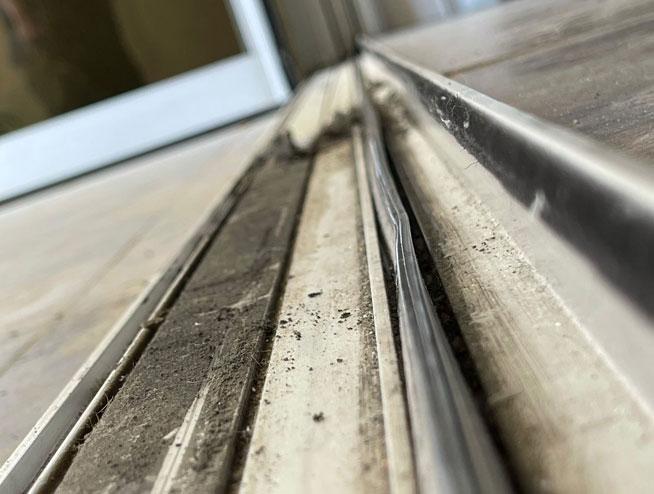
A 10-year-old track from a coastal Pompano Beach property — corrosion pitting and surface wear visible throughout.
New track installed — with proper maintenance, this should serve well for 15 or more years.
Aluminum vs. Vinyl Track Lifespan
The frame material of your door determines the track system used, and aluminum and vinyl tracks have different failure modes and lifespan profiles in South Florida's environment.
Aluminum Track Systems
Standard aluminum track extrusions are durable and handle heavy panel weights well, but they're susceptible to salt air corrosion. In coastal environments, aluminum tracks without protective treatment or anodizing are the first component to show age-related degradation. Anodized aluminum tracks — which have a harder, more corrosion-resistant surface treatment — perform significantly better in high-salt environments and can add 3 to 5 years to realistic service life. When replacing aluminum tracks in coastal properties, asking specifically for anodized extrusion is worthwhile.
Vinyl Track Systems
Vinyl frame doors use track systems with lighter-gauge profiles sized for their narrower rail grooves. Vinyl tracks resist salt air corrosion much better than aluminum — the polymer material isn't susceptible to oxidation in the same way. However, they're more prone to deformation under physical impact and can become brittle over years of UV exposure in Florida's intense sun. Vinyl track failure in South Florida more commonly presents as physical damage — dents, cracks, or warping — rather than corrosion.
Track Getting Close to the End? We'll Tell You Honestly.
Serving Pompano Beach, Fort Lauderdale, Deerfield Beach, Boca Raton, and all of South Florida. Free track assessments, same-day service, flat-rate pricing.
Early Warning Signs the Track Is Aging
Catching track deterioration early — before it reaches the point of requiring replacement — allows for protective treatment and maintenance that can extend service life by several years. These are the signs to watch for in the early stages.
- Light chalky white surface oxidation along the track rail — this is surface-level aluminum oxide and can be treated with fine steel wool and aluminum protectant before it progresses to pitting.
- The door needing slightly more frequent lubrication than it used to — a well-maintained track in good condition holds a silicone treatment for 3 to 4 months. If it's needing attention every 6 weeks, the rail surface is starting to degrade.
- Faint roughness when running a finger along the rail — not yet a groove, but the surface no longer feels glassy smooth. This is the beginning of abrasion damage and the point where protective measures are most effective.
- Minor staining or discoloration in the channel corners — indicates water pooling that should be addressed by clearing the weep holes before corrosion becomes significant.
Late-Stage Signs — When Replacement Is Overdue
These symptoms indicate a track that has passed the point where maintenance can meaningfully extend its service life. Replacement is the correct next step.
- Visible longitudinal grooves cut into the track floor by years of roller contact — new rollers won't seat correctly on a grooved surface and will wear prematurely.
- Deep corrosion pitting that has created craters across the rail surface — the structural integrity of the track is compromised and the surface creates uneven roller contact.
- New rollers wearing out significantly faster than expected after installation — the track surface is the abrasive causing the premature wear.
- Sections of the track that have cracked or broken away — a structural failure that cannot be repaired and represents a safety issue if the door panel derails.
- The door improving only marginally after thorough cleaning and fresh rollers — the track is the bottleneck that no amount of maintenance or roller quality can overcome.
If new rollers were installed within the last 12 to 18 months and the door is already getting rough again, the track is almost certainly the cause. Continuing to replace rollers on a grooved or corroded track is throwing money at a symptom rather than the root problem. A track replacement will solve both the immediate roughness and protect the longevity of future rollers.
How to Extend Your Track's Lifespan
The gap between a 10-year track and a 20-year track in South Florida almost always comes down to these specific maintenance practices applied consistently.
- Clean the track channel every 3 to 4 months with a stiff brush, vacuum, and damp cloth — never skip this step before lubricating
- Apply silicone-based spray lubricant after every cleaning — never use WD-40, oil, or grease
- Check and clear weep holes every time you clean — takes 30 seconds and prevents the most damaging failure mode
- Apply an aluminum protectant or clear sealant to the exposed rail surface annually — particularly important for coastal properties
- Replace worn rollers promptly — dragging rollers damage the track surface faster than any other single factor
- Never force a stiff door — forcing transmits deforming stress to the track walls
- Keep furniture and heavy objects away from the threshold — impact dents are among the most common causes of premature track failure
- Clean the track within 48 hours after any storm — storm-packed debris bonds quickly and is far harder to remove once dried
The Right Maintenance Schedule for South Florida
Frequency matters as much as the routine itself. Here's the schedule that maximizes track lifespan in South Florida's conditions.
- Every 3 months (coastal within 1 mile): Full clean + silicone lubricant + weep hole check
- Every 4 months (near-coastal, 1 to 5 miles): Full clean + silicone lubricant + weep hole check
- Every 6 months (inland, 5+ miles): Full clean + silicone lubricant
- Annually (all locations): Aluminum protectant applied to exposed rail surface; inspect track for early corrosion or wear
- After any storm: Clean within 48 hours, check weep holes, inspect for impact damage
- End of hurricane season (November): Full clean and inspection to address cumulative summer wear
Schedule track maintenance at the same time as a recurring household task — changing HVAC filters, testing smoke detectors, or a seasonal deep clean. Linking it to something you already do prevents it from being forgotten for years at a time. The 10 minutes this takes quarterly is the single most cost-effective maintenance investment on a South Florida sliding door.
Track Lifespan Around Pompano Beach
Pompano Beach represents a cross-section of South Florida's sliding door environment in a single city. Oceanfront properties on the barrier island east of A1A face the harshest conditions in Broward County — direct Atlantic salt spray, maximum sand exposure from the beach, and the full summer storm season. Tracks in these locations without consistent maintenance often need replacement within 8 to 10 years.
Moving west across Federal Highway and Atlantic Boulevard into the inland residential neighborhoods, the environment becomes progressively less aggressive. Properties a mile or more from the Intracoastal in communities along Sample Road or Copans Road routinely see 15 years or more from the same track type under reasonable maintenance. The Lighthouse Point and Hillsboro Beach areas to the north, with their significant canal and Intracoastal frontage, sit closer to the coastal end of the spectrum — those waterfront properties should treat track maintenance as a 3-month routine without exception.
For sliding door track service in Pompano Beach — whether you need an assessment of remaining service life, protective treatment, or full replacement — same-day service is available across all areas of the city. If your track has been in place for 10 or more years and hasn't been professionally inspected, a free estimate visit gives you a clear picture of where it stands and how many more years of reliable service you can expect from it. Schedule one today.
Not Sure How Much Life Your Track Has Left?
Serving Pompano Beach, Fort Lauderdale, Lighthouse Point, Deerfield Beach, and all of South Florida. Free track assessments, same-day service, warranty on every repair.
Frequently Asked Questions
In Florida, sliding door tracks typically last 10 to 20 years depending on proximity to the coast and maintenance habits. Coastal properties within a mile of the ocean may see track degradation in as few as 8 years without regular maintenance. Inland properties with consistent care can get 15 to 20 years from the same track.
The main factors are salt air corrosion, sand and debris abrasion, water pooling from blocked weep holes, worn rollers dragging on the track surface, petroleum-based lubricants that attract debris, and physical impacts from furniture or objects. In South Florida, salt air and sand abrasion are the dominant factors for coastal properties.
Clean the track every 3 to 4 months, apply silicone spray lubricant after each cleaning, check and clear weep holes seasonally, apply aluminum protectant annually, and replace worn rollers promptly. Never force a stiff door and keep furniture away from the threshold. These habits alone can double track lifespan in a coastal environment.
Early signs include light surface oxidation, needing more frequent lubrication, and faint roughness on the rail surface. Late-stage signs include visible grooves in the track floor, deep corrosion pitting, new rollers wearing out prematurely after installation, and cracked or broken sections. Any late-stage sign means replacement is overdue.
Yes. Aluminum tracks are durable but susceptible to salt air corrosion — the dominant failure mode in coastal Florida. Vinyl tracks resist corrosion better but are more prone to physical deformation and UV-related brittleness. In South Florida, aluminum tracks most often need replacement due to corrosion; vinyl tracks more commonly fail from physical damage.
It's one of the strongest predictors of track lifespan in South Florida. NOAA data shows salt deposition rates near the coast are dramatically higher than just a few miles inland. Oceanfront properties may need track replacement in 8 to 10 years. Properties 5 or more miles inland in the same county can see 15 to 20 years from identical tracks.